
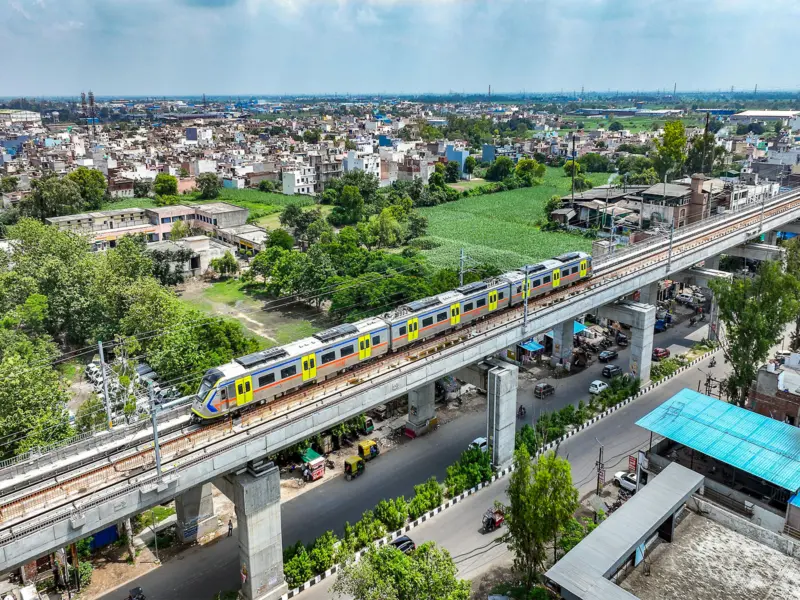

The Central Industrial Security Force (CISF) formally took charge of securing the Regional Rapid Transit System (RRTS) 'Namo Bharat' corridor during an induction ceremony at New Ashok Nagar on Tuesday.
This marks the start of full CISF deployment to safeguard India’s first high-speed regional rapid transit system, ensuring safe and efficient travel for commuters in the National Capital Region (NCR).
At the ceremony, the Managing Director of the National Capital Region Transport Corporation (NCRTC), Shri Shalabh Goel, symbolically handed over an insignia key to DG CISF, Shri Praveer Ranjan, signifying the official transfer of security responsibilities for the corridor.
The event commenced with DG CISF performing the Bhoomi Pujan/Shilanyas for the construction of bachelor accommodation to enhance infrastructure support for CISF personnel assigned to RRTS duties. Senior officers from both CISF and NCRTC reviewed operational preparedness, assessed infrastructure readiness, and interacted with personnel deployed for security of the corridor.
The CISF deployment will provide comprehensive security coverage across the RRTS network, utilising advanced surveillance systems, access control mechanisms, anti-sabotage checks, and rapid response capabilities.
Addressing the occasion, DG CISF Shri Praveer Ranjan stated, “The induction of CISF into the RRTS ‘Namo Bharat’ network marks a significant step in securing India’s next-generation transport infrastructure. As mobility systems become faster and more interconnected, our approach to security must be equally advanced, integrated, and technology-driven. CISF is committed to delivering a seamless, robust, and passenger-centric security environment that not only safeguards infrastructure but also inspires confidence among commuters. We look forward to working closely with NCRTC and all stakeholders to set new benchmarks in transit security.”
The event also included a familiarisation ride on the corridor, with DG CISF, MD NCRTC, and other officials travelling between New Ashok Nagar, Anand Vihar, and Sarai Kale Khan RRTS stations.
The induction of the CISF, following earlier integration with the Delhi Metro system through a jointly developed Standard Operating Procedure (SOP), establishes a unified security framework across regional transit networks, featuring coordinated inspections, controlled access management, and enhanced passenger safety.
Implemented by the NCRTC under the Ministry of Housing and Urban Affairs, the RRTS ‘Namo Bharat’ project aims to provide fast, reliable, and sustainable regional connectivity. Trains on the Delhi-Meerut corridor Phase-I are designed to operate at speeds of up to 180 km/h, significantly reducing travel times across the NCR.