




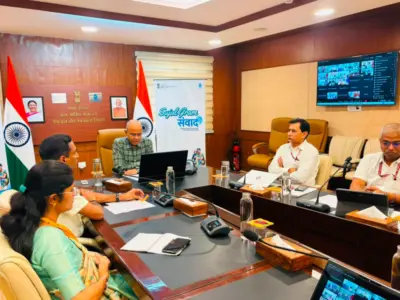

The Department of Drinking Water & Sanitation (DDWS), Ministry of Jal Shakti, held the ninth edition of the multilingual 'Sujal Gram Samvad' on Friday, reaffirming the government's commitment to community-led water governance under the Jal Jeevan Mission 2.0.
The virtual event brought together a diverse group of participants including Gram Panchayat (GP) representatives, members of Village Water and Sanitation Committees (VWSCs), community members, Jal Sahiyas, Jal Bahinis, Jal Sakhis, Anganwadi workers, students, teachers, and frontline GP functionaries, alongside JJM State Mission Directors, District Collectors, District Magistrates, Deputy Commissioners, DWSM officials, and senior state officers.
Ashok KK Meena, Secretary, DDWS, chaired the Samvad, accompanied by Kamal Kishore Soan, AS&MD, NJJM, D Senthil Pandiyan, Joint Secretary, NJJM, and other senior DDWS officers.
In his opening remarks, Mr Meena described Sujal Gram Samvad as a platform to learn from the experiences and challenges faced by Gram Panchayats. He stated, "The best practices shared during the interaction can help other Gram Panchayats strengthen their own systems." He also emphasised that drinking water and sanitation fall under the remit of Panchayati Raj Institutions as per the 73rd Constitutional Amendment and highlighted the importance of effective devolution of Funds, Functions and Functionaries (3Fs) to Gram Panchayats for sustainable rural water supply management.
Mr Meena further stressed that active community ownership through VWSCs, especially with the participation of women, youth, and ex-servicemen, is vital to ensure the long-term sustainability of rural drinking water infrastructure.
During the virtual event, various Gram Panchayat representatives and sanitation committee members shared their experiences. A representative from GP Subbegoundenpudur in Tamil Nadu spoke in Tamil about achieving 100% Har Ghar Jal coverage across villages and habitations, supplying 55 LPCD through surface water from the Bhavani and Aliyar rivers.
A village representative from Bariyarpur, Lakhisaria, Bihar, speaking in Angika, described the water challenges before the Jal Jeevan Mission, noting that many habitations relied on hand pumps and scattered local sources. They added, "Now Household tap connections have significantly reduced the burden on women and improved access to safe drinking water." A representative from GP Sonamarg in Jammu and Kashmir shared their experiences in Hindi, explaining that the Gram Panchayat receives drinking water via gravity-based spring water supply schemes which have markedly improved availability in the mountainous region.
They noted that the community actively participates in protecting and rejuvenating natural springs, and youth groups contribute to environmental conservation and cleanliness around tourist areas.
District officials reported that nearly 30 springs have been rejuvenated to date, District Improvement Plans (DIP) have been prepared for sustainable water security, and there remains a focus on source sustainability, gravity-fed systems, and convergence with other initiatives and local institutions.
Officials, Gram Panchayat representatives, and committee members from Mamit (Mizoram), Shahjahanpur (Uttar Pradesh), Balrampur (Chhattisgarh), Khunti (Jharkhand), and Panipat (Haryana) also shared local experiences, key achievements, and ongoing challenges in their respective languages during the event.