
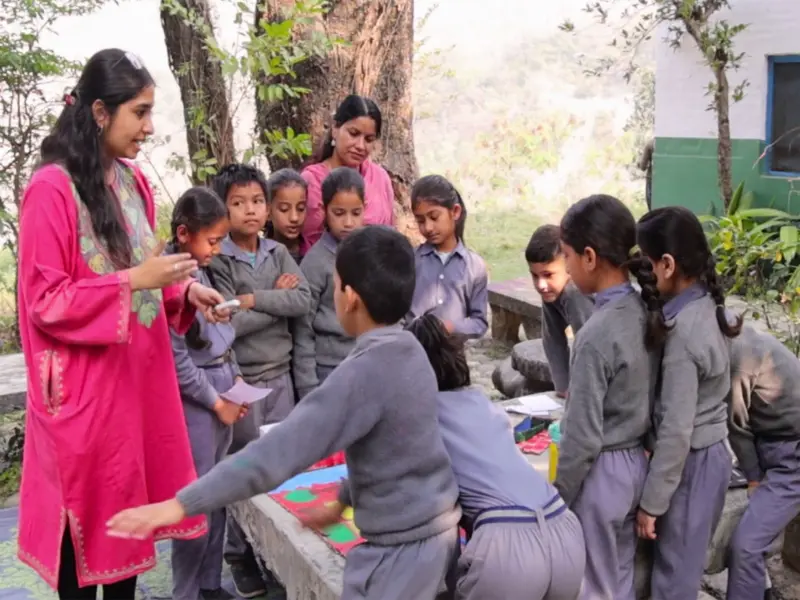

In the village of Katapatthar near Dehradun, Uttarakhand, a small school is redefining traditional education by taking learning beyond the classroom walls.
The institution, which educates around 70 children from nursery to Class 5, integrates natural surroundings into its teaching methods, allowing students to study under trees, across fields, and interact directly with the environment.
The school operates under the Surah programme, meaning “a meaningful path,” which combines conventional academics with experiential learning. Teachers act as facilitators who learn alongside their pupils, encouraging curiosity and active engagement with the natural world. Lessons include studying plants, insects, seasonal changes, and incorporating art forms like mandala designs to explain mathematical concepts.
English teacher Niranjana Chakravarti said, “In most schools, learning is limited to classrooms. Here, nature plays a central role in how children learn. They don’t just exist in this environment-they actively engage with it, ask questions, and explore.”
The school’s founder, Shrey Rawat, from Vikasnagar in the Dehradun district, established the institution in 2023 after recognising that education in hilly areas often lacks connection to children’s daily realities. Rawat left city life to create a space prioritising inquiry and hands-on learning.
Locally known as the “ulta-pulta” (upside-down) school, this approach avoids rote memorisation by encouraging students to think critically and relate lessons to real life. Teacher Savita Bhatt remarked, “Here, students not only learn concepts but also understand their relevance in real life. It helps them think, connect, and grow.”
Students express enthusiasm for this educational model. Paridhi Tomar said, “We don’t just study subjects-we connect them with nature. It makes learning more interesting and meaningful.” Another student, Kavya Verma, recalled a field lesson on grains: “We observed plants, measured their height, and even studied the insects around them. It helped us understand things much better.”
This school in Katapatthar offers a view of an alternative educational vision where learning is enriched by experience, curiosity, and interaction with nature. As India explores educational reforms, initiatives like this demonstrate that evolving teaching methods can nurture creativity, confidence, and deeper understanding beyond mere information acquisition.