




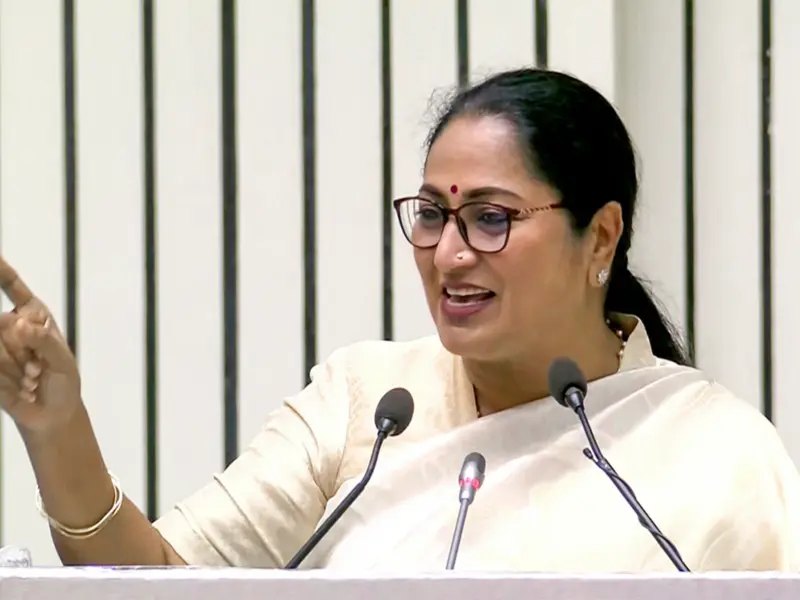

Delhi Chief Minister Rekha Gupta announced on Thursday that the Centre and the Delhi Government are jointly implementing extensive road and connectivity projects to ease traffic congestion, enhance mobility, and develop a future-ready transport network in the National Capital Region (NCR).
Under the dual-engine government framework, plans include new expressways, tunnels, elevated corridors, and connectivity links designed to modernise transportation across Delhi-NCR while considering future traffic demands.
Following a recent meeting with Union Minister of Road Transport and Highways Nitin Gadkari, the Union Minister informed the Chief Minister that several initiatives are underway to make Delhi congestion-free, alleviate traffic pressure, and improve regional connectivity. The Chief Minister expressed gratitude to Gadkari for supporting these projects.
One key project, the Urban Extension Road-2 (UER-II) Extension Delhi-Dehradun Expressway Link, proposes a 17-kilometre, six-lane corridor costing an estimated Rs 3,500 crore. This link road will connect the Delhi-Dehradun Expressway near Tronica City with UER-II, aiming to reduce traffic on the IGI Airport route, Barapullah corridor, Mukarba Chowk, Singhu Border, and Ashram-Badarpur stretch, while providing direct access from Dwarka, Rohini, Punjabi Bagh, and Gurugram. Construction is expected to start by December 2026, with alignment finalisation underway.
Another project, the Delhi-Dehradun Expressway Noida-Faridabad Connectivity Corridor, will span approximately 65 km with six lanes and an estimated cost of Rs 7,500 crore. This corridor will link the Delhi-Dehradun Expressway, Delhi-Meerut Expressway, DND, Faridabad, and Yamuna Expressway, improving accessibility for Loni, Baghpat, Ghaziabad, Noida, and Faridabad while easing congestion at Kalindi Kunj, Sarai Kale Khan, and Outer Ring Road. Work is projected to commence by December 2026.
A further initiative aims to connect the Delhi-Amritsar-Katra corridor with UER-II, allowing traffic from the Delhi-Katra Expressway direct access to Delhi, Gurugram, and IGI Airport via UER-II and the Dwarka Expressway. The 17-km, six-lane corridor, with an estimated cost of Rs 1,500 crore, seeks to divert heavy vehicles, reduce congestion, and improve freight movement; construction is planned to begin by March 2027.
Additionally, the development of service roads along the existing UER-II corridor - covering some 26 km with an estimated cost of Rs 6,500 crore - aims to enhance local connectivity and urban expansion in outer Delhi. Approval has been given for a 19-km, two-lane secondary service road at Rs 121 crore. This will facilitate safer access for residents and businesses, reduce main carriageway congestion, and benefit the Mundka industrial area and logistics hubs.
The Shiv Murti-Nelson Mandela Marg Tunnel Project will bring a significant infrastructure upgrade with an eight-kilometre, six-lane underground tunnel estimated at Rs 7,000 crore. The tunnel will provide signal-free connectivity from Dwarka Expressway to Vasant Kunj, easing congestion in Mahipalpur, Rangpuri, Dhaula Kuan, and reducing traffic on Rao Tula Ram Marg. The project, which has received approval from the Centre’s Public Private Partnership Appraisal Committee (PPPAC), will require Cabinet clearance to proceed.
The AIIMS-Mahipalpur-Gurugram Elevated Corridor, a 20-kilometre, six-lane project estimated at Rs 5,000 crore, will provide signal-free traffic flow linking AIIMS, INA, Hauz Khas, Vasant Kunj, Mahipalpur, and Gurugram. It is expected to reduce congestion on Dhaula Kuan, Mehrauli-Gurugram Road, Rao Tula Ram Marg, and the Delhi-Gurugram Highway, while enhancing connectivity to Aerocity, Rangpuri, Chhatarpur, and Ghitorni. Work is expected to start by April 2027.
The proposed Kalindi Kunj Interchange near Okhla Barrage, estimated at Rs 300 crore, will feature a 500-metre, six-lane interchange and flyovers to improve traffic flow on the Delhi-Noida-Faridabad corridor. Based on a feasibility study by the Central Road Research Institute (CRRI), the project aims to decongest Kalindi Kunj and enable signal-free travel between Noida, Jasola, Sarita Vihar, and Faridabad, reducing travel time, fuel consumption, and emissions. Land acquisition has begun, with construction expected to commence by October 2026.
Rekha Gupta reaffirmed the Delhi Government’s commitment to transforming the capital into a world-class, green, sustainable, and seamlessly connected city that offers faster, safer, cleaner, and more modern transportation facilities for residents.