
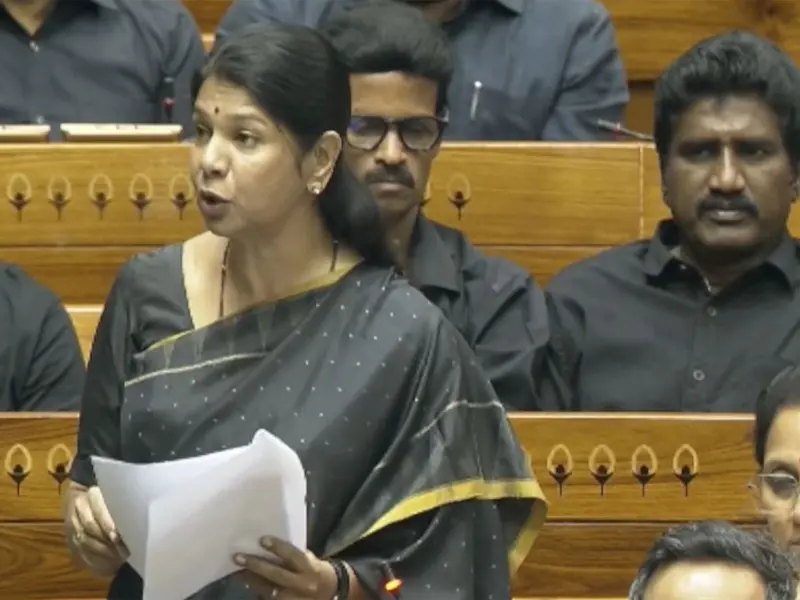

DMK MP Kanimozhi criticised the Constitution (131st Amendment) Bill on Friday, describing the delimitation process to increase the number of Lok Sabha seats as the 'greatest assault on the federal structure.' Speaking in the Lok Sabha while wearing a black saree as a form of protest, she condemned the Centre's notification of the Nari Shakti Vandan Adhiniyam, 2023, in the Gazette the previous night, during discussions on the one-third reservation for women legislators in Parliament.
Kani mozhi said, “I not only stand as a representative of the Dravida Munnetra Kazhagam, but also eight crore people who have been told amidst the elections that their votes will count less and their voice in this Parliament will be diminished. It is really shocking. We are discussing the Bill here, so what was the need to notify it yesterday? What is the respect you have for this House? These three bills are disguised as if they are in support of reservation for women, constitute the single greatest assault on federal structure.”
She criticised population-based delimitation as unfair to southern states, highlighting that Tamil Nadu’s fertility rate has fallen to 1.6 and it has completed its demographic transition. Kanimozhi added, “Delimitation at its heart stands as a promise to the southern states. Five states which have resisted the onslaught of the BJP and stood out as models for development. We listened to the government’s call to control the population. We complied, and our fertility rates fell. In 2001, there was a government which listened to the voices of the South. We have to give you (the BJP) the credit where it’s due. It gave 24 more years, because the then Parliament understood that this injustice needed to be addressed. Why do we have to increase the seats to 850 now? The statement of objectives states that the demographics have changed, yet you are using 15-year-old 2011 census data to conduct delimitation. You are contradicting yourself. Most of the MPs might not even get a chance to speak in Parliament. Today, Tamil Nadu’s fertility rate is 1.6, lower than that of France, Australia and the United States. We have completed a demographic transition. Uttar Pradesh’s population has grown by 120 per cent since 1971 and Tamil Nadu’s only by 15 per cent.”
Home Minister Amit Shah had earlier assured that southern states would not face discrimination, stating that Tamil Nadu’s Lok Sabha representation would increase from 39 to 59, maintaining a similar percentage in the House. Kanimozhi, however, argued that the Home Minister’s statement contradicted the constitutional amendment Bill. She invoked Dravidian leader Periyar, saying, “Contrary to what the Home Minister said yesterday, the Delimitation Bill clearly states that it will be on the basis of the latest census figures. The latest available census is 2011, and according to that, UP gains 13 seats, and Tamil Nadu loses 11. Our ideological leader, Periyar, taught us that ‘Justice is not giving everyone the same thing, justice is giving every person what they need and deserve.'”
She criticised the Bill's vagueness, stating it allows the majority party to select which census to use for the electoral map. She added, “This shows non-application of mind or a mind determined to push its own agenda on this country. The Delimitation Commission will be chaired by a retired Supreme Court judge appointed by the Union government, with no consultation with the Chief Justice of India, states or the Parliament. States get associate members who are not allowed to vote or sign, except to sit and watch from the wings.”
On Thursday, Union Minister Amit Shah assured Parliament that delimitation would not adversely affect southern states. He presented figures, noting, “If we listen to the entire narrative created for the South, then out of the 543 seats created by you, 129 MPs currently sit in this House, which is approximately 23.76 per cent. In the new House, 195 MPs will be sitting here, and their power will be 23.97 per cent.”
Shah added that Karnataka currently has 28 seats, constituting 5.15 per cent of the Lok Sabha, which would rise to 42 seats and 5.44 per cent after the bill's passage. He stated, “Karnataka will not suffer any loss at all. Andhra Pradesh has 25 seats, which is 4.60 per cent. After the passage of the bill, the number of MPs will increase from 25 to 38, which will be 4.65 per cent.”
Regarding Tamil Nadu, Shah said it currently holds 39 seats (7.18 per cent), which will increase to 59 seats, or 7.23 per cent of the new 816-seat House, asserting that Tamil Nadu will also not lose representation. For Kerala, he noted the current 20 seats (3.68 per cent) will rise to 30 seats with 3.67 per cent representation in the new House.