




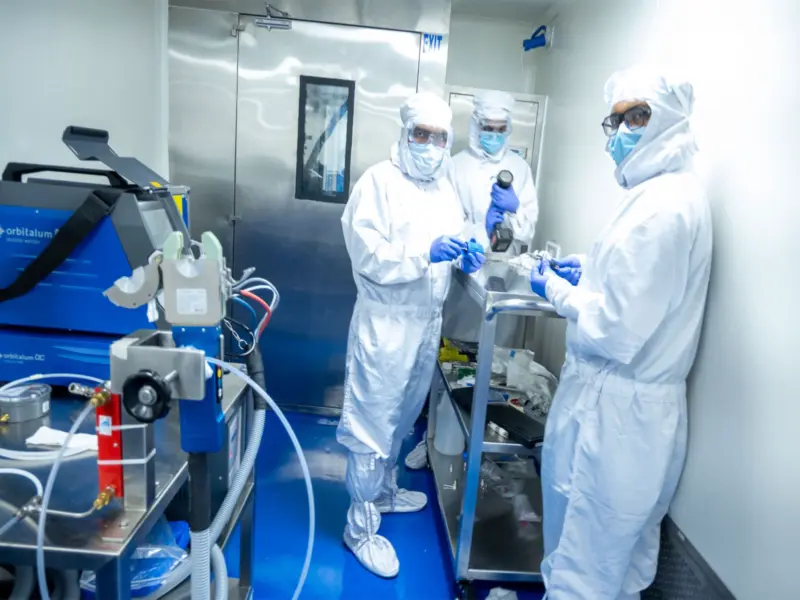

The Industrial Training Institute (ITI) at Dholera, Gujarat's semiconductor hub, saw the graduation of its first cohort from the Ultra High Purity (UHP) Welding for Semiconductors Program on April 13. This marks a significant step in developing a skilled workforce to support the state's expanding semiconductor sector.
The UHP Welding for Semiconductors Program is a structured, cohort-based training initiative at the ITI level designed to prepare workers for cleanroom environments in semiconductor manufacturing. The programme is conducted by Tata Indian Institute of Skills (Tata IIS) in partnership with the Government of Gujarat and Tata Electronics.
This initiative is the first of its kind in India, providing a semiconductor-focused cleanroom training facility directly linked to a commercial semiconductor fabrication plant under development. It equips students with specialised skills in UHP welding, necessary for contamination-free gas delivery and process piping within semiconductor fabs.
Admission is open to ITI students currently enrolled or graduated from any trade, without specific trade prerequisites. Selection is conducted through structured sessions by Tata IIS. Officials report that an ISO Class 1 Lac containerised cleanroom has been established at ITI Dholera. “The lab is designed to replicate actual semiconductor manufacturing conditions, enabling hands-on training in a real cleanroom environment. The lab includes specialised equipment such as orbital welding machines, IR fusion welding systems, helium leak testing systems, pressure testing setups, and cleanroom infrastructure, including air lock and air shower systems,” an official stated.
The programme spans six weeks in total, comprising a two-week preparatory phase at IIS Ahmedabad and a four-week advanced training phase in the cleanroom at ITI Dholera. Students receive instruction in cleanroom protocols, precision tube preparation, orbital and IR fusion welding, leak testing, quality inspection, and documentation methods. Approximately 70 per cent of training is practical, with ongoing assessment and individual performance monitoring. Tata IIS trainers deliver the curriculum, which aligns with industry standards defined by Tata Electronics.
The Gujarat semiconductor industry is gaining momentum through government efforts to deliver specialised training aligned with private sector collaboration. Sixteen students from Dholera and neighbouring regions successfully completed the programme.
Under the leadership of Chief Minister Shri Bhupendra Patel, Gujarat has positioned itself as a semiconductor hub, creating employment opportunities through diverse corporate partnerships in skill development. Graduates become deployment-ready as certified UHP precision welders with cleanroom experience, with their credentials shared with industry stakeholders. This establishes a direct path to employment within semiconductor fabs, engineering procurement and construction contractors, and companies specialising in high-purity piping and gas delivery systems for advanced manufacturing.
Gujarat has emerged at the forefront of India’s semiconductor sector by implementing facilitation-focused governance combined with industrial-scale preparedness. It was the first state to introduce the Gujarat Semiconductor Policy (2022-27), providing fiscal incentives, land allotment, expedited approvals, and access to utilities including power, water, and gas.
The state’s strategic location includes a long coastline, major ports, and connectivity via the Delhi-Mumbai Industrial Corridor, alongside airports, highways, and railways ensuring efficient operations. Gujarat also offers fast-track facilitation, transparent subsidy disbursement, and a thriving ecosystem for investors and innovators. As a result, the state accounts for nearly 40 per cent of India’s approved semiconductor manufacturing capacity and attracts investments of approximately Rs 1.25 lakh crore, representing more than 75 per cent of the national total.