




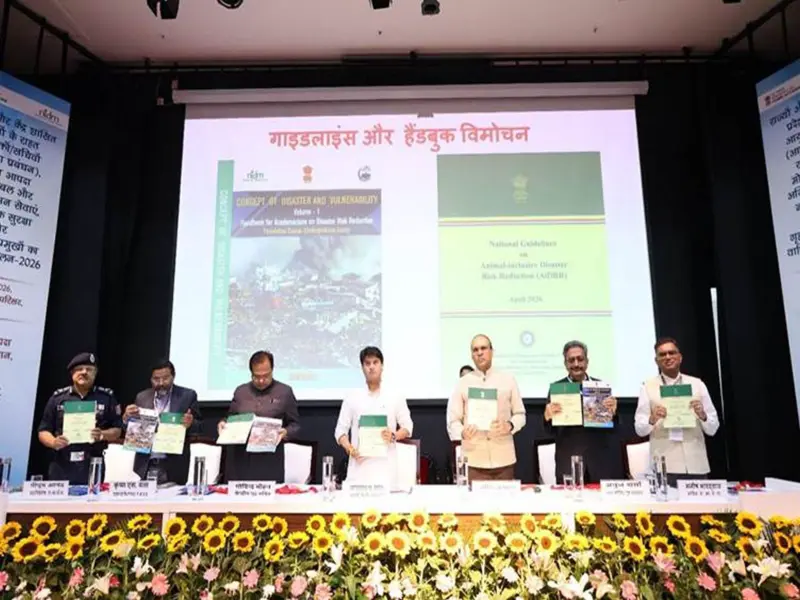

The Government of India has launched a nationwide Cell Broadcast System (CBS) to enhance the country's disaster warning and emergency communication infrastructure.
The system will enable near real-time, geo-targeted alerts to mobile phones across India.
The initiative was inaugurated on Saturday by Union Minister for Communications Jyotiraditya Scindia, who described the launch as a major advancement in strengthening India's disaster management framework. “The launch of the Cell Broadcast System marks a transformative step in India’s disaster management framework, reflecting our shift from a reactive to a proactive approach in safeguarding citizens,” Scindia said.
Developed indigenously by the Centre for Development of Telematics (C-DOT) under the Department of Telecommunications (DoT), the CBS was created in collaboration with the National Disaster Management Authority (NDMA) and the Ministry of Home Affairs. It allows authorities to broadcast emergency alerts simultaneously to mobile users within specific geographic locations.
The Ministry of Communications reported that the system can deliver near real-time, geo-targeted alerts to millions instantly, ensuring that no individual in an affected area is missed during emergencies. Unlike traditional SMS systems, which may experience delays due to high network congestion, CBS operates reliably even under heavy load.
Alerts are sent as priority pop-up notifications accompanied by loud tones, with some devices also able to read the messages aloud, improving accessibility. A nationwide trial took place on the launch day, during which emergency alerts and a distinctive beep sound were broadcast across mobile phones nationwide, demonstrating the system's capacity to deliver warnings within seconds to large populations.
The government emphasised that CBS supports multilingual communication and works across all telecom networks, including 2G, 3G, 4G, and 5G, covering urban, rural, remote, and roaming users. It offers precise geo-targeting at the level of individual cell towers, allowing alerts to be sent only to affected areas, avoiding unnecessary disruption elsewhere. The system is also scalable to issue alerts at district, state, or national levels as required.
CBS is integrated with the Common Alerting Protocol (CAP)-based SACHET platform, enabling standardised, rapid dissemination of warnings for various emergencies such as flash floods, cyclones, earthquakes, and industrial hazards like gas leaks.
The Ministry of Communications said the system enhances disaster management by reducing response times, minimising public panic, and improving trust and compliance during emergencies. It ensures communication remains uninterrupted during large-scale disasters or network congestion.
According to government sources, pan-India trials were completed previously with successful deployment during disasters in Odisha, Andhra Pradesh, and Uttarakhand, as well as during large public events like the Char Dham Yatra to assist crowd management and safety alerts.
The indigenous system has also been demonstrated internationally and aligns with the United Nations’ “Early Warnings for All” initiative, positioning India as a contributor to global disaster preparedness efforts.
Maharashtra Chief Minister Devendra Fadnavis commented on the nationwide alert system test conducted during the launch. He said, “The message you received on your mobile phones today is a test of our disaster preparedness and our system for disseminating information across the country.” Fadnavis praised the emergency alert mechanism for being developed indigenously by the Department of Communications alongside the National Disaster Management Authority, adding, “The most commendable aspect is that this entire system has been developed indigenously within India; I believe this marks yet another technological leap forward for the nation.”