


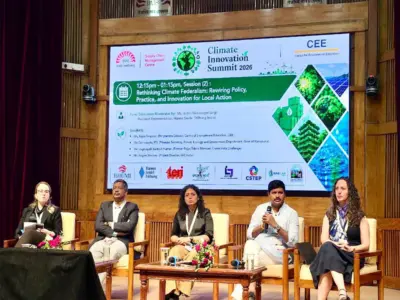

Joginipally Santosh Kumar, former Rajya Sabha MP and founder of the Green India Challenge, called for a fundamental activation of climate federalism in India, emphasising that the main challenge is bridging the gap between national climate policies and grassroots implementation.
Speaking at the Climate Innovation Summit 2026 held at the Indian Institute of Management Bangalore (IIMB), Santosh Kumar highlighted that India already possesses robust climate policies such as the National Action Plan on Climate Change, State Action Plans, carbon trading mechanisms, and Mission LiFE. However, he noted the “missing middle” lies between national commitments and delivery at the ground level.
During the panel discussion "Rethinking Climate Federalism: Rewiring Policy, Practice, and Innovation for Local Action", Santosh Kumar shared the stage with Srinivasulu IFS, Principal Secretary, Forest, Ecology and Environment Department, Government of Karnataka; Rejini Simpson, Programme Director, Centre for Environment Education; and Regina Sanchez, Project Director, GIZ India. The session was moderated by Judith Weinberger-Singh, Head of Hanns-Seidel-Stiftung India.
The two-day summit, jointly organised by the IIMB Supply Chain Sustainability Lab and Net Zero Think, convened over 70 global speakers and industry pioneers across ten thematic tracks to advance India's pathways to Net Zero for Viksit Bharat 2047.
In his opening remarks, Santosh Kumar described the Green India Challenge as evidence of climate federalism in action, mobilising 196 million geo-tagged trees and 44 million citizens across India without reliance on government directives or central schemes.
He said, “India has excellent climate policies, the NAPCC, 34 State Action Plans, the Carbon Credit Trading Scheme, and Mission LiFE. The bottleneck is not design. The bottleneck is the missing middle, the space between a policy document in Delhi and a farmer in Telangana, a student in Karnataka, a fisherwoman in Odisha.”
Santosh Kumar noted that the initiative has engaged diverse sectors of Indian society, including Prime Minister Narendra Modi, spiritual leaders such as Pujya Gurudev Sri Sri Ravi Shankar, Sadhguru, and Param Pujya Pejavar Swamy, cultural icons including Bharat Ratna Sachin Tendulkar and Padma Vibhushan Amitabh Bachchan, as well as Chief Ministers from five states. He stated that framing climate action as a people's movement can unite the country's social fabric.
He added, “Does cooperative federalism need a fundamental redesign? No it needs a fundamental activation. And that activation must come from three forces working together: government policy from the top, civil society movements from the ground, and corporate capital from the market.”
During the moderated discussion, Santosh Kumar emphasised India's urgent climate policy gap: the exclusion of heatwaves from the list of notified disasters under the State Disaster Response Fund (SDRF) or National Disaster Response Fund (NDRF) frameworks.
He stated, “Heatwaves have killed more Indians than floods, cyclones, and earthquakes combined in recent years. In April 2026, six Indian cities crossed 46 degrees Celsius. The NHRC has issued warnings. 247 billion labour hours were lost to heat stress in 2024 alone. Yet heatwaves remain the only major climate disaster excluded from SDRF or NDRF funding. This must change,” calling on the Karnataka government and all Indian states to advocate for reclassification at the next National Disaster Management Authority meeting.
Regarding the Carbon Credit Trading Scheme (CCTS) launching in 2026 with 740 entities across nine sectors, Santosh Kumar urged the inclusion of community-level nature-based solutions in the carbon market framework.
He commented, “Our 196 million trees are a verified carbon sink. But the carbon market is designed primarily for industrial emitters, not for community-level nature-based solutions. If we want climate federalism to work, states, districts, and gram panchayats must be able to participate in the carbon market — not just large corporates. The Article 6.4 mechanism under the Paris Agreement offers this pathway, and we are actively building it.”
Santosh Kumar also introduced the concept of campuses as micro-units of climate governance through the Climate Action Campus Talks (CACT) programme delivered by Igniting Minds Organisation, a Section 8 non-profit with UNFCCC COP29 and UNCCD COP16 Observer status.
CACT has been conducted at 20 premier institutions, including IIT Mumbai, IIT Delhi, JNU Delhi, and BITS Hyderabad, and is expanding to 200 campuses in Telangana with 5-Year Net-Zero Campus Roadmaps and Mission LiFE integration.
He said, “India has over 40 million students in higher education. If every campus becomes a unit of climate governance with carbon audits, Green Clubs, and data feeding into state climate dashboards, you would have the most granular climate governance system in the world. That is bottom-up climate federalism.”
As a unique initiative at the conference, the Green India Challenge planted one geo-tagged bamboo tree for every speaker and participant at the summit, committing to nurture each tree for 1,000 days. Named “Punarvasu The Reconstruction Tree” after Lord Sri Rama’s birth nakshatra, the bamboo initiative made the Climate Innovation Summit 2026 a verified carbon-negative event.
Attendees received personalised Punarvasu Certificates with GPS coordinates and QR codes linking to real-time growth and CO₂ absorption data.
Bamboo absorbs up to four times more CO₂ than equivalent tree species, generates 35% more oxygen than hardwood forests, and can grow up to 91 cm in a day, making it the fastest-growing and most carbon-efficient plant on Earth.