
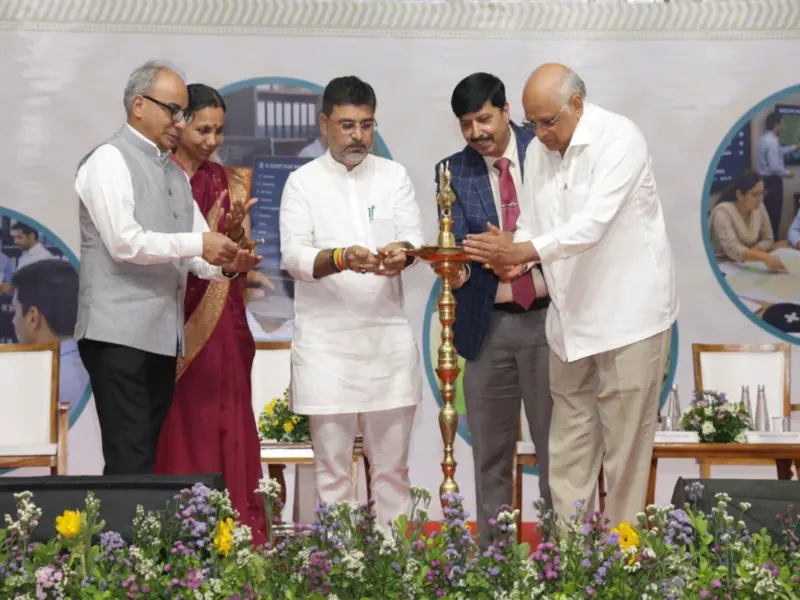

Gujarat Chief Minister Bhupendra Patel inaugurated the three-day Chintan Shibir of the State Government's Revenue Department at Trimandir, Adalaj, on Tuesday, May 5, 2026. Addressing the gathering, he described the event as a valuable platform for self-reflection and for considering the welfare of ordinary citizens.
Chief Minister Patel emphasised that with the collective strength of the Revenue Department and district collectors, who serve as administrative heads, Gujarat should effectively implement Prime Minister Narendra Modi’s mantra of “Sauno Saath, Sauno Vikas, Sauno Vishwas and Sauno Prayas.” The event, held under the theme “Collaborate, Innovate and Transform for Better Land Governance,” includes participation from district collectors and Revenue Department officers across the state.
Noting Prime Minister Modi’s contributions, Patel said the Prime Minister has continually enhanced national pride by establishing systems that promote public welfare and people-centric governance. He underlined the significant authority held by collectors, who, being responsible for public welfare, should address issues with clarity, sensitivity, and calm focus. Patel also advised revenue officers to ensure that individuals approaching them experience no hesitation and depart with a sense of satisfaction, stressing courteous and approachable behaviour.
Referring to the teachings of Dada Bhagwan, Patel stated that one must develop an understanding of how the world functions and abandon egoistic attitudes, adopting a collaborative approach to resolve issues effectively.
Appreciating the contributions of the Revenue Department and district collectors to the state’s development, the Chief Minister stressed the importance of collective work with zero tolerance towards grievances through continuous deliberation and reflection. He urged all participants to work with full dedication to public service to achieve the Prime Minister’s vision of “Viksit Bharat 2047” through “Viksit Gujarat.”
At the inauguration, Pujya Deepak Desai delivered an inspiring discourse urging revenue officers and staff to integrate spirituality with duty and service. He emphasised understanding the principles of karma and the purpose of work, alongside following teachings of Dada Bhagwan such as avoiding theft, pursuing service and devotion, practising altruism and charity, maintaining purity in conduct, gaining practical wisdom through self-awareness, and upholding values and culture.
Desai also encouraged ethical financial dealings, earning wealth through righteousness, appropriate conduct with parents, ensuring no harm to others, and freeing oneself from anger, greed and illusion while living to transcend the cycle of birth and death.
Minister of State for Revenue Sanjaysinh Mahida highlighted that resolving common citizens’ problems by treating administrative processes as a service to the public is a priority for the state government. He noted that Gujarat has embraced ‘faceless’ and ‘paperless’ governance through initiatives such as IORA and e-Dhara, achieving digital transformation. The state government’s ‘zero delay’ policy in land allocation for industries and public purposes, along with transparent administration, has made Gujarat a preferred destination for global investors.
Mahida added that drone technology and satellite imagery are now employed to rectify past survey discrepancies. Processes such as 135-D notices, inheritance rights, and record documentation have been simplified and accelerated. Real-time updates, complete digitisation of land records, and modern reforms in legacy laws, aligned with the Prime Minister’s vision of ‘zero tolerance,’ further strengthen Gujarat’s administration.
Chief Secretary Manoj Kumar Das praised the functioning of the revenue system and emphasised adopting technology and transparency to realise the goal of Viksit Bharat@2047. He noted the Revenue Department has achieved record-breaking land allocation for development projects recently. Gujarat’s leadership in renewable energy, notably in wind and solar sectors, is attributable to the department’s significant contributions.
Das also stated that the Chief Minister has approved new positions of Additional Collectors in districts to strengthen administrative processes. New recruitments of Talatis and surveyors have been undertaken to reinforce the foundational structure of the revenue system.
Additional Chief Secretary of the Revenue Department Jayanti Ravi presented a detailed overview of the Chintan Shibir, remarking that governance requires not only logic and science but also a balance of inner stability and spiritual energy. She explained that organising the camp in the presence of Dada Bhagwan aims to enable officers to regard their duties as a form of ‘yoga,’ thereby gaining strength to work amid challenges.
Ravi referred to the 254-year history of the Collector institution in India, noting that collectors continue to have a distinct public identity. She explained that the camp’s timing at the start of the new financial year aims to enhance precision and transparency in administration. The Chintan Shibir aims to produce qualitative transformation in the Revenue Department, directly benefiting citizens.
State Settlement Commissioner Bijal Shah formally welcomed the attendees and detailed the sessions and activities planned during the Shibir. Present at the event were Principal Secretary to the Chief Minister Sanjeev Kumar, Additional Principal Secretary to the Chief Minister Vikrant Pandey, Relief Commissioner and Secretary Alok Kumar Pandey, Member of the National Disaster Management Authority Shri Dinesh Kumar Aswal, Gandhinagar District Collector Ravindra Khatal, along with district collectors, revenue officers, and staff.