
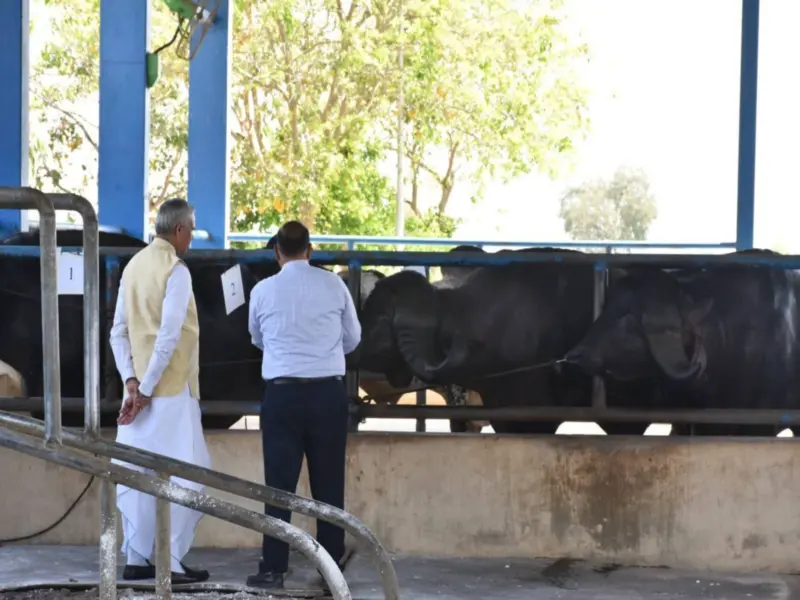

Taufiqbhai Momin, a livestock farmer from Koita village in Saraswati taluka of Patan district, owns 40 cows and 130 buffaloes and produces around 250 litres of milk each day.
Until recently, he faced the challenge of bearing the cost of raising male calves born to his cows or buffaloes. This issue has now been resolved through the use of sexed semen technology for artificial insemination, resulting in all six of his cows giving birth solely to female calves.
“Due to this new technology introduced by the government, we have benefited greatly. With the birth of male calves being avoided, maintenance costs have reduced. Moreover, milk production has increased, and within just two years, the female calves start producing milk, which boosts our income. Now I am using this technology regularly,” Momin said, highlighting the advantages of sexed semen technology.
Livestock farmers often worry about the economic implications of male calf births. However, in Gujarat, farmers are increasingly adopting sexed semen technology, eliminating this concern. The Gujarat government's Animal Husbandry Department has actively promoted this technology, achieving significant success. Scientific advancements now allow for female calf births with up to 90 per cent accuracy.
The state established the Gujarat Bovine Semen Sexing Institute in Patan, with a government-approved project to produce 800,000 sexed semen doses initiated in 2018-19. Production began in June 2021, and by February 2026, the institute had met its target. Of the doses produced, 341,000 had been utilised through the Animal Husbandry Department's field offices, resulting in 63,439 pregnancies and the birth of 37,469 calves. Among these calves, 34,184 were female and 3,285 were male, yielding a success rate of approximately 91.23 per cent female births.
Sexed semen technology enables farmers to predetermine the sex of offspring by separating or deactivating specific chromosomes. Naturally, semen contains “X” and “Y” chromosomes - the latter producing male offspring and the former female - with births occurring at a near 50:50 ratio. Using this technology, frozen semen doses are prepared to ensure predominantly female births with around 90 per cent accuracy.
This technology substantially reduces the number of male calves, lowering feed and maintenance costs. Female calves begin milk production in a few years, enhancing farmers' earnings and decreasing the necessity to purchase animals externally, which reduces disease transmission risks. Farmers can also generate income by selling surplus female calves. Furthermore, the technology accelerates genetic improvement in livestock, while enhancing advanced breeding techniques such as Progeny Testing, Embryo Transfer, and In Vitro Fertilisation.
The production cost of each sexed semen dose is Rs 710; however, to ensure accessibility, the government initially charged farmers Rs 300 per dose, which has now been reduced to Rs 50. Artificial insemination services are available through departmental field offices at this subsidised price. Additionally, milk unions across Gujarat produce sexed semen doses and offer artificial insemination at nominal costs.
During 2025-26, Gujarat's milk unions produced 709,000 sexed frozen semen doses and conducted 335,000 inseminations. This led to 52,246 pregnancies and 30,719 births, of which 24,968 (approximately 81 per cent) were female calves.