
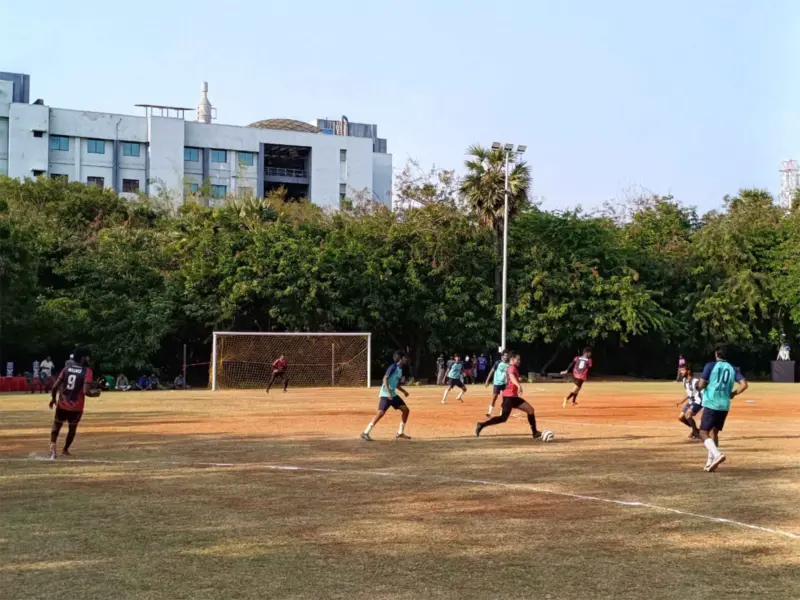

The Indian Institute of Technology Madras (IIT Madras) has introduced OmegaBall to India, marking the sport's debut in the country through a pioneering initiative.
The institute plans to establish the IIT Madras OmegaBall Club at the national level to promote the sport's development and wider adoption.
On April 17, 2026, IIT Madras organised an inter-college OmegaBall tournament at the Campus Football Field, hosted by the Institute Gymkhana and the Office of Dean (Students). The event featured teams from several prominent Chennai institutions, including Loyola College of Engineering and Technology, Guru Nanak College of Arts and Science, Dr. Ambedkar Law University, The New College, Nazareth College of Arts and Science, Saveetha University, and YMCA College of Physical Education, alongside IIT Madras Orange and Blue teams.
OmegaBall is a fast-paced variation of football played by three teams simultaneously on a circular field with three goals. Each team attacks two goals while defending one, encouraging continuous play, higher scoring, and increased spectator engagement. The sport has gained traction internationally in the United States, Brazil, and parts of Europe as a modern alternative to traditional football formats.
The tournament was inaugurated by Prof. V. Kamakoti, Director of IIT Madras, in the presence of Prof. Sathyanarayana N Gummadi, Dean (Students), Prof. Shruti Dubey, Advisor (sports), Prof. Sudakaran Chandran (Co-Advisor Sports), faculty, students, and participating teams.
At the launch event, Prof. Kamakoti stated: “OmegaBall reflects the spirit of innovation that IIT Madras stands for. By introducing a new and dynamic sporting format in India, we are not only expanding opportunities for student engagement but also contributing to the evolution of sports culture in the country. We believe such initiatives will inspire youth participation, encourage creativity in sports, and open pathways for India to engage with emerging global sporting trends.”
Prof. Sathyanarayana N Gummadi added: “At IIT Madras, we are committed to providing students with diverse avenues for all-around development. OmegaBall is an exciting addition to our campus sporting ecosystem. The response from students has been enthusiastic about this format because of more ball contact time and the game speed. Through the proposed OmegaBall Club and upcoming tournaments, we aim to nurture talent, build competitive exposure and create opportunities for students to represent India in international platforms in the future.”
According to the Game Laws, OmegaBall is played on a circular pitch approximately 50 to 55 metres in diameter with three goals placed 120 degrees apart, which creates dynamic and multi-directional gameplay. Matches consist of three sessions lasting 13 minutes each, and no offside rule is applied, enabling fluid and attacking play.
The proposed IIT Madras OmegaBall Club will be registered under the Tamil Nadu Societies Registration Act, formally recognising IIT Madras as the first Indian institution to introduce the sport and conduct a tournament. The initiative aims to encourage greater youth participation in sports and promote innovative sporting formats.
Rafad Abdul Rasheed, a fourth-year Engineering Design student, shared his experience: “OmegaBall is a completely new and exciting experience for me. Unlike regular football, it involves three teams playing simultaneously on a circular ground with three goalposts, where each team can score against either of the two opposing teams. This makes the game much more dynamic and unpredictable, as players must stay alert at all times and balance attacking and defending continuously. Since only one team can win while the other two teams lose, the level of competition and pressure is much higher than in normal matches. The presence of three goalposts changes the strategy of the game entirely, requiring quick decision-making, strong communication, and tactical awareness from every player on the field. It also improves teamwork and coordination, as players must constantly adjust their positioning depending on the movement of two opposing teams instead of one. Playing OmegaBall gave me a fresh perspective on football and helped me develop better situational awareness and adaptability during the game. Overall, it was a thrilling and memorable experience, and I really enjoyed being part of such an innovative and fast-paced format of the sport.”
Zachary Langstieh, a second-year Medical Science and Technology student, commented: “OmegaBall is not just a variation of football, but a powerful way to develop game intelligence. With three teams playing at once, players are constantly required to scan the field, anticipate multiple threats, and make quick decisions under pressure. This significantly improves situational awareness, positioning, and adaptability during play. The dynamic nature of the game forces players to think beyond traditional strategies, strengthening their understanding of space, timing, and teamwork. It challenges both individual skills and collective coordination, making players more alert and tactically sharp. We are truly grateful for the opportunity to experience such an innovative format, as it has helped us grow not only as players but also in our overall understanding of the game.”
Approximately 100 IIT Madras students have taken part in demonstration matches so far, with strong enthusiasm recorded. The initiative is expected to provide opportunities for students to develop their skills and potentially represent India in international competitions.
This effort aims to establish IIT Madras as a leader in introducing and nurturing emerging sports in India while fostering a culture of innovation, inclusivity, and active student engagement.