
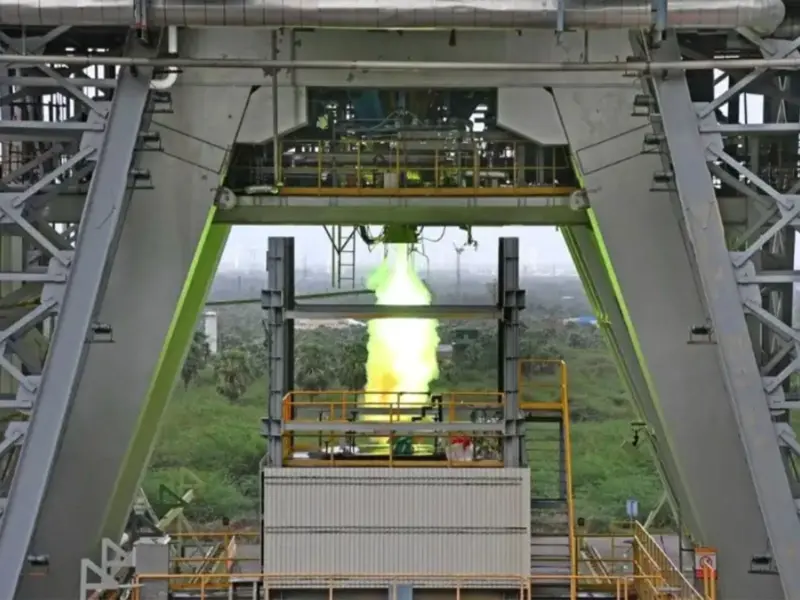

The Indian Space Research Organisation (ISRO) conducted technical discussions with Russia's space agency Roscosmos in Moscow regarding the delivery of semi-cryogenic engines, according to ISRO's Annual Report 2025-26. Officials from ISRO visited Moscow for detailed talks, and a draft contract for the engines is currently undergoing approval.
The semi-cryogenic engine is an important technology for India's future heavy-lift launch vehicles, utilising a combination of refined kerosene and liquid oxygen. This engine offers higher efficiency and thrust compared to existing systems, which is expected to enhance India's capabilities for launching heavier payloads and deep space missions.
While India is developing its own semi-cryogenic engine programme, collaboration with Roscosmos aims to accelerate timelines and address technological challenges. The Annual Report did not specify the timeline for contract finalisation or engine delivery, but the approval process indicates progress beyond initial discussions.
ISRO stated on March 28, 2025, that it was "achieving progress in the design & development of a semicryogenic engine or Liquid Oxygen / Kerosene engine with a high thrust of 2000 kN that will power the semicryogenic booster stage of the LVM3 launch vehicle." ISRO achieved a major breakthrough on that date with the first successful hot test of the Engine Power Head Test Article at its Propulsion Complex in Mahendragiri, Tamil Nadu.
The Liquid Propulsion Systems Centre (LPSC) of ISRO is developing both the semi-cryogenic propulsion engine and its associated stage. The SC120 stage, powered by the 2000 kN semi-cryogenic engine (SE2000), is planned to replace the current core liquid stage (L110) of the LVM3 to enhance payload capacity and will also serve as the booster stage for future launch vehicles.
ISRO added, "Non toxic and non hazardous propellants (Liquid Oxygen and Kerosene) are employed in semi cryogenic propulsion and this will deliver higher performance compared to existing L110 stage. Induction of semi cryogenic propulsion system along with uprated cryogenic stage in the LVM3 vehicle enhances its payload capability from 4 tonne to 5 tonne in GTO."
Major subsystems of the SE-2000 engine include the thrust chamber, pre-burner, turbo pump system, control components, and start-up system. The engine operates with a complex oxidiser-rich staged combustion cycle, a high chamber pressure of 180 bar (with propellant feed system pressures up to 600 bar), and a specific impulse of 335 seconds, ISRO stated. The agency also noted that the development of such a high-thrust engine is highly challenging and that this technology is possessed by only a few nations.
The Moscow visit forms part of ISRO's broader international engagements in the past year, with discussions ongoing with multiple countries and agencies on human spaceflight, satellite navigation, Earth observation, and capacity building.
ISRO's cooperation with Russia also extends to planetary missions, with Russia's Space Research Institute selected as a payload partner for India's planned Venus Orbiter Mission. Technical discussions for the partnership are underway.
According to the Annual Report, "The objectives of the Venus Orbiter Mission (VOM) encompass studying the Venusian atmosphere, ionosphere, surface, subsurface, and its interaction with the Sun. International collaboration efforts have been formalised, with approval granted for MoUs related to key international payloads. The Science Working Group (SWG) has been constituted to maximise the science returns from the payloads, and the Principal Scientist of the mission has also been declared. The Preliminary Design Review (PDR) of the mission has also been completed."
ISRO obtained approvals in April 2025 for advancing international collaboration on the Venus Orbiter Mission, including initiating a Memorandum of Understanding with Roscosmos for the Venus InfraRed Atmospheric gases Linker (VIRAL) payload and formalising an MoU with the Swedish Institute of Space Physics for the VNA payload.
Further information is expected following formal approval of the semi-cryogenic engine contract.