




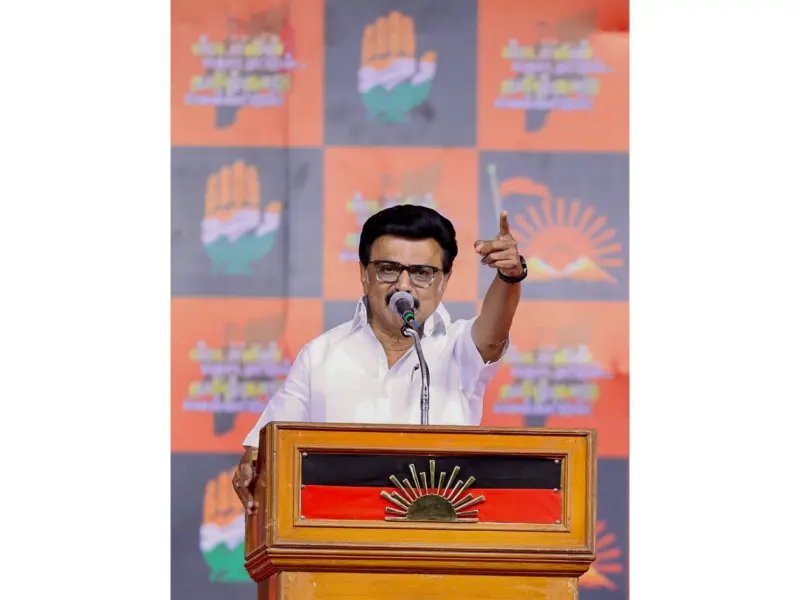

Tamil Nadu Chief Minister M K Stalin has criticised the Union government and Prime Minister Narendra Modi for the lack of transparency surrounding the upcoming special session of Parliament, which is expected to pass the Women's Reservation Amendment Bill.
Addressing concerns on X on January 31, 2026, Stalin questioned the timing of the session while elections are being held in four states, and expressed alarm over the secrecy of the proposed delimitation exercise. He asked why the Union government had not clearly announced how it intended to conduct delimitation.
Stalin stated: “Delimitation Danger: Is India Sliding Towards Dictatorship? Don’t Turn a Gentle Breeze in the South into a Storm! The Hon’ble Prime Minister must respond to the legitimate questions raised by the people of the South! Why has the Union BJP Government kept the entire delimitation process under wraps in secrecy, without transparently announcing how it intends to conduct it?”
He referred to the 2001 decision by former Prime Minister Atal Bihari Vajpayee to defer delimitation for 25 years and questioned why a similar decision could not be considered now. He also challenged the urgency of calling a special parliamentary session during ongoing elections in five states and highlighted that opposition leaders had requested the session be held only after April 29, a request he said was ignored.
“Just as former Prime Minister Vajpayee deferred delimitation for the next 25 years in 2001, what is Prime Minister Modi’s response to the just demand put forward by the southern states that he should do the same? What is the urgent necessity to convene a special session of Parliament right in the middle of elections in five states? What is the hidden mystery in ignoring the fair opinion of opposition leaders that ‘the special session of Parliament should be convened only after April 29?'” Stalin asked.
He further criticised the Centre for seeking to implement significant constitutional changes without consulting all parties, describing this as undemocratic. Stalin warned this approach could undermine southern states’ rights and concentrate power in the North.
Emphasising that the future of people in the South was at stake, Stalin said: “What else is the attempt to carry out highly important constitutional amendments without convening an all-party meeting for consultation, if not a move towards dictatorship? It doesn’t answer the questions asked by opposition parties and the media. Will it at least answer the questions of the people? The DMK will not stand idly by watching the Union BJP Government’s actions that undermine the rights of southern states and shower power on the North. This is the future of the people living here! We will not agree to any decision taken in this regard without our consent, without even talking to us–no matter what it costs us! We are demanding Fair Delimitation!”
Previously, on March 24, Stalin had expressed concerns about reports that proposals to enhance women’s representation in Parliament and State Assemblies may be based on the 2011 Census. On X, he noted this would be contrary to the provisions of the Constitution (128th Amendment) Bill, 2023, which envisages women’s reservation only after fresh delimitation based on a census to be conducted after 2026.
The special session of Parliament is scheduled for three days from April 16, with a focus on the Women’s Reservation Amendment Bill. The government plans two major amendments: amending the 2023 Nari Shakti Vandan Act to use 2011 Census data for delimitation and seat redistribution, and introducing a separate Delimitation Bill. Both must be passed as constitutional amendments to implement women’s reservation.
Currently, the Lok Sabha has 543 seats, but post-amendment this may increase to 816, with approximately one-third of the seats reserved for women. There is no provision in the bills for OBC reservation, and Scheduled Caste and Scheduled Tribe reservations will continue. States will not have a role in the process; once passed, the bills will apply to all states.
The government argues that it cannot wait for a new census to provide women-who comprise half of the country's population-with fair representation in Parliament, and thus intends to proceed with delimitation using 2011 census data.