
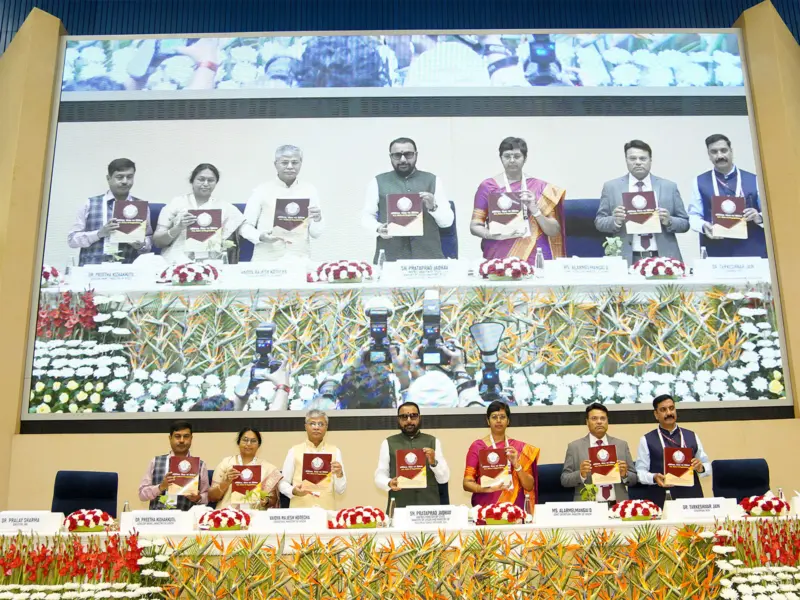

The Ministry of Ayush observed World Homoeopathy Day 2026 with a national celebration focused on the theme 'Homoeopathy for Sustainable Health' at Vigyan Bhawan, New Delhi.
The event gathered policymakers, researchers, practitioners, academicians, and students from across India, marking the birth anniversary of Dr Samuel Hahnemann and highlighting the growing role of homoeopathy in promoting inclusive and sustainable healthcare.
Prataprao Jadhav, Union Minister of State (Independent Charge) for the Ministry of Ayush and Minister of State for Health and Family Welfare, stated, “Over the years, India has developed a strong and expanding homoeopathy workforce, supported by robust institutions and research bodies. Organisations such as CCRH, NCH and NIH are continuously strengthening the scientific foundation, regulatory framework and public trust in Homoeopathy through research, education and quality healthcare delivery, thereby contributing meaningfully to accessible and affordable healthcare across the country.”
Jadhav emphasised the necessity of evidence-based progress, interdisciplinary collaboration, and sustained research to establish homoeopathy as a credible and globally relevant system of medicine. He highlighted the importance of enhancing scientific studies, improving educational standards, and strengthening coordination among practitioners, researchers, and policymakers to provide high-quality, patient-centred healthcare. He reinforced the Government’s commitment to promoting a holistic and sustainable healthcare model aligned with national priorities and global health goals.
Vaidya Rajesh Kotecha, Secretary of the Ministry of Ayush, mentioned that the Government is enhancing the Ayush ecosystem through investments in infrastructure, the expansion of services, and digital platforms like the Ayush Grid and HMIS to support evidence-based healthcare delivery. He also underscored efforts to modernise education and training systems to develop a skilled, future-ready workforce.
Kotecha further stated that India has become a global leader in homoeopathy, supported by robust institutional networks and increased emphasis on research and standardisation, contributing to accessible and sustainable healthcare.
Ms Alarmelmangai D, Joint Secretary of the Ministry of Ayush, drew attention to homoeopathy’s continued vital role in India’s healthcare system, emphasising institutional growth, standardisation, and global outreach. She observed that initiatives such as the National Register for Practitioners of Homoeopathy enhance transparency and reinforce the professional ecosystem. The expanding network of educational institutions and practitioners reflects the system’s growing acceptance. She stressed the need to align this growth with high standards in clinical training and pharmaceutical quality to ensure safe, reliable, and effective patient care.
Dr Preetha Kizhakkutil, Advisor (Homoeopathy) at the Ministry of Ayush, described homoeopathy as a patient-centred and cost-effective healthcare approach with significant potential in preventive and chronic disease management. She noted that ongoing Ministry initiatives are improving accessibility and integration, while continued focus on education, research, and ethical practice is enhancing the system’s credibility and reach.
The programme began with a welcome address by Dr Subhash Kaushik, Director General of the Central Council for Research in Homoeopathy (CCRH), who stated, “World Homoeopathy Day has evolved into an important national and international platform that reflects the growing recognition of homoeopathy. This forum brings together researchers, practitioners, educators and policymakers to promote dialogue, innovation and collaboration. Our focus today is to strengthen the link between research, policy and practice so that scientific knowledge can translate into meaningful public health outcomes.”
Dr Tarkeshwar Jain, Chairperson of the National Commission for Homoeopathy (NCH), highlighted that “Homoeopathy in India today is not merely an alternative but is established as a mainstream system of medicine, supported by more than 3.45 lakh registered practitioners and 291 educational institutions. Through the National Commission for Homoeopathy, we are strengthening transparency, quality in education, and ethical standards to further enhance the credibility and effectiveness of the system.”
During the event, several important publications and knowledge resources were released, including the new official logo of CCRH and the event souvenir. Key publications unveiled included “CCRH Journey: Publication Outreach and Knowledge Dissemination,” a monograph on Acorus calamus, and “Scientific Perspectives of Homoeopathic Medicines: A Practitioner’s Guide.” Additionally, the revamped newsletter of CCRH and the latest issue of the Indian Journal of Research in Homoeopathy (IJRH), Volume 20 Issue 1, were launched, alongside Volume 2 of the Act, Rules and Regulations by the National Commission for Homoeopathy.
Digital initiatives featured a certification course on the Ayush Grid portal, AI-enabled knowledge dissemination content, IRINS integration, a Hindi Shabdkosh website, and an audio-visual compilation of nationwide activities from Homoeopathic Awareness Week (April 1-7, 2026).
The event reaffirmed the Government of India’s commitment to advancing homoeopathy as an evidence-based, accessible, and patient-centred healthcare system. With ongoing focus on research, education, digital integration, and public outreach, the Ministry of Ayush aims to strengthen homoeopathy’s role in providing affordable and holistic healthcare to all sectors of society.