
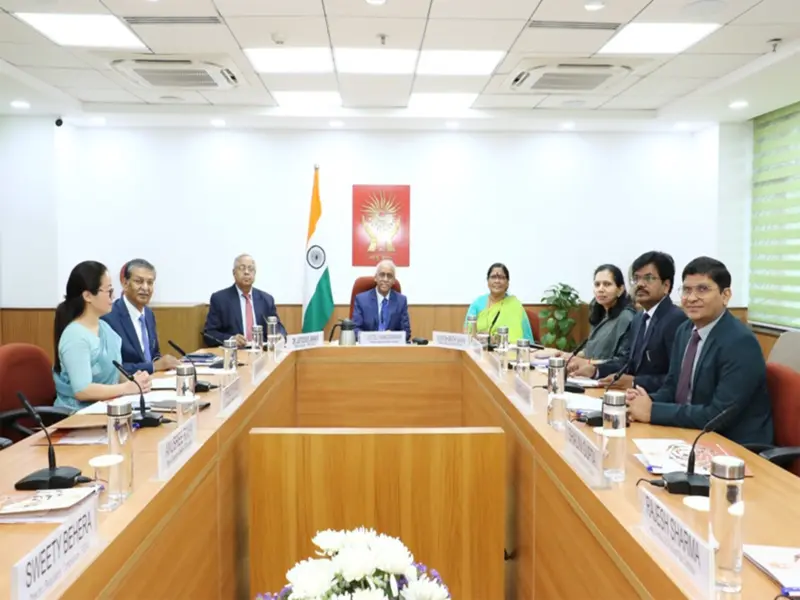

The National Human Rights Commission (NHRC) of India convened a Core Group meeting on the Right to Food and Nutrition focusing on 'Tackling Food Adulteration in India: Understanding the Scale, Challenges and Reforms' in a hybrid format at its New Delhi headquarters.
The session was chaired by NHRC Chairperson Justice V Ramasubramanian and attended by NHRC Members Justice Bidyut Ranjan Sarangi, Vijaya Bharathi Sayani, Secretary General Bharat Lal, Director General (Investigation) Anupama Nilekar Chandra, Registrar (Law) Joginder Singh, Joint Secretaries Samir Kumar and Saidingpuii Chhakchhuak, alongside senior officials from central and state governments, statutory bodies, human rights defenders, consumer activists, academics, civil society representatives, and domain experts.
In his address, Justice Ramasubramanian reviewed the progression of India's legal framework to combat food adulteration, beginning with the Madras Prevention of Adulteration Act of 1918 and culminating in the Food Safety and Standards Act of 2006. He highlighted sustained efforts over decades to reduce adulteration and stressed that increased life expectancy should correspond with an improved quality of life, in line with constitutional guarantees.
Justice Ramasubramanian emphasised that every individual is entitled to a healthy, disease-free life, urging stakeholders to consider the broader consequences of food adulteration beyond statistical data. Referencing the notion that 'food should be medicine,' he noted that this principle has diminished over time. He expressed concern that cases under the Prevention of Food Adulteration Act of 1954 continue to reach courts with evidence often over 15 years old, weakening prosecutions. Although food production and testing infrastructure, including mobile laboratories, have increased, he questioned their effectiveness and maintenance. He also cited consumer indifference as a critical problem, calling on participants to suggest actionable government interventions.
Justice Bidyut Ranjan Sarangi underscored the necessity of raising widespread awareness about food safety, expressing worries over excessive pesticide usage in agriculture and urging prompt actions to prevent adulteration. He stressed educating farmers at the grassroots level to foster safer practices and improve food grain quality.
Justice Vijaya Bharathi Sayani proposed establishing a multi-level special task force to combat food adulteration. She recommended mobile food testing in schools and public venues along with monthly inspections, strict enforcement including imposing fines, around-the-clock helplines, introduction of food adulteration topics in school curricula, timely victim compensation, and expedited grievance redressal systems.
Earlier, NHRC Secretary General Bharat Lal highlighted the severe risks food adulteration poses, particularly to vulnerable groups such as children, pregnant women, and the elderly. He characterised food adulteration as a global issue affecting both formal and informal sectors despite existing legal frameworks. Noting the difficulty in tracing or recalling adulterated products once they enter the supply chain, he stressed that even a single failed food sample can have wide-reaching effects.
Lal indicated that the NHRC has received multiple complaints regarding mid-day meal adulteration and other issues, and has taken cognisance of these to ensure accountability. He urged participants to move beyond diagnosing the problem to collectively identifying practical and implementable solutions aimed at securing safe and nutritious food for all.
Rajit Punhani, CEO of the Food Safety and Standards Authority of India (FSSAI), described FSSAI's efforts encouraging food vendors to register through straightforward and continuous drives, with states issuing licences to vendors as well. He emphasised the need to fill vacant positions within state governments to enhance monitoring and control of adulterated products.
Anusree Raha, Deputy Secretary of the Department of School Education and Literacy, called for increased community and Self-Help Group involvement in combating food adulteration. She referenced capacity-building programmes aimed at raising awareness and suggested utilising school laboratories for food sample testing to familiarise students and youth with the issue.
Richa Kumar of IIT Delhi advocated for monitoring at the farm level, highlighting issues of chemical adulteration, hazardous pesticide use, and associated health risks. She called for a comprehensive systemic ban on harmful chemicals.
Professor Bejon Mishra, an international consumer policy expert, urged stakeholder consultations to ensure product standards, transparency, and accountability in food testing. He also recommended a 24/7 consumer helpline, proper utilisation of the Consumer Welfare Fund, stronger vigilance mechanisms, and enhanced public awareness of adulteration.
Consumer rights activist and senior journalist Pushpa Girimaji stressed the necessity of a national comprehensive study to pinpoint areas and products vulnerable to adulteration.
Other participants included Satyen Kumar Panda, Advisor (Quality Assurance), FSSAI; Alka Rao, Advisor (Quality Assurance), FSSAI; Bharati Kulkarni, Director, ICMR-National Institute of Nutrition (NIN), Hyderabad; Shweta Khandelwal, Senior Advisor, Jhpiego; Monalisha Sahu, Associate Professor, All India Institute of Hygiene and Public Health; Vandana Singh, CEO, Food Security Foundation India and India Food Banking Network; Monika Singh, Director, Ministry of Women and Child Development; Rajesh Sharma, Deputy Secretary, Department of Food and Public Distribution; Giridhar Parvatam, Director, CSIR Central Food Technological Research Institute; Mamoni Das, Principal, Department of Food Science & Nutrition, Assam Agricultural University; and N. Venkateswaran, Chief Executive, National Accreditation Board for Testing and Calibration Laboratories (NABL), among others.