
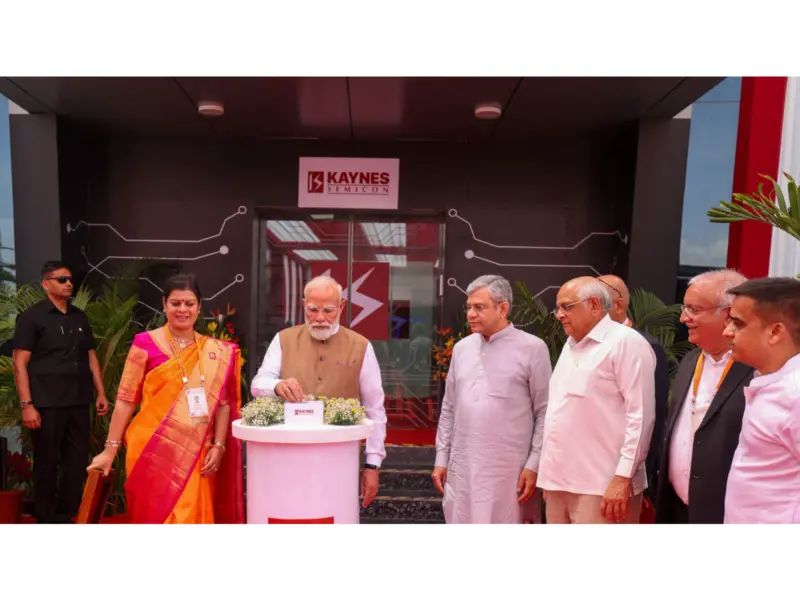

Prime Minister Narendra Modi conducted a one-day visit to Gujarat on January 31, inaugurating projects valued at over Rs 20,000 crore across multiple sectors and launching the Kaynes Technology semiconductor plant in Sanand.
The Prime Minister commenced his visit in Gandhinagar with the inauguration of the Samrat Samprati Museum at Korba Pith, coinciding with the occasion of Mahavir Jayanti. He praised the museum's architecture and design for reflecting India's grandeur and identity, and highlighted its seven galleries that display the country's cultural richness and diversity. The first gallery introduces the Navpad (Nine Jewels), including Arihant, Siddha, Acharya, Upadhyay, and Sadhu Sangh, presenting Samyak Darshan (Right Faith), Samyak Gyan (Right Knowledge), Samyak Charitra (Right Conduct), and Samyak Tap (Right Austerity).
PM Modi stated, "In India, knowledge has always been a free-flowing stream. In every era, Tirthankaras and sages-thinkers have incarnated. The compilation of knowledge kept growing. With time, much that is new has continued to be added." The museum, named after Samrat Samprati, the grandson of Ashoka and a revered figure in Jain tradition, showcases the historical, cultural, and spiritual legacy of Jainism through seven distinct wings dedicated to India's civilisational traditions.
In Sanand, he inaugurated the Rs 3,300 crore Kaynes Technology semiconductor plant, marking the second such facility in India and a significant achievement for the semiconductor sector. The Prime Minister described this as a critical initiative under India's Semiconductor Mission that will accelerate the country's progress in the industry.
He remarked, "A new bridge has been built between Sanand and Silicon Valley," and declared the current period as the "decade of India." Highlighting rapid growth in the domestic electronics sector, PM Modi projected that by the end of this decade, "India's semiconductor market could exceed USD 100 billion dollars." The start of production at this plant further signifies India's strengthening role as a reliable global semiconductor supplier.
Emphasising India's progress, the Prime Minister said Kaynes has become "a strong part of the global semiconductor supply chain" and noted that the intelligent power modules manufactured at the Sanand facility are in high demand internationally. He highlighted the strategic importance of the sector amid global supply chain disruptions caused by pandemics and conflicts, stating, "Whether it is chips, rare earth minerals, energy, they have been greatly affected by a conflict. These are things related to the rapid development of humanity." He stressed the importance of India, as a democratic nation, advancing in this field for global development.
PM Modi outlined the India Semiconductor Mission, launched in 2021, which he described as an "announcement of India's self-confidence" rather than a mere industrial policy. Currently, ten projects worth Rs 1,60,000 crore are underway across six states. Following initial success, the government announced the Semiconductor Mission 2.0 in this year's budget, focusing on semiconductor equipment and materials production to create a "full-stack Indian semiconductor ecosystem."
Concluding his visit in Vav-Tharad, PM Modi inaugurated multiple development projects worth over Rs 20,000 crore across sectors including Power, Railways, Road Transport & Highways, Health, Urban Development, Tribal Development, and Rural Development. He assured that the BJP-led government will continue the "Superfast Express of development" with public trust from local governments to Parliament levels.
Praising Gujarat's budget of Rs 4.08 lakh crore, the Prime Minister said, "The Gujarat government has presented the budget of over 4 lakhs crores. This money will be spent on the development of villages, towns and cities. As long as your trust remains - from the Panchayat to the Parliament - the 'Superfast Express' of development will continue to move forward at this very pace."
PM Modi also inaugurated the Ahmedabad-Dholera Expressway, an access-controlled highway constructed at a cost exceeding Rs 5,100 crore. He laid the foundation stone for the construction of the 4-lane Idar Badoli bypass section with paved shoulders, as well as the upgradation of the Dholavira-Mauvana-Vauva-Santalpur section (Package-II) of NH-754K to a two-lane paved shoulder carriageway.
Additionally, he laid the foundation stone for key road infrastructure projects including a flyover at Bhaijipura Junction on the Gandhinagar-Koba-Airport Road, intended to ease traffic congestion and provide organised parking facilities beneath the structure.
The Prime Minister inaugurated and laid the foundation stone for 44 urban development projects worth approximately Rs 5,300 crore across Gujarat. Health and Family Welfare initiatives included the opening of an 858-bed Rain Basera facility at Civil Hospital, Asarwa, Ahmedabad, and similar facilities at Gandhinagar Civil Hospital and GMERS Medical College, Gandhinagar.