




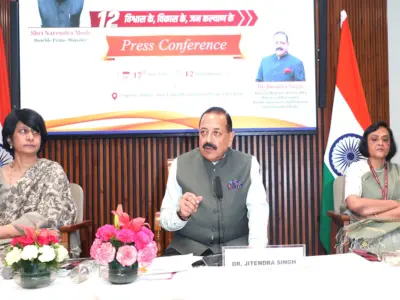

Union Minister Jitendra Singh on Wednesday urged State Governments to adopt the central government's governance platforms, administrative reforms, and citizen-centric service delivery models developed under Prime Minister Narendra Modi's leadership.
He noted these initiatives have transformed public administration, strengthened citizen trust, and are increasingly recognised internationally as effective governance models.
Singh highlighted platforms such as Mission Karmayogi, the Centralised Public Grievance Redress and Monitoring System (CPGRAMS), and Digital Life Certificate as examples of technology-driven governance reforms that enhance transparency, accountability, and efficiency. He called for wider replication of these systems to accelerate progress towards Viksit Bharat 2047.
Speaking at a press conference on the “12 Years’ Achievements of the Ministry of Personnel, Public Grievances and Pensions,” Singh said governance reforms have evolved beyond administrative exercises into instruments of social and economic transformation under Modi's leadership.
The event was attended by Secretary of the Department of Personnel and Training (DoPT) Rachna Shah; Secretary of the Department of Administrative Reforms and Public Grievances (DARPG) and Department of Pension and Pensioners’ Welfare (DoPPW) Nivedita Shukla Verma; Director General of the Press Information Bureau Nanu Bhasin; and other senior government officials.
Recalling Modi’s vision that “Good Governance is the key to a Nation’s progress,” Singh observed a profound transformation in institutions responsible for personnel administration, governance reforms, and pensioners' welfare over the past twelve years. He noted that departments once operating in the background have become primary drivers of reform, innovation, and citizen-centric governance.
He stated, “The Department of Personnel and Training has emerged as a catalyst for reform across government, the Department of Administrative Reforms and Public Grievances has become central to improving service delivery and accountability, while the Department of Pension and Pensioners’ Welfare has expanded its focus from pension processing to ensuring dignity, welfare and quality of life for retirees.”
Singh emphasised that the transformation is guided by three principles: innovation, imagination, and inclusion, driven by technology, administrative sensitivity, and an understanding of India's evolving aspirations.
He noted that Indian governance initiatives now attract global interest, with delegations from countries including South Africa, Mongolia, and the Maldives studying India's public administration, digital governance, grievance redressal, and civil service reforms.
Highlighting landmark reforms, Singh recalled the 2014 decision to introduce self-attestation of documents, which replaced bureaucratic hurdles with trust in citizens and marked a shift from colonial-era practices. He said the reform “sent a powerful message that governance in a modern democracy must be based on trust rather than suspicion.”
He also cited the abolition of interviews for Group B (Non-Gazetted) and Group C posts as a transformative measure that reduced subjectivity and strengthened merit-based recruitment. Combined with technology-driven examination systems, Aadhaar-enabled verification, computer-based testing, and the Public Examinations (Prevention of Unfair Means) Act, 2024, recruitment has become faster, more transparent, and more credible.
Singh added that more than 1.2 million appointment letters have been distributed through 19 National Rozgar Mela events since October 2022, demonstrating the government's commitment to fair recruitment.
He stressed social justice remains central to personnel policies, citing implementation of reservation for Economically Weaker Sections, increased opportunities for Persons with Benchmark Disabilities, initiatives to fill backlog vacancies, and efforts to improve representation of disadvantaged groups in public employment.
Describing Mission Karmayogi as one of the most ambitious civil service reforms globally, Singh said it has shifted capacity building from rule-based to role-based, competency-driven governance. The iGOTKarmayogi platform has over 16.5 million registered users and nearly 130 million course completions, creating a continuous learning ecosystem for public servants. He added that artificial intelligence integration via AI Sarthi, AI Tutor, and AI-enabled learning tools is preparing a future-ready civil service.
Singh noted that governance reforms have yielded tangible improvements in citizen grievance redressal and service delivery. Annual grievances registered have risen from around 200,000 to nearly 2.5 million, indicating increased public confidence. Grievance disposal times have reduced from 157 days to 13 days, demonstrating the impact of technology and accountability. He described CPGRAMS as one of the largest and most effective citizen grievance platforms worldwide.
Technology has been the defining enabler of governance reform over the last twelve years, Singh said. Digital platforms such as online RTI systems, e-Human Resource Management System, e-Office, AI-enabled citizen interfaces, and paperless administration have enhanced efficiency, transparency, and accessibility.
"India is no longer merely adopting global best practices but is increasingly creating governance solutions that are being emulated elsewhere," he stated.
Regarding anti-corruption and transparency, Singh highlighted the operationalisation of the Lokpal, amendments to the Prevention of Corruption Act, and technology-enabled vigilance mechanisms. He explained the reforms ensure accountability while fostering an environment where honest decision-making is encouraged and protected.
The Minister also drew attention to employee-centric reforms, including expanded maternity and childcare provisions, surrogacy leave, special leave for organ donation, and enhanced educational support for differently-abled children. He particularly mentioned special maternity leave in stillbirth cases and extending family pension benefits to divorced and separated daughters as measures addressing long-standing inequities.
On pension reforms, Singh emphasised efforts to ensure retirement with dignity, convenience, and security. He cited the success of the Digital Life Certificate initiative, which uses face-recognition technology to reduce pensioners' need for physical visits, as well as Pension Adalats, grievance redressal systems, and the Anubhav platform that captures retiring employees' knowledge for institutional benefit.
India has also emerged as a global leader in transparency and anti-corruption, Singh said, referring to initiatives during its G20 Presidency, BRICS engagement, and innovations such as the BharatPOL platform and the Abhay AI Chatbot that enhance international cooperation and empower citizens digitally.
Secretary DoPT Rachna Shah detailed advances in recruitment reforms, personnel administration, and capacity building, including expansion of the iGOTKarmayogi ecosystem, UPSC and SSC reforms, AI-enabled training tools, cadre reviews, and recruitment rule changes aiming to create a more agile and skilled civil service.
Nivedita Shukla Verma, Secretary of DARPG and DoPPW, highlighted the expansion of digital governance and citizen-service delivery mechanisms. She noted the nationwide rollout of e-Office, successful Special Campaigns for cleanliness and pendency reduction, AI-enabled grievance tools like Samadhan Didi, growth of the Bhavishya portal, and plans for an integrated AI single-window pension platform supporting multiple languages for a zero-delay pension system.
Concluding the event, Singh stated that the achievements over the past twelve years demonstrate how governance reforms driven by trust, technology, and a citizen-first approach can serve as powerful instruments of national transformation. He said the shift from procedural administration to responsive governance has strengthened public confidence, improved service delivery, and created a strong foundation for a developed India by 2047.