




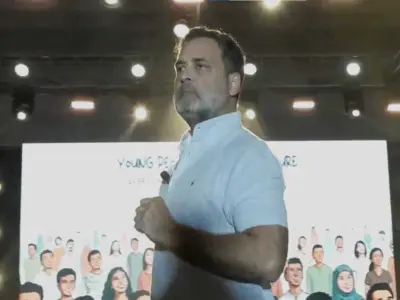

Rahul Gandhi, Leader of Opposition and Congress MP, visited Kota, Rajasthan, on June 17 to engage with students about the growing pressures in India's education system.
Avoiding partisan rhetoric, he presented the discussion as essential to addressing the mental health crisis and systemic challenges affecting young people, as part of his outreach programme “Echo of Students.” The campaign aims to highlight issues such as exam paper leaks, rigging, declining education standards, and rising fees.
Speaking in a city known for its rigorous coaching industry, Gandhi emphasised that the meeting was strictly non-political. He said his main aim was to confront the harsh realities faced by students striving for a future. “This evening is about you. It is about what you are facing. It is about the challenges that you’re dealing with every single day,” he stated.
Reflecting on his cross-country Yatra, Gandhi criticised structural changes in education, including the decline of public institutions and the high costs of private schooling. He argued that the system “pressures, stresses, suppresses, and crushes its children,” fostering a high-pressure environment that has led to tragic outcomes. His urgent goal was to promote a future in which no Indian student feels driven to self-harm.
A central theme was the limited vocational and creative diversity in India’s career choices. Gandhi noted that millions of young people he met strive for only five professions: Engineer, Doctor, Lawyer, IAS, and Forces. “The biggest shortcoming of our education system is that we do not fulfil our children’s dreams,” he remarked, challenging the system’s failure to nurture broader ambitions or respect individual aspirations. He called for an educational framework that empowers rather than suppresses student ambitions.
Gandhi intensified his campaign against what he described as a “corrupt and broken system.” In a post on X, he announced his arrival in Kota and asserted that student distress stems from systemic failure and governmental neglect. He did not shy away from condemning the financial burden on families, describing the education sector as an “extortion mechanism.” “Just think–the amount of money families across the country spend just on NEET preparation is equal to the entire education budget of the Government of India,” he stated.
Highlighting the tragic suicides of two students-Umesh in Sikar and Riya in Dehradun-under pressure from the Re-NEET cycle, Gandhi held the “broken and corrupt” administration responsible, directly criticising Prime Minister Narendra Modi and Education Minister Dharmendra Pradhan. He accused them of safeguarding “future-traders” and paper-leak mafias rather than protecting students.
Responding to the government’s recent Telegram ban aimed at curbing paper leaks, Gandhi dismissed it as a superficial measure. He said, “Instead of catching the thief, [the government] is putting a lock on the victim’s house.” He questioned the effectiveness of such bans, noting both students and illicit groups are aware these actions are not foolproof. Gandhi warned that this approach could extend to other platforms like WhatsApp.
Addressing the government directly, he implored, “Modi ji, stop the posturing. Attack the mafia, not the students.” He urged authorities to listen to young people’s voices, warning that current student anger marks the start of a larger movement to reclaim their rights.
The NEET-UG 2026 re-examination is scheduled for June 21, following the cancellation of the May 3 exam due to paper leak controversies.