
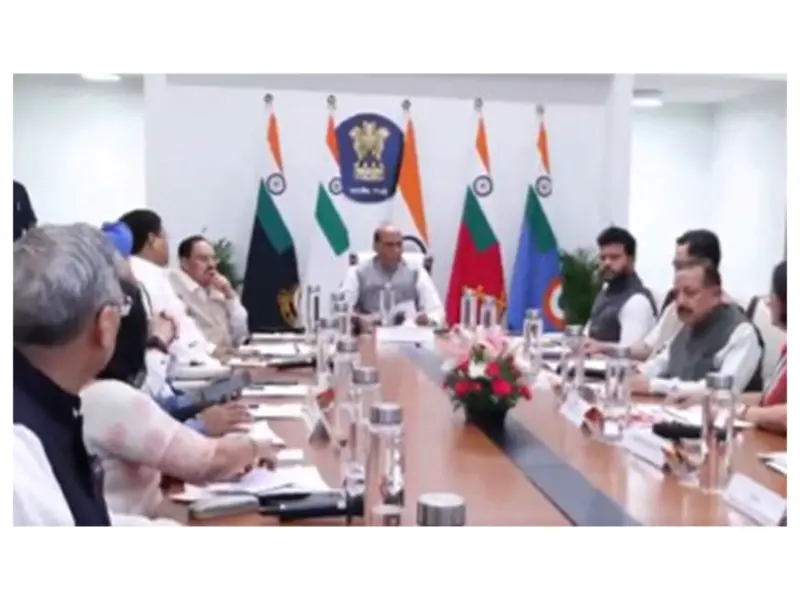

Defence Minister Rajnath Singh chaired a meeting of the Informal Empowered Group of Ministers (IGoM) on Monday to monitor developments in West Asia.
The session focused on reviewing the evolving regional situation and discussing related matters.
Previously on Sunday in Hyderabad, Prime Minister Narendra Modi called on every Indian citizen to participate in a collective movement for economic resilience amid increasing global tensions. Speaking against the backdrop of global supply chain disruptions and rising costs caused by international conflicts, the Prime Minister described the current crisis as a test of national character beyond a mere government challenge.
“Patriotism is not only about the willingness to sacrifice one’s life on the border,” Prime Minister Modi stated. “In these times, it is about living responsibly and fulfilling our duties to the nation in our daily lives.”
The Prime Minister’s address served as a tactical guide for “economic self-defence,” urging citizens to modify their consumption habits to safeguard the nation’s financial wellbeing.
To address fuel price volatility, PM Modi encouraged a shift in transportation habits. He urged citizens to reduce petrol and diesel use by opting for metro and public transport where available, practising car-pooling when private vehicles are necessary, preferring railways for goods movement, and increasing electric vehicle use wherever possible.
Reflecting on efficiencies gained during the COVID-19 pandemic, he called for revitalising virtual infrastructure to decrease the national carbon footprint and energy costs.
In a direct appeal, PM Modi asked citizens to act as “guardians of the Rupee” by being mindful of foreign exchange outflows. He urged people to conserve foreign exchange reserves by avoiding unnecessary foreign travel, overseas holidays, and foreign weddings, instead promoting domestic tourism and local celebrations within India.
He also requested people to refrain from non-essential gold purchases for one year to lessen pressure on foreign exchange outflows.
The Prime Minister encouraged the prioritisation of Made-in-India and locally manufactured products, including everyday items such as shoes, bags, and accessories. He also asked families to reduce edible oil consumption, emphasising benefits for both national economic health and personal wellbeing.
Addressing the farming community, PM Modi advocated transitioning to natural farming and urged a 50% reduction in chemical usage, positioning farmers as frontline soldiers in the pursuit of environmental sustainability and economic independence.
Concluding, the Prime Minister emphasised that while global conditions may be turbulent, India’s strength resides in the “micro-efforts” of its 1.4 billion people. His message was clear: India's future growth will be determined not only by policy documents but also by the daily choices made at the petrol pump, jewellery store, and dining table.