
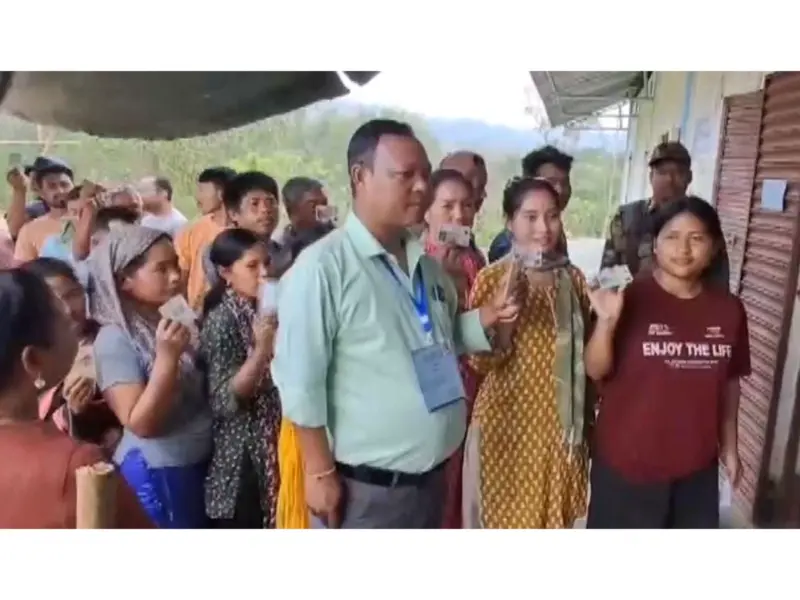

The Tripura Tribal Areas Autonomous District Council (TTAADC) general election in 2026 saw an overall voter turnout of approximately 21.5 per cent by 9 am, according to official data.
In the first two hours of polling from 7 am to 9 am, nearly 204,679 voters cast their ballots out of 951,613 registered electors, indicating robust participation during the morning period.
Of these, about 100,058 were male voters, while women cast 104,621 votes, reflecting a marginally higher turnout among female voters.
Several Scheduled Tribe-reserved constituencies, including Kathalia-Mirza Rajpur, Maharani-Chelagang, and Ramchandraghat, reported comparatively higher turnout rates of around 24 to 25 per cent. Conversely, Machmara, Chaumanu, and Dasda-Kanchanpur constituencies recorded lower participation levels, ranging from 20 to 21 per cent. Dhamcharra-Jampui reported the lowest turnout so far, with just 16 per cent of voters participating in the initial two hours.
Tripura State Election Commission Secretary Anurag Sen stated that 1,257 polling stations had been established across all 28 TTAADC constituencies to facilitate smooth voting. The election encompasses 16 subdivisions with a total of 962,547 registered voters, comprising 481,959 male voters, 480,582 female voters, and six transgender voters.
A total of 173 candidates are contesting the election, including 165 men and eight women. Security arrangements involve deployment of the Tribal Security Reserve and Civil Police at all stations, supported by 24 Central Armed Police Force companies-12 from the Border Security Force, 10 from the Sashastra Seema Bal, and two from the Central Reserve Police Force.
The TTAADC holds a distinctive position under the Sixth Schedule of the Indian Constitution, granting it significant autonomy in governing Tripura’s tribal regions. This legal framework permits the Council to manage indigenous customs, local administration, and economic development.
Endowed with extensive administrative and legislative authority, the Council plays a vital role in directing development projects, enhancing infrastructure, advancing education, and preserving cultural heritage. Its operations help the indigenous communities of Tripura to achieve socio-economic progress while maintaining their unique identity, establishing the TTAADC as an essential body for self-governance and community welfare.