
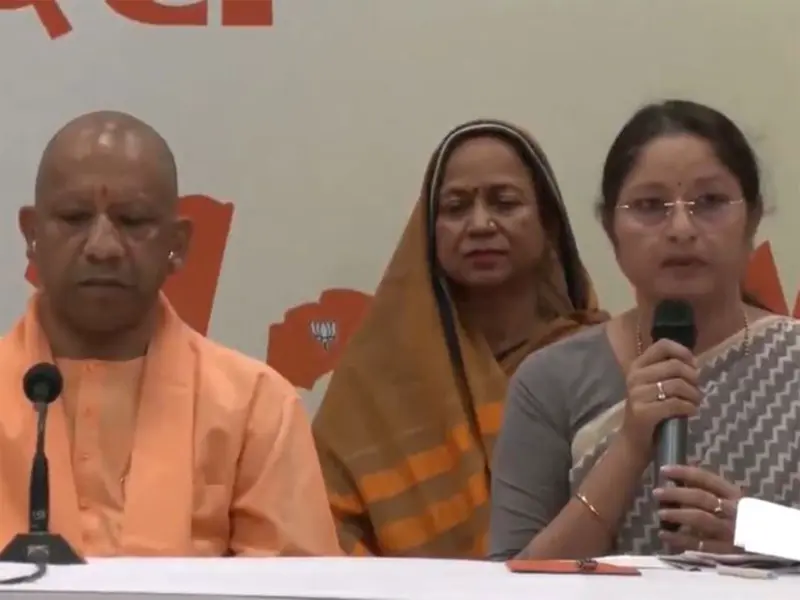

Union Women and Child Development Minister Annpurna Devi criticised the opposition for voting against a women's reservation bill, describing April 17 as 'a black day of the 21st century'.
Speaking at a conference in Lucknow, she accused the INDIA bloc of adopting an anti-women stance.
Devi stated, “April 17 will be known as a black day of the 21st century. Now is the time to politically empower women. This (Nari Shakti Vandan Adhiniyam) was for the representation of women in state assemblies and the Lok Sabha.”
She added, “Crores of women were looking towards the Lok Sabha with eyes full of hope. But due to the anti-women stance of the INDIA alliance, they voted against it. They have not only killed the bill but also broken the hearts of women.”
Highlighting Prime Minister Narendra Modi’s remarks, Devi said, “Narendra Modi delivered a very emotional address in the name of women. His wish was that, having already achieved economic and social empowerment, women must now be politically empowered as well.”
“In line with this vision, amendments to the Nari Shakti Vandan Act were introduced in the Lok Sabha so that women could secure full participation by 2029. He made an effort towards this, but when the bill was not passed, the INDIA alliance celebrated its failure and insulted women. Women across the country are outraged by this, and they will hold them accountable,” she added.
On April 17, opposition parties in the Lok Sabha voted against the Constitution Amendment Bill, which aimed to implement women’s reservation. The three-day Special Session from April 16 to April 18 featured discussions by Prime Minister Narendra Modi, Union Home Minister Amit Shah, and multiple opposition leaders including Samajwadi Party chief Akhilesh Yadav, AIMIM chief Asaduddin Owaisi, and Congress leader KC Venugopal.
The 131st Constitution Amendment Bill, also referred to as the Delimitation Bill, failed to pass in the Lok Sabha as the INDIA bloc opposed the delimitation process. During a division, 298 members voted in favour and 230 against the bill.
Following the bill’s defeat, the government decided not to pursue the other two linked bills - the Delimitation Bill and the Union Territories Laws (Amendment) Bill - since all were interrelated.