
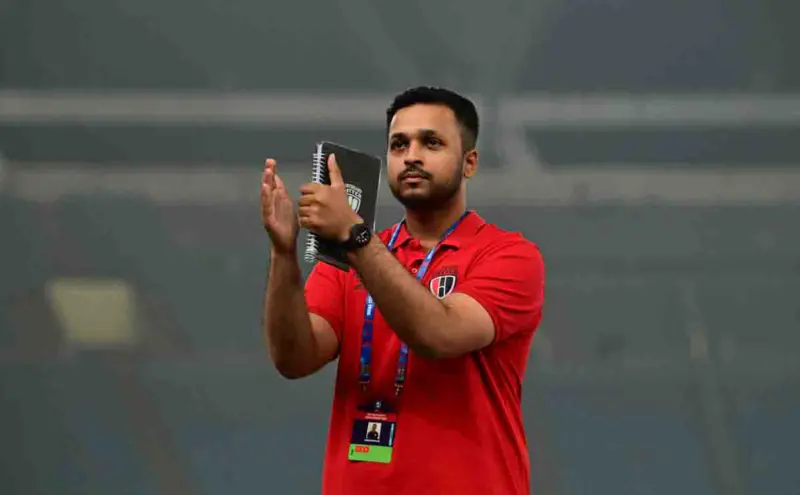

At 25, Amogh Adige became the youngest coach to manage a side in an Indian Super League match when he took charge of NorthEast United FC against FC Goa in Guwahati on April 24. A product of British football education with UEFA A and now undergoing AFC Pro licence, Adige has spent three years at NEUFC - moving from analyst to first-team assistant coach under Juan Pedro Benali.
In a conversation with The News Mill, he spoke about the record, his journey across three continents, and what Indian football needs to find its identity.
You made history on April 24, becoming the youngest coach to take charge of an ISL match. What does that mean to you?
I’m grateful to have had the opportunity to lead NorthEast United FC in the Indian Super League for the match against FC Goa and subsequently become the youngest ever coach to take charge of a game in the top division in India. But for a UEFA A-licensed coach, teamwork to reach a desired goal matters more than individual milestones. It wouldn’t have been possible without the support of everyone at the club, and especially coach Juan Pedro Benali.
You’ve been at NEUFC for three years now. How has that journey shaped you?
It’s been a journey across three years. I joined initially in an analyst capacity with the first team - performance analysis, recruitment, scouting - and that gradually mixed with coaching responsibilities in the first team and with the reserve team under Naushad Moosa. This year, I got the opportunity to transition into a full-time coaching position with the first team. It’s been a gradual progression across different areas within the club, and one that has taught me a great deal.
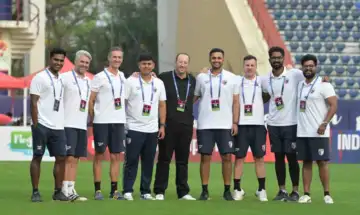 Amogh Adige with head coach Juan Pedro Benali and other coaching staff | NEUFC
What has been the single biggest influence on your growth as a coach?
The group of people I’m working with right now. That runs from our head coach to the goalkeeper coach, the fitness coach - all of them. Working closely with them for three years, it has become like a family. I jokingly tell them all the time that these three years have been like a bachelor’s degree in football for me. These people, the coaching staff and everyone around have had a very big impact on where I am today.
Tell us about your early days and how you came into football.
I always wanted to do something in sports. I was a wicket-keeper batsman in cricket and a goalkeeper in football. I represented the Kolhapur zone in Maharashtra for the state championship in cricket, and played football up to university level in Pune. Then I had an unfortunate back injury and a head injury that changed things. I didn’t want to leave football, so I thought the best way to stay involved was to get educated on the technical side.
In India, formal education in football was limited at the time, so I went to the UK. I was there for four years, completed a BSc in football coaching and performance, and also got my UEFA A licence. After that, I went to the US and coached at an MLS Next Academy team for a year. I came back to India, joined Bengaluru FC, completed my AFC coaching licences, and I’m currently pursuing the AFC Pro licence. I’ve also had the opportunity to work within the national team setup with the India under-23 side under Naushad Moosa coach.
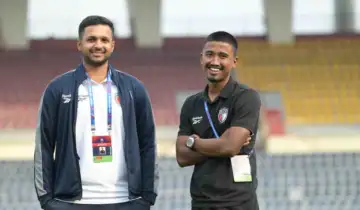 Amogh Adige with NEUFC forward Parthib Gogoi | NEUFC
You’ve been working in a setup with a strong Spanish influence. What has that taught you?
Working with the same Spanish staff for three years has taught me a great deal about being creative and loving the ball. The Spanish coaches I work with have really instilled that in me - the idea that if you don’t have the ball, you cannot play. I’ve also picked up good Spanish along the way. All our discussions now happen in Spanish, which has been a wonderful addition.
You spoke about the culture shock when you went to the UK. What stood out?
The biggest shock was the culture. In India, we are not a nation that has sports deeply embedded in daily life in the same way. There, football is part of your identity from birth. You speak about football, you think about football, you dream about football. That creates a very strong culture from the youth level right through to the senior game.
More than new coaches, new tactics, or foreign players, what India needs is to develop a football culture. Right now, that kind of culture exists for cricket in this country. When we can replicate that for football - when the whole country is singing the same tune - that is when we will see real development.
What specifically did the UEFA coaching course teach you about how elite football is structured?
Everything at that level comes down to very small details. What struck me was the clear structure and guiding principles. In the academies, there, from under-9 to under-18, there is a specific curriculum. A team in the south of the country and a team in the north will share distinct features because they are guided by the same underlying principles. That is how you build a national DNA.
Think about Spain - you immediately think of possession-based football, players who love the ball. Brazil brings to mind creativity, one-on-one duels, and expressive players. England makes you think of physical intensity, aerial dominance, and box-to-box football. These traits are distinct to each country because they are guided by set principles across all ages. If you ask me to describe a characteristic Indian playing style, I would find it very difficult. That is what we need to work on.
How do you see your role evolving from here?
Right now, it is about taking experience, learning as much as possible, and implementing fresh ideas into the environments I am in - whether that is the youth setup or senior football. My dream is to help instil a culture of football wherever I work and to hopefully contribute to India becoming a successful footballing nation.
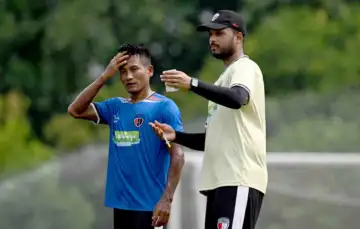 Amogh Adige during a training session | NEUFC
You’ve spoken about how football has shaped you as a person. Can you elaborate on that?
Football is a team sport, and it teaches you how to deal with wins and losses, with really good moments and really bad ones. That mirrors life. Being in this environment on a week-to-week basis creates a strong character. The key lesson I carry outside of football is to be stable and calm in victory, and stable and calm in defeat - because every day brings another chance to be better.
What would you say to young people who want to pursue sports as a career but are not professional players?
I remember one sentence I really believed in - I didn’t want to keep football as a hobby. I wanted to make sure it was my profession. That is what I wrote in my university application when I went to the UK to study, and right now I tell it to everyone: I am living my dream. Football is my profession.
What we need is awareness among parents that sports can be a profession, not just a side activity. The sports industry now has vast sectors. In football alone, you can be a coach, an analyst, a physio, a strength and conditioning coach, a media manager, a journalist - the list goes on. If something interests you, take it up. Be passionate about it. You only live once.
Guwahati has been your home for the past few years. How has that been?
I came here quite close-minded, not really sure what to expect. Now I am very proud and happy to call this my home. I spend more time here than anywhere else. The people are lovely. I enjoy Bihu, the food, and the local sweets. I have tried to immerse myself in the culture of the place, and it has been a genuinely mind-opening experience.