
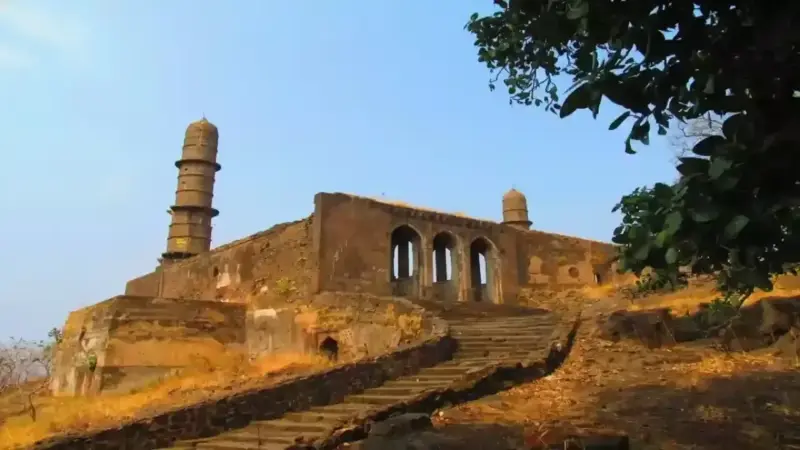

To understand Asirgarh Fort is to understand the geographical truth that shaped the politics of North and South India for centuries. Located in the Satpura hills near Burhanpur in Madhya Pradesh, this fort is not like an ordinary stronghold.
It is a route. It is a gateway. And that is why it has often been called the "Gateway to the Deccan." Any power that wished to move from North India to the South had to pass through the region controlled by this fort. And when a place becomes a route, it ceases to be just a location it becomes a strategy.
Strategic Location and Importance
The location of Asirgarh is highly distinctive. It stands atop a high hill from where the entire surrounding region can be clearly observed. The land below is open, the fort stands above, and the elevation between the two itself becomes its greatest defensive advantage. The routes leading to the fort are not straight. They are winding, narrow at several points, and in many places designed in such a way that the speed of an advancing force is automatically controlled. This is not merely construction it is thought, a form of military strategy where the enemy is exhausted at the very first stage.
Historical Background and Mughal Connection
The history of Asirgarh is considered extremely ancient, but its real and fortified form developed during the medieval period. After its early structures, the fort passed through the control of various rulers, with each era adding something to it. However, its most significant historical phase emerges when it becomes central to the strategy of the Mughal Empire. In the late 16th century, Akbar decided to bring this fort under his control. This decision was not just about conquering a fort it was about securing the route to South India.
The siege of Asirgarh by Akbar was not a simple military campaign. It was a long and patient struggle. The fort's structure was so strong and its position so secure that capturing it through direct warfare proved extremely difficult. Ultimately, like many other forts, it did not fall solely to force but to time, strategy, and internal circumstances. This clearly shows that Asirgarh was not merely a strong fort it was one that demanded patience and planning to conquer.
Architecture and Multi-Layered Defense
From a construction perspective, Asirgarh is also the result of long-term development. It is not a single fort but a three-tiered system lower, middle, and upper sections. This multi-layered design makes it even more complex. Even if an invader managed to breach one level, they had to face resistance again at the next. Thus, the fort continuously presented challenges, with each level becoming a new test. There is no precise record of the time taken for its construction, but it is evident that it evolved over several centuries. There is also no clear record of its cost, but its structure indicates that it was a highly significant and resource-intensive project.
Life Inside the Fort
Life within the fort was as organized as its outer defenses. There are mosques, temples, reservoirs, and residential structures. This fort was not meant only for soldiers it was a complete fortified settlement where life could continue for long periods. Water management was extremely important here, as availability of water at such heights could be a challenge. This issue was addressed through tanks and reservoirs that collected rainwater.
Psychological Strength and Decline
Another important aspect of Asirgarh is its psychological impact. The fort did not inspire fear merely because of its structure, but also because of its position. When an army reached its base, the sheer sight of the massive fort standing above made it clear that the battle would not be easy. This is the point where the strength of the fort becomes not just physical but mental.
Over time, as new political powers emerged and modern warfare techniques developed, the importance of Asirgarh gradually declined. However, its historical significance never disappeared. Even today, it stands as evidence of a time when forts were built not just for defense, but for controlling routes and regions.
Conclusion
If Asirgarh Fort is to be understood in a single sentence, it can be said that this is the place where a fort is not a wall, but a gateway. Whoever controls it does not merely control a fortress, but an entire route. And that is what makes it one of the most strategic and significant forts in India.