




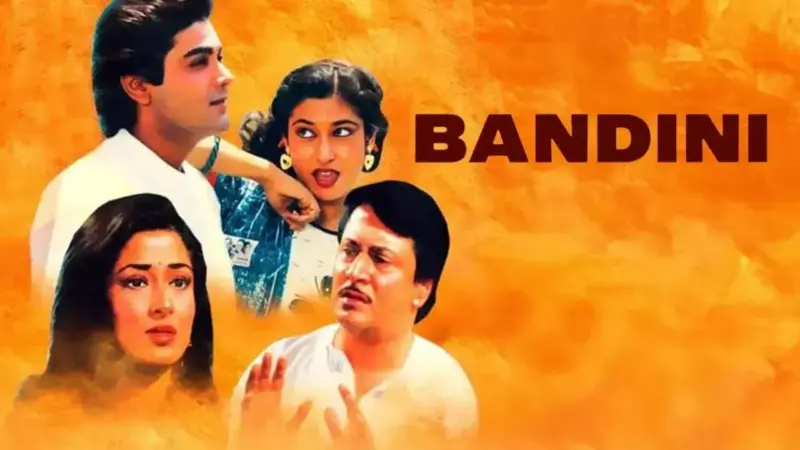

When Bandini was released in 1963, female characters in Hindi cinema were largely confined within fixed frameworks of sacrifice, love, and family honour.
Women often served as the emotional center of stories, but their inner desires, guilt, anger, and personal freedom were rarely explored with honesty. It was at precisely such a moment that Bimal Roy created Bandini, a film that portrayed the silent war raging inside an Indian woman with such depth that it ceased to remain merely a love story and evolved into one of the most sensitive cinematic expressions of female consciousness in Indian cinema.
Bandini is the story of a society where a woman is forced to make the most painful choices between love and morality. At the center of the film stands Kalyani, a woman who loves, waits, breaks apart, commits a crime, and then spends her life searching for justice and liberation within herself. For Indian society of the 1960s, this was an extraordinarily bold and unconventional portrayal. That is why, over time, Bandini did not remain merely a classic; it came to be regarded as one of the deepest psychological films in Indian cinema.
Bimal Roy: The Filmmaker Who Searched for Emotional Truth
By then, Bimal Roy had already established himself as one of India's greatest filmmakers through socially sensitive films like Do Bigha Zamin, Sujata, and Parakh. He did not seek noise in cinema; he searched for emotional truth. Even with Bandini, his intention was not to create a conventional melodrama. He wanted to tell a story in which a woman would not merely appear as a victim, but as a complex human being.
The film was based on a novel by celebrated writer Jarasandha. Jarasandha himself had been associated with prison administration and had closely witnessed the loneliness, emotional collapse, and inner suffering of women prisoners. That is why the prison world in Bandini never feels artificial. The silence, locked doors, physical labour, waiting, and emotional exhaustion all feel deeply authentic.
Nutan: Becoming Kalyani From Within
The casting of Nutan remains one of the film's greatest achievements. She was already regarded as a highly respected actress, but Kalyani demanded far more than ordinary performance. This role functioned less through dialogue and more through eyes, silence, and the emotional devastation unfolding internally.
Nutan completely restrained her acting persona for the role. She consciously avoided melodrama. In many scenes she simply sits quietly, yet the audience can feel the storm raging within her. Many film historians believe that Bandini contains the greatest performance of Nutan's career.
The Extraordinary Use of the Camera
Bimal Roy did not want the prison to resemble a glamorous cinematic set. Realistic prison structures and restrained production design were therefore used extensively. Thick walls, iron bars, harsh sunlight, and confined corridors continuously create an atmosphere of suffocation throughout the film.
Cinematographer Kamal Bose made exceptional use of light and shadow. Inside the prison, lighting was often intentionally limited so the psychological imprisonment of the characters could be felt visually. In several scenes, only half of Nutan's face is illuminated while the other half remains in darkness. This was not merely aesthetic beauty; it became a symbol of her emotional division.
Ashok Kumar and Dharmendra: Inspired Casting Choices
The casting of Ashok Kumar was equally important. At the time, he was among the most respected actors in Hindi cinema. His character, Bikash, carries charm, political idealism, and emotional weakness all at once. Bimal Roy did not want the audience to see him as a straightforward villain. It is precisely this complexity that gives the film emotional depth.
Meanwhile, Dharmendra was still a relatively new actor. As Dr. Devendra, his presence brings stability and human compassion into the narrative. Interestingly, during that period Dharmendra was mostly seen as a romantic and handsome young star, but Bandini offered an early glimpse of the serious actor within him.
S. D. Burman: Turning Pain Into Music
The music of the film functions as an extension of its soul. Composer S. D. Burman was already considered one of Indian cinema's most sensitive musicians. He understood that in Bandini, music could not become noise; it had to become inner pain.
Songs like Mora Gora Ang Lai Le, O Jaanewale Ho Sake To Laut Ke Aana, and Ab Ke Baras Bhejo Bhaiya Ko Babul did not merely become popular melodies. They transformed into the voice of longing, loneliness, and emotional fracture hidden inside Indian womanhood.
Mora Gora Ang Lai Le carries historic importance because it marked one of Gulzar's first major works in Hindi cinema. Both Bimal Roy and S. D. Burman were deeply impressed by the poetic texture of his language. That very song laid the foundation for Gulzar's extraordinary future journey.
During the recording sessions, live orchestras were used. S. D. Burman did not want the music to sound excessively heavy. Hence, restrained arrangements involving flute, sitar, and controlled percussion were employed. Special effort was made to preserve a folk-like emotional purity in the songs.
Kalyani's Decision at the Crossroads
The film's most emotionally powerful moment arrives in its final act, when Kalyani is forced to choose between two paths in life. She can embrace a stable, secure future, or return to the man who once shattered her emotionally. It is this decision that elevates Bandini far above the level of an ordinary social drama. Here, for perhaps the first time in mainstream Indian cinema, a woman is seen choosing her own path.
Many film historians believe that Bandini was one of Indian cinema's earliest feminist films, even though the term itself was not widely popular at the time. The film presented a woman not as a moral symbol, but as a complete human being with desires, weaknesses, and the ability to make decisions. That is why even today younger audiences continue to connect with it on a profound level.
A Film Admired by Everyone
The film's budget was not particularly large. Its total cost is believed to have been between 2.5 and 3 million rupees. But its greatest strength was never grandeur; it was emotional depth. Bimal Roy understood that Bandini would not move audiences through visual noise, but through emotional honesty.
When the film was released, critics praised it extensively. Nutan's performance was described as historic. Audiences too embraced the film emotionally. From a commercial standpoint, Bandini achieved respectable success, which was considered a major accomplishment for a serious social film of that era.
Internationally as well, the film was admired as an example of India's sensitive cinematic storytelling. European critics particularly praised its emotional simplicity and visual restraint. Many placed it alongside some of the greatest female-centered films in world cinema.
Over time, the stature of Bandini only continued to grow. Today it is not merely regarded as a classic, but as one of the most important films in the evolution of female characters in Indian cinema. And perhaps that is why Kalyani remains unforgettable even now. Because she was not merely a prisoner inside a jail. She was a prisoner of her time, her love, and her society, a woman who ultimately found the courage to choose her own destiny.