




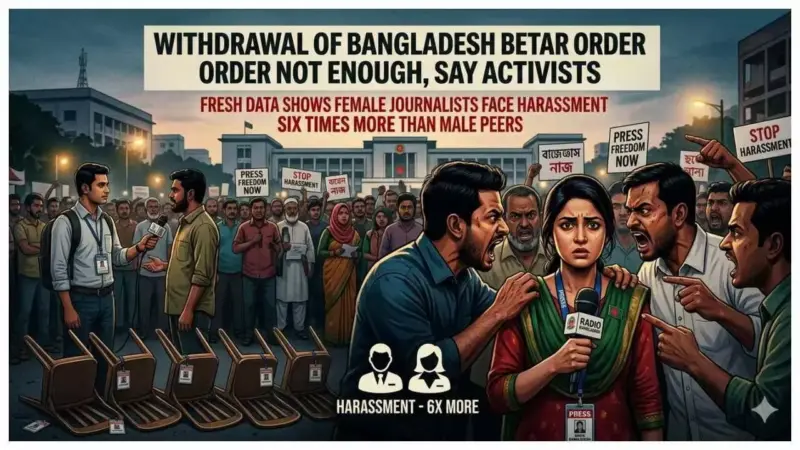

A dress code directive issued by Bangladesh's state-owned radio broadcaster has ignited a fierce debate over women's rights, professional autonomy, and institutional accountability, and that too even after the order was formally withdrawn.
The Directive
Bangladesh Betar issued a directive on May 4, 2026, setting specific clothing guidelines for female news presenters, instructing them to wear sarees or salwar-kameez with dupattas, while discouraging the wearing of "large bindis" and draping the dupatta on one side. The order was pulled back shortly after, following an immediate and vocal public backlash.
Withdrawal Not Enough, Say Activists
But for many, the rollback came too late, and meant too little.
A group of women's rights activists, academics, artists, and civil society members wrote an open letter to Information and Broadcasting Minister Zahir Uddin Swapan, saying that while they welcomed the cancellation of the directive, merely withdrawing it was not sufficient and that the mindset behind such instructions also needed to be critically reviewed.
The signatories described the directive as culturally insensitive and contrary to women's dignity, rights, and constitutional values of equality, personal freedom, and cultural inclusion. They called for accountability for those who drafted and issued the order, and urged authorities to put in place inclusive, non-discriminatory workplace policies going forward.
A Broader Pattern
The Bangladesh Betar controversy did not emerge in a vacuum. As recently as July 2025, Bangladesh Bank issued guidelines telling women officials and staff to wear sarees, salwar-kameez with scarves, or other formal and modest attire, while explicitly prohibiting short-sleeved dresses and leggings, with non-compliance framed as a breach of discipline.
Critics say such directives reflect a deeply rooted institutional tendency to police women's bodies in professional spaces, a concern now backed by concrete data.
Harassment Crisis in Newsrooms
A recent international study adds a troubling layer to the conversation. Covering 339 media professionals across Bangladesh, the survey found that female journalists were nearly six times more likely than their male counterparts to experience sexual harassment, with most incidents going unreported out of fear of career consequences. Sixty per cent of female respondents reported facing verbal sexual harassment, against just nine per cent of male respondents.
The findings come from a multi-country study conducted by WAN-IFRA Women in News, City St George's University of London, and BBC Media Action, covering over 2,800 media professionals across 21 countries.
Of the women who experienced verbal harassment in Bangladesh, 52 per cent chose not to report it. In cases that were reported, employers took no action in 43 per cent of instances.
"Sexual harassment has a deeply negative impact on those who experience it and on the general working atmosphere in newsrooms," said Lindsey Blumell of City St George's, University of London. "Research shows that experiencing harassment decreases job satisfaction and increases the risk of leaving the industry entirely."
Constitutional Contradiction
Analysts point out that Bangladesh's constitution promises equality in text, but gender continues to shape whose rights get suspended in practice, from the family to the factory floor, and now visibly in the country's public broadcasting spaces. The open letter signatories stressed that dress code restrictions do not exist in isolation. They reinforce harmful social norms and feed a culture of control over women in professional life.
The Information and Broadcasting Ministry is yet to issue a formal response to the open letter.