
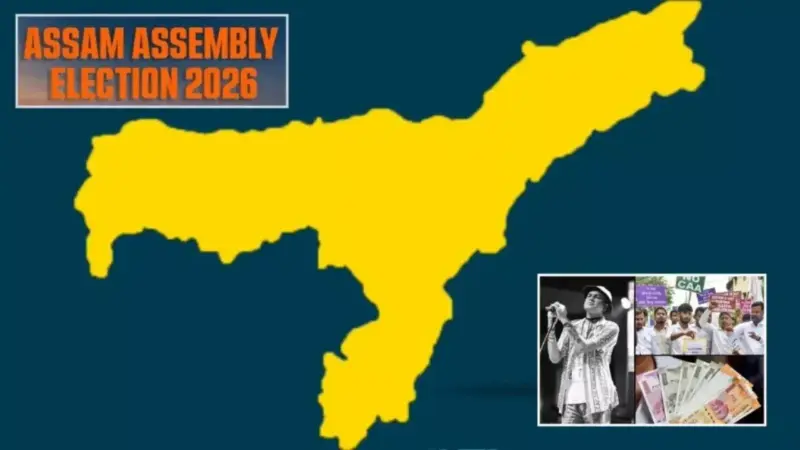

Assam's assembly election will not be decided by broad regions or familiar narratives, it will be won and lost in the fine-grained sub-regional battlegrounds that lie beneath them.
The real story of this election is hidden inside 126 Assembly seats, broken into 13 distinct belts where identity, community arithmetic, development, and local power networks intersect in very different ways.
From the Ahom heartland of Upper Assam to the volatile Muslim-majority stretches of Lower Assam and the unpredictable, multi-cornered contests of the Barak Valley, each zone is playing by its own rules. The question is no longer just who is ahead statewide, but which belt tilts, where margins collapse, and from which cluster the next government in Dispur will finally emerge.
Nagaon-Morigaon-Hojai-Kaziranga belt
The first major sub-region of Upper Assam is the mixed Nagaon-Morigaon-Hojai-Kaziranga belt. This includes the 8 Assembly seats of the Nagaon Lok Sabha segment-Jagiroad, Lahorighat, Morigaon, Dhing, Rupohihat, Samaguri, Nagaon-Batadraba, and Raha. It also includes the 10 seats of the Kaziranga Lok Sabha segment-Kaliabor, Barhampur, Binnakandi, Hojai, Lumding, Golaghat, Dergaon, Khumtai, Bokakhat, and Sarupathar. This 18-seat belt is among the most mixed belts in all of Assam. Here Assamese voters, Muslim voters, tea-tribe communities, some tribal groups, and local regional discontent all operate together. In places like Jagiroad and Hojai, questions of identity, infiltration, displacement, and local representation have repeatedly surfaced. In Hojai, the issue of eviction and rehabilitation has recently become a major campaign question. That is why this belt does not fall neatly into the pocket of any one party. My estimate is that in these 18 seats, the 'NDA' could land in the range of 8 to 12, the Congress-led opposition in the range of 5 to 8, and others, including the 'AIUDF' and local players, in the range of 1 to 4.
Sonitpur-North Bank West Belt
The second sub-region of Upper Assam is the Sonitpur-North Bank West belt, which includes the 9 seats of the Sonitpur Lok Sabha constituency-Dhekiajuli, Barchalla, Tezpur, Rangapara, Naduar, Biswanath, Behali, Gohpur, and Bihpuria. This belt is a mix of the Assamese middle class, rural Hindu voters, the tea belt, some tribal presence on the margins, and pockets of local dissatisfaction. Here the BJP benefits from organization, governance, and beneficiary politics. But if local resentment against a candidate or a surge of regional feeling rises sharply, the opposition can make inroads. My estimate is that in these 9 seats, the 'NDA' may win 5 to 7, the opposition 2 to 4, and others 0 to 1.
Lakhimpur-Dhemaji-North Bank East Belt
The third sub-region of Upper Assam is the Lakhimpur-Dhemaji-North Bank East belt, which includes the 9 seats of the Lakhimpur Lok Sabha constituency-Ranganadi, Naoboicha, Lakhimpur, Dhakuakhana, Dhemaji, Sissiborgaon, Jonai, Sadiya, and Doomdooma. This region is shaped by Assamese self-respect, river erosion, floods, frontier life, tribal representation, and an agrarian economy. Here the influence of Mising, Deori, other tribal communities, and Assamese ethnic sentiment is visible. The BJP has a structural advantage here, but flood erosion and the issue of regional dignity open some space for the opposition. In this sub-region, my estimate is that out of 9 seats, the 'NDA' may secure 6 to 8, the opposition 1 to 3, and others 0 to 1.
Dibrugarh-Tinsukia Belt
The fourth sub-region of Upper Assam is the Dibrugarh-Tinsukia tea, oil, and industry belt, which includes the 10 seats of the Dibrugarh Lok Sabha constituency-Margherita, Digboi, Makum, Tinsukia, Chabua-Lahowal, Dibrugarh, Khowang, Duliajan, Tingkhong, and Naharkatia. This is the belt where tea-garden labour, the oil industry, old industrial towns, labour-based politics, and the BJP's deep organizational reach are seen most clearly. Recent reporting on Khowang has explicitly noted that tea-tribe voting, flood erosion, and regional identity continue to define the contest here. The opposition may create some symbolic battles, but the structural advantage still appears to rest with the BJP. In this 10-seat belt, the 'NDA' may take 6 to 8, the opposition 2 to 4, and others 0 to 1.
Jorhat-Sivasagar Ahom Heartland
The fifth and politically most symbolic sub-region of Upper Assam is the Jorhat-Sivasagar Ahom heartland. It includes the 10 seats of the Jorhat Lok Sabha constituency-Sonari, Mahmora, Demow, Sivasagar, Nazira, Majuli, Teok, Jorhat, Mariani, and Titabor. This is the very belt where the politics of the three Gogois, the memory of the 'CAA', the Ahom mind, Assamese pride, and an emotional anti-BJP narrative are most densely concentrated. Yet this is also the same region where the BJP, through welfare politics, women-focused beneficiary schemes, organization, and leadership, has managed to retain ground. That is why this is the region where the opposition has its greatest hope, but the least certainty of victory. In this 10-seat sub-region, the 'NDA' should be seen in the range of 5 to 7, the Congress-led opposition in the range of 3 to 5, and others within 0 to 1.
A Clear Picture
When these 5 sub-regions are added together, the overall picture of Upper Assam's 56 seats becomes clear: this remains the backbone of power. Here, the BJP-led alliance appears to hold a range of roughly 30 to 42 seats. The opposition appears to be in the range of 12 to 22, and others in the range of 0 to 4. If the opposition catches the best possible wind, the election becomes competitive from here. But if the BJP crosses 38 or more here, the government becomes nearly secure for it.
Sub-Regional Blueprint of Lower Assam
Bodoland-Kokrajhar belt
The first sub-region of Lower Assam is the Bodoland-Kokrajhar belt, which includes the 9 seats of the Kokrajhar Lok Sabha constituency-Gossaigaon, Dotma, Kokrajhar, Baokhungri, Parbatjhora, Sidli-Chirang, Bijni, Manas, and Baksa. This remains one of Assam's most distinctive zones of power arithmetic, because the main contest here is not simply BJP versus Congress. It emerges through the interaction of the 'BPF', 'UPPL', Bodo leadership, non-Bodo reaction, and the BJP's electoral partnerships. This time, the struggle between Hagrama Mohilary and Pramod Boro may have a kingmaker effect in Bodoland, because the 'BPF' is with the BJP while the 'UPPL' is contesting separately. In this 9-seat belt, the 'NDA' may secure 4 to 6, the 'UPPL' and other Bodo forces 2 to 4, and the Congress camp 0 to 2.
Dhubri-border Muslim Belt
The second sub-region of Lower Assam is the Dhubri-border Muslim belt, which includes the 11 seats of the Dhubri Lok Sabha constituency-Golakganj, Gauripur, Dhubri, Birsing-Jarua, Bilasipara, Mankachar, Jaleswar, Goalpara East, Srijangram, Mandia, and Chenga. This is the region where Muslim voting, its internal fragmentation, the Congress-versus-'AIUDF' rivalry, and the BJP's identity politics collide most directly. Recent campaigning has shown Badruddin Ajmal fighting to recover his ground, while the Congress's 2024 parliamentary win in Dhubri has also signalled that Muslim voters are no longer uniformly aligned with the 'AIUDF' everywhere. This belt is the single greatest zone of uncertainty in the election. In these 11 seats, the Congress-led front may land in the range of 4 to 7, the 'AIUDF' in the range of 1 to 4, and the 'NDA' in the range of 2 to 5. Strategic voting is the real key here.
Barpeta-Bongaigaon-Nalbari Belt
The third sub-region of Lower Assam is the Barpeta-Bongaigaon-Nalbari mixed belt, which includes the 10 seats of the Barpeta Lok Sabha constituency-Abhayapuri, Bongaigaon, Bhabanipur-Sorbhog, Barpeta, Pakabetbari, Bajali, Hajo-Sualkuchi, Barkhetri, Nalbari, and Tihu. This is neither a purely Muslim belt nor a purely Hindu one. It is a mixed social geography where Congress, 'AIUDF', BJP, 'AGP', and strong local candidates all exert influence. Recent campaigning in Barpeta has also shown that opposition coordination is not equally strong on every seat. Therefore, outcomes in this belt may become highly candidate-driven. In these 10 seats, the 'NDA' may take 3 to 5, the Congress-led front 3 to 5, and the 'AIUDF' and others 1 to 3.
Darrang-Udalguri-Tamulpur
The fourth sub-region of Lower Assam is the Darrang-Udalguri-Tamulpur belt, which includes the 11 seats of the Darrang-Udalguri Lok Sabha constituency-Rangia, Kamalpur, Tamulpur, Goreswar, Bhergaon, Udalguri, Mazbat, Tangla, Sipajhar, Mangaldoi, and Dalgaon. Here Bodo voters, non-Bodo voters, Assamese Hindus, some Muslim pockets, and tribal politics all move together. The politics of Tamulpur and Udalguri are linked to Bodoland, while areas like Sipajhar, Mangaldoi, and Dalgaon are influenced by questions of identity and demographic balance. This belt is better for the BJP, but not completely comfortable. In this 11-seat sub-region, the 'NDA' may secure 5 to 8, the opposition 2 to 4, and others 1 to 3.
Guwahati-Kamrup Urban Expansion
The fifth sub-region of Lower Assam is the Guwahati-Kamrup-urban expansion belt, which includes the 10 seats of the Guwahati Lok Sabha constituency-Goalpara West, Dudhnai, Chamaria, Boko-Chaygaon, Palasbari, Dispur, Dimoria, New Guwahati, Guwahati Central, and Jalukbari. This is among the most uneven but BJP-friendly sub-regions. On the urban seats, the BJP's lead remains clear, while in rural and semi-urban stretches it faces ethnic, local, and candidate-driven challenges. Delimitation has also been described as a major factor here because it has produced voter confusion and restructured seats across the Guwahati region. Even so, seats like Dispur, Guwahati Central, and Jalukbari provide a strong base for the BJP. In this 10-seat sub-region, the 'NDA' may secure 6 to 9, the opposition 1 to 3, and perhaps one seat may go elsewhere.
Blueprint of Southern Assam
Barak West-Cachar belt
The first sub-region of Southern Assam is the Barak West-Cachar belt, which includes the 7 seats of the Silchar Lok Sabha constituency-Lakhipur, Udharbond, Katigorah, Borkhola, Silchar, Sonai, and Dholai. This is the part of the Barak Valley where Bengali-speaking Hindus and Bengali-speaking Muslims are both influential, and where along with language, roads, bridges, hospitals, jobs, and the question of regional neglect have also become electoral issues. In the Barak Valley, broken roads, unfinished bridges, and stalled development have been described as major election questions. That is why voters here are not asking only about identity, but also whether actual work has been done. In this 7-seat belt, the 'NDA' may remain in the range of 3 to 5, and the opposition in the range of 2 to 4.
Karimganj-Hailakandi-Barak East Belt
The second sub-region of Southern Assam is the Karimganj-Hailakandi-Barak East belt, which includes the 6 seats of the Karimganj Lok Sabha constituency-Hailakandi, Algapur-Katlicherra, Karimganj North, Karimganj South, Patharkandi, and Ramkrishna Nagar. This is a Bengali-speaking region with a large Muslim presence and by nature a multi-cornered competitive zone. Recent reporting has highlighted that the 13 seats of the Barak Valley are multi-cornered, and that all major players are contesting seriously here. That is why any one-sided projection for this belt would be risky. Still, in these 6 seats, the 'NDA' may secure 2 to 4, the opposition 2 to 4, and perhaps one seat may go elsewhere-though even that is difficult to say with confidence.
Hill Autonomous Area
The third sub-region of Southern Assam is the hill autonomous area, which includes the 6 seats of the Diphu Lok Sabha constituency-Bokajan, Howraghat, Diphu, Rongkhang, Amri, and Haflong. This is Assam's most distinctive hill-tribal region. Covering the 6-seat belt of Karbi Anglong and Dima Hasao, it is the BJP's hill bastion. Delimitation, too, has strengthened its advantage. At the same time, tensions between Karbi and non-Karbi groups, along with questions of local autonomy, remain the central political line here. That is why in this 6-seat hill belt, the 'NDA' appears to hold a clear advantage in the range of 4 to 6 seats, while the opposition may be limited to 0 to 2.
Combined Statewide Picture
When all these 13 sub-regions are placed together, the most realistic combined picture appears to be this: the 'NDA' lies within a broad range of 59 to 89 seats, though the more focused and probable range is 68 to 79. The Congress-led front lies within a broad range of 26 to 47, while the more probable range appears to be 34 to 44. The 'AIUDF', 'UPPL', and other parties may remain in the range of 3 to 12 seats. The essence of this entire arithmetic is that Upper Assam is the BJP's backbone, Lower Assam is both its greatest risk and its greatest opportunity, and Southern Assam is the region that can make the final victory either comfortable or stressful.
To put it in absolutely clear language, Assam's government will be made in three places. Whether 'Jorhat-Sivasagar-Dibrugarh' gives the BJP a strong enough lead, how much 'Dhubri-Barpeta-Bodoland' allows the opposition to consolidate, and whether the 'Barak Valley' gives the BJP a gain of 3 seats or a gain of 7-that is the whole game. At this moment, the ruling side appears to be ahead. But the deepest electoral tension lies in Lower Assam and in some of the symbolic sub-regions of Upper Assam. These are the pockets where a movement of 10 to 12 seats up or down can completely change the final political story of the state.