

The renowned thinker Marcus Garvey once wrote, "A people without the knowledge of their past history, origin and culture is like a tree without roots." This statement is not merely a cultural warning; it is a principle that underpins the very existence of civilizations.
Looking toward the past does not mean turning away from the future-because it is the past that lays the foundation for the future.
Yet, the irony in our context has been stark. Under the influence of leftist thought, pseudo-liberal discourse, and Anglicized intellectual traditions, a tendency developed to view our own past with suspicion, inferiority, and neglect. As a result, a society that could have taken pride in its philosophical and spiritual richness began to hesitate even in acknowledging its foundational texts. Today, recalling the glory of the past is often dismissed as backwardness, and any reference to religion or spirituality is quickly labeled as communalism. It is this mindset that has repeatedly generated controversies around religion, education, and culture.
The hijab controversy that began in Karnataka had barely subsided when a new dispute was ignited-this time around the Bhagavad Gita. Earlier, a similar uproar had been raised in Gujarat over the decision to introduce the Gita in school curricula from classes VI to XII.
Those raising objections perhaps overlook a basic fact: the Gita is already being studied across the world. Institutions such as the Oxford Centre for Hindu Studies offer structured courses on it. The Indian Ministry of Education provides courses on the Vedas and the Gita through its digital platforms. At Maharishi International University, Gita studies are part of the curriculum. The Birla Institute of Technology and Science has offered Gita-based courses since 2012. At Indian Institute of Technology Kanpur, a Gita study program is conducted by learned faculty. Kurukshetra University offers a full-time course in philosophy centered on the Gita, while Panjab University runs a one-year certificate course. University of Lucknow has also conducted teacher-training programs on the Gita in collaboration with ISKCON. Even Anna University has incorporated Gita principles into engineering education under guidelines from the All India Council for Technical Education. Concepts like Nishkama Karma (selfless action) are now widely cited in management and leadership studies.
Since Charles Wilkins published the first English translation of the Gita in 1785, more than 1,900 translations across 75 languages had appeared by the late twentieth century. Leading global universities such as University of Oxford, Harvard University, and University of California Berkeley include the Gita within their study of Indian philosophy. This alone demonstrates that the Gita is not merely a religious text-it is a subject of global philosophical discourse.
From Mahatma Gandhi to Aldous Huxley, Henry David Thoreau, J. Robert Oppenheimer, Carl Jung, and A. P. J. Abdul Kalam, numerous thinkers have expressed deep reverence for the Gita. Gandhi wrote, "When doubts haunt me and disappointments stare me in the face, I turn to the Gita and find a verse to comfort me." Sri Aurobindo remarked that the clarity of truth in the Gita is so profound that anyone who comes into contact with it becomes convinced of its depth. This is not merely faith-it is intellectual acknowledgment.
Perhaps no other text in the world has inspired as many commentaries and philosophical interpretations as the Gita. From Adi Shankaracharya to Ramanujacharya, Madhvacharya, Nimbarkacharya, Vallabhacharya, Madhusudana Saraswati, Sant Dnyaneshwar, Bal Gangadhar Tilak, Vinoba Bhave, Swami Chinmayananda, Sarvepalli Radhakrishnan, Annie Besant, and Osho-hundreds of scholars have interpreted it. From Dnyaneshwar's Bhavarth Deepika to Tilak's Gita Rahasya, each has approached the text differently-Shankaracharya emphasizing Jnana Yoga, Tilak focusing on Karma Yoga, and A. C. Bhaktivedanta Swami Prabhupada popularizing it globally through Bhagavad Gita As It Is.
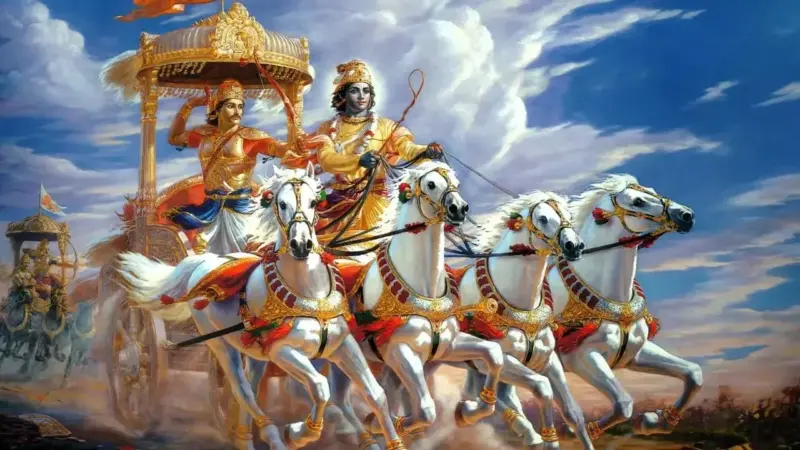
The Gita forms part of the Mahabharat, specifically within the Bhishma Parva, consisting of 18 chapters and 700 verses. It is a central text of the Prasthanatrayi, alongside the Upanishads and the Brahma Sutras. If the Upanishads are likened to a cow, the Gita is considered its milk. It synthesizes Vedanta, Samkhya, Yoga, Bhakti, and Karma into a unified philosophical vision. When a person is caught between duty and emotional attachment, the Gita offers balance, courage, and clarity.
The real question today is not whether the Gita should be taught. The question is whether a philosophical text should be rejected merely because it originates from Indian tradition. Some argue that if philosophy is to be taught, then texts like the Quran and the Bible should also be included. Indeed, comparative study is both possible and desirable. It does not constitute an attack on any religion. To label the Gita as escapist is factually incorrect, for its central message is not withdrawal from action but commitment to duty.
Arguments are also made about conflicts between Sanskrit and Tamil. Yet linguistic research shows extensive interaction between Sanskrit and Dravidian languages. Scholars like Thomas Burrow have highlighted this cultural exchange. To artificially construct linguistic conflict does not align with historical reality.
Modern psychology tells us that intellectual quotient alone is not sufficient for success. Emotional intelligence, social awareness, and resilience are equally important. The study of the Gita can help cultivate these dimensions, as it teaches self-discipline, equanimity, and responsibility.
Ultimately, the controversy around the Gita is less about the text and more about our mindset. We tend to view our own traditions either through blind devotion or deep suspicion-rarely with balance. The Gita should neither be turned into a political weapon nor confined within narrow boundaries. It is a philosophical dialogue-a response to the inner conflict of a human being standing on the battlefield of life.
Instead of manufacturing unnecessary disputes, the need of the hour is to place the Gita in an open space of study and dialogue. Those who revere it should understand it, and those who question it should read it. Knowledge does not create fear; ignorance does. Reading the Gita is not an imposition-it is an engagement with a living intellectual tradition.