




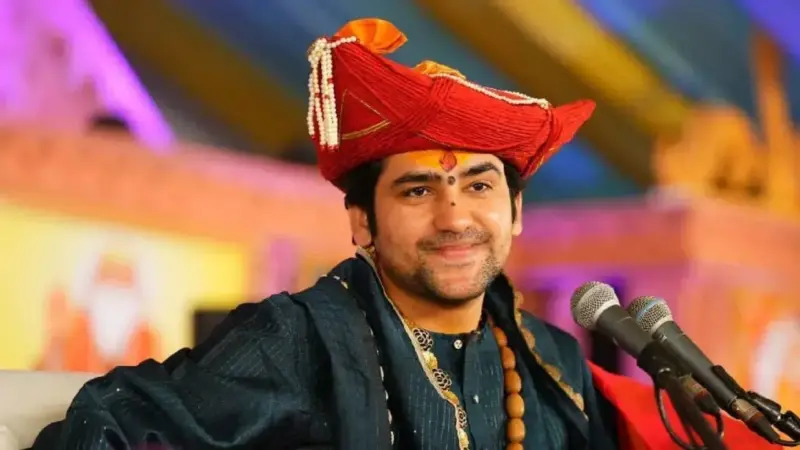

The identity of Bageshwar Dham was not shaped merely as that of an ancient religious site or a centre of devotion. Rather, its most discussed and distinctive axis came to be established in the form of the Divya Darbar.
This is the very centre where devotees do not come merely for दर्शन, but arrive carrying the sorrows of their lives, their crises, illnesses, mental anguish, family entanglements, and heartfelt wishes. Popular faith holds that through the grace of Balaji Sarkar, the पीठाधीश्वर, Acharya Pt. Shri Dhirendra Krishna Shastri, comes to know the devotee's problem without being told and then shows the path toward its resolution. It is for this reason that the Divya Darbar lifted Bageshwar Dham out of the limited circle of local devotion and turned it into a subject of national and international discussion.
To understand the tradition of the Divya Darbar is not merely to understand a miraculous religious practice. It is also to understand that guru-tradition, that popular faith, and that spiritual current whose roots are believed to lie in the sadhana of Sannyasi Baba, Dada Guruji, and in complete devotion to Balaji Sarkar. अर्जी, पेशी, pilgrimage on foot, the message of Hindu unity, religious storytelling and dharma-propagation across India and abroad, and the honours received at various platforms-all these elements together establish Bageshwar Dham as a contemporary religious-social centre where faith does not remain merely a personal experience, but assumes the form of collective consciousness and cultural energy.
Divya Darbar
At present, the Divya Darbar is conducted by Pt. Dhirendra Krishna Shastri ji. In the Divya Darbar, thousands and even lakhs of people sit together at one time. Devotees who have faith believe that Acharyashri can call any person from among those seated there and tell things related to that individual's life. It is widely believed that whoever comes to the Darbar with a question, Acharyashri writes down that person's problem and its solution on a slip even without being told anything.
This Divya Darbar has been held at many places in India and abroad. On witnessing the Divya Darbar, many journalists from India and overseas, people with a scientific outlook, and ordinary observers too have often expressed astonishment as to how one person can know the thoughts of another's mind. Acharyashri himself says, "If the Guru's grace is there, everything is possible."
Media from India and abroad has on many occasions gone to the Divya Darbar and tried in front of the camera to know its reality-how can a saint write someone's issue on a slip without asking anything? Acharyashri has many times, from open platforms, expressed this challenging faith that even if any one person from among a crowd of lakhs is made to stand up, the slip written beforehand will turn out to belong to that very person.
In the Divya Darbar, Acharyashri resolves people's problems before everyone. Whether someone comes saying that he suffers from an incurable disease, or prays for relief from some negative obstruction, devotees believe that through his Divya Darbar, Acharyashri assures them of a solution.
Where did the tradition of the Divya Darbar begin?
At Bageshwar Dham Sarkar, Sannyasi Baba is regarded as the first priest of the Bageshwar temple. According to popular tradition, he had attained the siddhis of Balaji Sarkar, which he used in public welfare and the good of the people. Through this, people's wishes were fulfilled and their sufferings were removed.
Later, Pt. Dhirendra Krishna Shastri ji's grandfather, who came to be known as Dada Guruji, was regarded as the inheritor of those same spiritual powers. Dada Guruji too began relieving people's problems and placing their petitions in the court of Balaji. It is said that Dada Guruji used to write people's problems on a slate without asking them. In a real sense, it may be said that Dada Guruji too deserves the credit for giving a systematic shape to the tradition of holding Darbar at Bageshwar Dham.
After the passing of Dada Guruji in the year 2010, that same spiritual tradition is believed to have reached Pt. Dhirendra Krishna Shastri ji. It is also mentioned that before Acharyashri, his uncle too was believed to have the grace of Balaji Sarkar, and he too would write people's problems on slips without asking them.
Pt. Dhirendra Krishna Shastri ji gave this Darbar tradition a wider form. In addition to Bageshwar Dham, wherever his kathas were held, he sought to address people's problems by conducting the Divya Darbar there as well.
What is an Arji?
Arji means that prayer, request, or heartfelt wish with which a devotee comes to the Dham, or through which he seeks the resolution of some problem from Balaji Sarkar. At Bageshwar Dham Sarkar, अर्जियाँ are offered for the solution of one's problems. Lakhs of people place their Arji here.
For example, if a person is suffering from a grave illness, if doctors have given up hope, or if he is going through some other personal, family, or mental crisis, then he places an Arji for good health, peace, or the resolution of his problem. In simple words, whatever a devotee asks from Bageshwar Dham, or whatever grace he seeks from Balaji Sarkar, that is called his Arji.
How is an Arji offered?
According to Acharyashri, an Arji can be offered in two ways-
- By reaching Bageshwar Dham
- From home
Ordinarily, lakhs of people come to Bageshwar Dham for the fulfillment of their wishes and, after the दर्शन of Balaji Sarkar, place their Arji before him there. Those who cannot go to the Dham may place their Arji from home as well.
Tuesday and Saturday are considered suitable days for placing an Arji. At Bageshwar Dham, for placing an Arji, a coconut wrapped in red cloth is offered at the Dham. If someone is placing an Arji from home, he must tie a coconut in red cloth and keep it at his place of worship, and then offer his Arji by chanting the mantra 'Om Bageshwaraya Namah' 108 times.
While placing the Arji, meditating upon Balaji Sarkar, one is to pray in this manner-
"O Lord of Bageshwar Dham! O Balaji! O Sannyasi Baba! O King of Kaliyug! Show your grace upon us, have mercy upon us, hear our Arji. We promise that for our entire life we shall remain connected to your feet, your Dham, and your Darbar. Hear our Arji. Victory to you."
After this, devotees bow mentally before Balaji.
It is believed that if the Arji is accepted, then for two consecutive days monkeys are seen in dreams. If any member of the family receives such a sign, it is taken as a sign that the Arji has been accepted. If this does not happen, then the Arji is placed again on the next Tuesday or Saturday.
What is Peshi?
Whatever Arji is placed before Bageshwar Dham Sarkar, for that the devotee also has to pray to Balaji Sarkar. Peshi in simple terms means going to the Dham, taking दर्शन of Balaji Sarkar, and humbly requesting the fulfillment of one's Arji.
Some people are required to make five Peshis, some 11, and some 21. There is also faith that for some devotees their wish is fulfilled in even 1 or 2 Peshis. Peshi means that on as many Tuesdays or Saturdays as required, one has to be present at the Dham that many times.
Purpose of the Yatra
The Sanatan Ekta Padyatra was organized by Pujya Gurudev from Bageshwar Dham to Orchha Nagari. The core purpose of this journey was not merely to move from one place to another, but to awaken a feeling of broad cultural unity by ending caste, hierarchy, and internal divisions within Hindu society.
In Acharyashri's words, Bharat is not merely a country enclosed by geographical boundaries, but a way of life and an idea that has internalized the spirit of Vasudhaiva Kutumbakam.
This journey was undertaken to erase the discrimination of caste from the soil of India. In his view, the poison of hierarchy and caste is weakening the land of Bharat like termites. India will progress only when an atmosphere of love, harmony, and equality is built in society.
All those born on the soil of Bharat should consider themselves children of Bharat Mata and unite for the progress of the nation-this was the central message of the journey.
Why did the idea of the journey arise?
According to Acharyashri, under present circumstances in India, Hindu society has become divided into caste, hierarchy, forward and backward classifications, and because of this, its collective strength has weakened.
His perspective is that many kinds of events-the insult of religious scriptures, atrocities against Hindu daughters, attacks on saints, and atrocities against Hindus abroad-point to the fact that a scattered society is in need of a wider unity.
In this context, he holds the view that Hindus should rise above caste divisions and unite. In his eyes, the strength of society lies in its cultural unity and self-respect.
Where all did the journey take place?
The Sanatan Ekta Yatra was a padyatra of approximately 158 kilometres from Bageshwar Dham to Shri Orchha Dham. In this journey, Pujya Gurudev passed through village after village along with fellow travellers, and while halting at different places for the night, addressed society through public gatherings.
This nine-day padyatra had around eight night halts. During the journey, guidance and support were received from various saints, social organizations, and respected individuals.
Acharyashri called for carrying along the backward and deprived sections, administering an oath for Hindu unity, and going from village to village awakening Sanatan consciousness through tilak.
After this padyatra, the idea was also expressed of a second journey from Delhi to Vrindavan Dham, a third from Lucknow to Ayodhya Dham, and a fourth from Bengaluru to Tirupati Balaji Dham.
The resolve of the journey
The essence of the resolves expressed through this journey was as follows-
We shall firmly follow the most ancient religious tradition in the world and the Sanatan Dharma of our ancestors. We shall work for Hindu unity in order to strengthen a Hindutva weakened by the poison of casteism. We shall remain devoted to all the deities of Sanatan Dharma. We shall make our children rational, dharma-abiding, and connected to the Vedic tradition. Every Tuesday and Saturday, we shall gather at temples and recite the Hanuman Chalisa. We shall preserve our reverence for the cow, the Ganga, Gauri, the Gita, the Gayatri, and the Guru.
The letter of Pujya Gurudev Bageshwar Dham Sarkar
The spirit of Pujya Gurudev's letter is that Bharat is not merely a nation, but a great cultural consciousness. According to him, the element that is weakening India the most in the present time is the poison of caste, hierarchy, untouchability, and discrimination.
He says that in this country there is neither any Dalit, nor any backward, nor any forward-we are all Hindus, and Hindustan belongs to all of us.
In this letter, Hindu society was called upon to unite in order to protect its traditions, culture, saints, sages, scriptures, and national identity. It was for this very purpose that he undertook the resolve of a 158-kilometre padyatra from 21 November to 29 November 2024-to end caste, hierarchy, and discrimination and to give the message of Hindu unity.
The central message of his letter is this-
Now is not the time to break, but to unite. Under the one Om flag, we must come together to protect nation, dharma, and culture.
Expansion in India and abroad
India
The renowned kathavachak of Bundelkhand, Pt. Dhirendra Krishna Shastri ji, who awakens the flame of Hindutva in India and the world, has been going to every corner of the country and propagating Sanatan Dharma through Bhagwat Katha, Ram Katha, Hanumant Katha, bhajan-kirtan, and the Divya Darbar.
Throughout the year, Acharyashri conducts kathas not only at Bageshwar Dham but also in many states across the country. From Assam to Gujarat, from Jammu and Kashmir to Tamil Nadu, and in major cities such as Delhi, Mumbai, Patna, Prayagraj, Nagpur, Raipur, Bhopal, Haridwar, Rishikesh, Kanpur, Bengaluru, Hyderabad, Chennai, Guwahati, and Pathankot, he has continued to go for religious propagation.
Abroad
Pujya Gurudev is also carrying the banner of Sanatan Dharma across the world. By visiting different countries, he seeks to make the Hindus living there aware of their culture, tradition, and security.
Australia visit
After celebrating his birth anniversary at Bageshwar Dham on 4 July, Acharyashri left for Australia on 6 July 2024. Programs of Shri Hanumant Katha, Divya Darbar, and Guru-Diksha were scheduled from 6 July to 17 July 2024 in Brisbane, Melbourne, and Sydney.
During this period, while he was narrating Katha in Melbourne, an invitation also came for Anant Ambani's Ashirwad ceremony. Acharyashri was initially unable to attend due to program commitments, but upon special insistence, he came to Mumbai in a private aircraft, attended the ceremony, and then returned again to Melbourne.
In Sydney too, through Katha and the teachings of Sanatan Dharma, he addressed the Indian community living there.
Fiji visit
After a program at Parmarth Niketan, Rishikesh, Acharyashri went to Fiji. From 29 July to 31 July 2024, a three-day program had been proposed for him in Nadi city, Fiji.
Upon reaching Fiji, he first visited and worshipped at the Murugan Swami temple. Thereafter, when he arrived at the Katha venue, he was welcomed by Fiji's Deputy Prime Minister Viliame Gavoka and by the President and Member of Parliament of the World Sanatan Organisation, Parveen Bala.
In Fiji, Shri Hanumant Katha commenced with the national anthems of both countries. Thereafter, through Katha, Divya Darbar, and Annapurna Seva, the message reached thousands of people.
New Zealand visit
After Fiji, Acharyashri went to New Zealand. At The Trusts Arena in Auckland, from 3 August to 5 August 2024, Shri Hanumant Katha, kirtan, Hanuman Chalisa, and the Divya Darbar were organized.
Other foreign visits
Acharyashri also made visits in 2022 to London, in 2023 to Nepal, Dubai, and London, and in 2024 to Nepal, Dubai, and London. The purpose of these visits was stated to be to unite Hindus living abroad and to connect them with Sanatan Dharma.
Honours
The popularity of Bageshwar Maharaj is not confined to India alone, but extends across many countries of the world. His followers exist in large numbers not only within India, but abroad as well.
In the year 2022, Bageshwar Maharaj had gone on a visit to London. There too he held the Divya Darbar, which was widely seen. He heard people's problems and presented solutions.
During this visit, when he was advised by the English to learn English, he replied with gentle satire and self-respect that if we learn English, we shall be coloured in your shade, so you learn Hindi.
Pt. Dhirendra Krishna Shastri was honoured in the Parliament of England. It is mentioned that in the British Parliament he was decorated with honours such as Sant Shiromani, World Book of London, and World Book of Europe.
It is said that during his presence in the Parliament of England, slogans of Jai Shri Ram were also raised. This honour is said to have been conferred in connection with the works of human service being carried out at Bageshwar Dham.
It is noteworthy that Bageshwar Peethadhishwar Pt. Dhirendra Krishna Shastri is counted today among those saints in the country whom crores of people listen to and follow. He has been honoured by many religious organizations in India and around the world. Today, the popularity of Bageshwar Dham Sarkar remains a subject of wide public support and discussion.
(Courtesy: the book Ek Sadhak Ki Gatha.)