
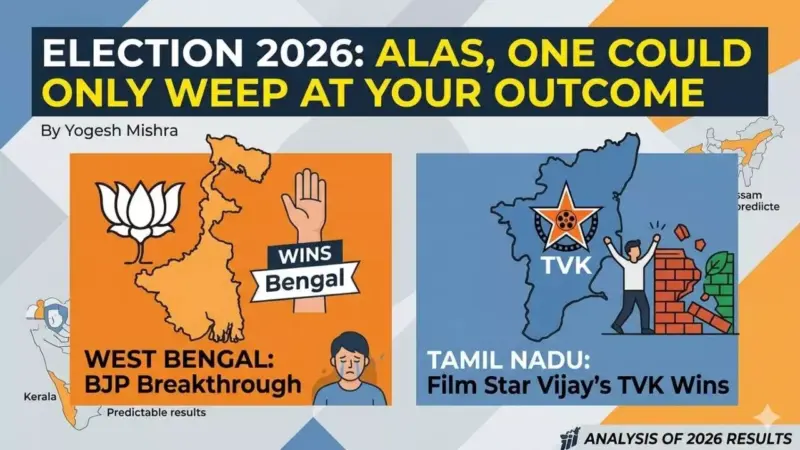

The assembly elections in five states ended in a manner that was partly expected and partly astonishing. If we recall recent state elections, it becomes clear that none had generated the kind of hype that this one did especially the election in West Bengal.
Assam never produced any real suspense from beginning to end. It was rather like a long-time girlfriend or live-in partner finally becoming one's wife there is hardly any thrill left because the outcome is already known.
Puducherry, too, was never going to create much excitement. Many people in the country may not even know that it is also a state-like political unit, let alone know the name of its Chief Minister or major political party.
That leaves three states Kerala, Tamil Nadu and West Bengal. Kerala, too, looked fairly predictable. There, power usually alternates between the UDF and the LDF, though this had not happened for two terms. So it was expected that this time Pinarayi Vijayan's exit was almost certain.
Tamil Nadu's Political Earthquake

The most dramatic change was seen in Tamil Nadu. Politics there has long moved between two Dravidian poles, much like Kerala alternates between the Left and non-Left fronts. In Tamil Nadu, the DMK and AIADMK have been the two principal players. From MGR to Jayalalithaa and from Karunanidhi to Stalin, politics continued to revolve around the Dravidian model. Although the AIADMK weakened with time, the DMK's fortress remained standing. This time, however, that fortress collapsed. The victory went to film star Vijay's party, TVK.
It would not be correct to call Vijay's victory a fluke, because he successfully converted his massive fan base into an effective cadre. That gave him an advantage, of course, but the bigger factor was that first-time voters the youth preferred to bet on a new player instead of the old DMK-AIADMK model. This is why Tamil Nadu's time-tested formula of distributing fridges, televisions and similar freebies for votes did not work this time.
BJP's Historic Entry Into Bengal
Now we come to the most fascinating battle West Bengal. This was an election whose outcome was somewhat expected, but never certain. BJP turned Bengal into a battle of prestige. The political maneuvering in this battle was one thing, but this was also the first election in which the electoral system itself underwent a major cleansing from the voter list to the security framework.
The people have given their verdict, and for the first time BJP has entered power in Bengal.
What happens in Bengal affects the entire country. The British entered India through Bengal. The Battle of Plassey was fought in Bengal, and it ultimately led to British rule. It was in Bengal that the communist foundation was laid, flourished and eventually collapsed. Bengal was also home to a major pillar of the present opposition, and that pillar has now fallen.
From Bengal, a new stream of national politics will now begin. The second pillar of the anti-BJP camp Stalin has also fallen. The Mamata era, too, has set. Now, more than the ruling side, that is BJP, attention will remain fixed on the fate of the opposition.
Changing Voter Mindset in India
If one looks at this entire electoral landscape, it becomes clear that Indian politics has now reached a decisive turning point. The voter no longer wants to remain tied only to tradition or established parties. Instead, the voter appears ready to test alternatives and give new faces a chance. This change has not come suddenly. Over the past decade or decade and a half, social, economic and technological transformations have together influenced the mindset of the electorate.
The rising participation of the youth is the biggest sign of this shift. Today's young voter is not voting merely on the basis of caste, religion or regional sentiment. He wants politics that speaks of employment, education, health and opportunities. That is why, wherever he felt that traditional parties were failing to meet his expectations, he turned toward new alternatives. Tamil Nadu is the latest example, where a decades-old political structure faced a serious challenge.
How Election Campaigns Have Changed
Election strategies have also changed significantly. Earlier, campaigns were largely limited to rallies and posters. Now social media, digital campaigns and micro-management have begun shaping electoral outcomes. Parties are trying to reach every voter and understand individual priorities. This has made elections more competitive and unpredictable.
The Bengal results also indicate that national parties are now penetrating deeply into regional politics. This trend may intensify in the coming years, creating an existential crisis for regional parties. On the other hand, it is also possible that regional parties reorganize themselves and present a stronger alternative politics.
These elections have settled one more issue the role of religion as a factor in political change. Governance has its place. Freebies have their place. Welfare schemes have their place. But religion, too, has now become a factor.
The results have made it clear that in Indian democracy, the voter is now evaluating religion as well. It has become such a factor that no party can assume its victory is guaranteed. Every election is a new test, and every time, the public mood can change. In the coming years, politics is likely to become even more dynamic, uncertain and interesting.