




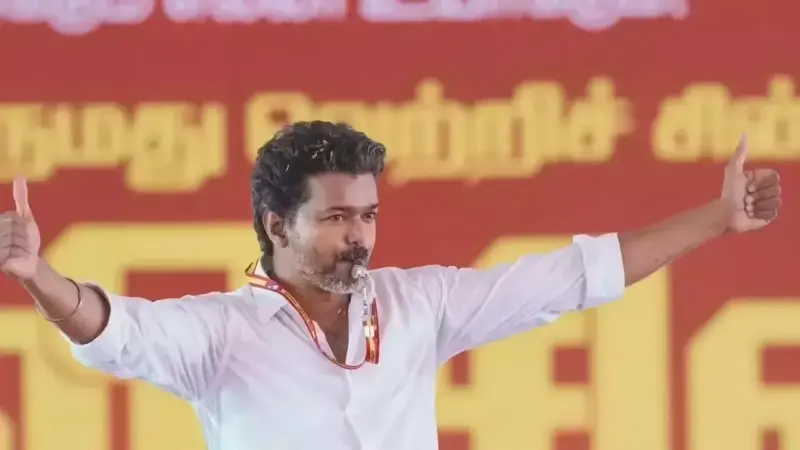

The rise of Tamilaga Vettri Kazhagam (TVK) in Tamil Nadu politics is not an overnight phenomenon. It is the outcome of a long, silent, and carefully planned journey.
At its center stands Vijay an actor, a mass icon, but more importantly, a figure who gradually shaped himself into a socio-political alternative.
Vijay's story begins with fan clubs. But these were not ordinary fan associations. They evolved into a disciplined and structured network spread across Tamil Nadu. Since the 1990s, this network has been steadily built. What began as cinematic admiration slowly transformed into organized social engagement blood donation camps, welfare activities for the poor, and disaster relief efforts. These initiatives created trust and built social capital. That very capital later became the foundation of a political base.
Vijay never allowed this network to weaken. He continuously nurtured it through engagement, periodic interaction, and structured events. It was a form of silent organization-building largely invisible, yet steadily strengthening. This is why, when TVK was formally launched, the party did not struggle for grassroots workers something most new political parties face as their biggest hurdle.
His political entry, too, was not impulsive. Vijay spent years observing Tamil Nadu's political landscape the dominance of Dravida Munnetra Kazhagam (DMK) and All India Anna Dravida Munnetra Kazhagam (AIADMK), the patterns of competition, and the evolving mindset of voters. While stability existed, there was also visible fatigue especially among the youth. A desire for a new political alternative was emerging. Vijay recognized this vacuum.
This shift was also reflected in his films. His characters gradually moved beyond entertainment. They began confronting systemic corruption, representing the common man, and challenging authority. Films like Sarkar carried powerful political undertones. One of its iconic lines "I may be alone, but if truth is on my side, that is enough" resonated beyond cinema. It became a signal of intent.
Similarly, Mersal questioned systemic issues in healthcare and governance, while Master portrayed resistance against flawed systems. Through these narratives, Vijay carefully shaped his image as someone willing to stand against injustice. It was, in effect, a gradual psychological preparation of the audience for his political transition.
Rather than entering politics abruptly, Vijay built the ground first. He engaged with students, honored academic achievers, and participated in small yet meaningful public interactions. These initiatives may have seemed modest, but their strategic depth was significant. They established a direct connection with young voters the future electorate.
When 2024 arrived, it marked a decisive moment. Vijay formally announced the formation of Tamilaga Vettri Kazhagam. This was not just the launch of a political party it was the public culmination of years of groundwork. It was the moment when a film star transformed into a full-fledged political figure.
The structure of the party reflected his unconventional approach. Instead of relying heavily on established political leaders, Vijay leaned on his existing grassroots network. Fan clubs were converted into political cadres. District-level structures were created. Local workers were activated. It was a classic bottom-up political model and that became its core strength.
Perhaps the most strategic decision was patience. Vijay chose not to contest the 2024 Lok Sabha elections. This sent a strong signal he was not in a hurry. He was playing a long game. Organization first, elections later. This approach clearly distinguishes TVK from many newly formed political outfits that rush into electoral battles without groundwork.
Another crucial aspect of this journey is the behind-the-scenes preparation. Fan clubs had already been interacting with local communities, understanding issues, and informally gathering ground-level insights. When the party was officially formed, this groundwork immediately translated into operational strength. This is why TVK entered the political space with a ready grassroots presence.
Vijay's political positioning is also noteworthy. He does not confine himself to opposing a single party. Instead, he questions the system as a whole. This broader, anti-establishment stance gives him a wider appeal especially among younger voters who seek systemic change rather than partisan alignment.
Tamil Nadu has a long history of cinema influencing politics. Leaders like M. G. Ramachandran and J. Jayalalithaa are prime examples. Vijay has clearly studied this legacy but adapted it for a new era. By integrating social media, digital outreach, and youth engagement, he has crafted a modern version of that model.
An interesting dimension of his journey is restraint. Despite repeated calls from fans to enter politics earlier, Vijay consistently waited. He chose timing carefully. That patience now appears to be one of the strongest pillars of his strategy.
His decision also involves significant personal risk. Leaving behind a highly successful film career and established stardom to enter politics is not an easy move. It reflects that this is not an experiment for him it is a serious, long-term political commitment.
In essence, TVK is not a spontaneous political creation. It is a carefully built, ground-connected political project. It combines emotional connect, organizational depth, strategic timing, and a widely accepted public face.
That is precisely why Tamil Nadu's political ecosystem is not taking it lightly. TVK represents not just a new party but a new possibility, a new direction, and potentially, a significant political shift.