
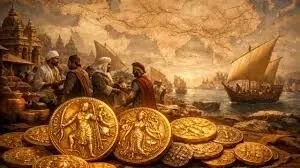

The story of the Indian Rupee is not merely the story of a currency. It is a reflection of India's economic, political, and cultural journey.
The rupee we hold today is the result of thousands of years of evolution. This journey has seen many ups and downs-different rulers, changing systems, shifting materials, evolving shapes, the arrival of paper, and now digital payments. Yet one constant has remained-the need for exchange, the necessity of trade, and the search for trust.
Let us begin with ancient India. The word "rupee" did not exist then, but the concept of currency did. Around the 6th century BCE, punch-marked coins came into use. These were small pieces of silver, irregular in shape, stamped with various symbols. Each symbol could represent a kingdom, authority, or ruling entity. This was the Mahajanapada period, when trade was expanding and the need for a standardized medium of exchange was increasingly felt. These coins were also known as Karshapana, marking India's first organized monetary system.
At that time, the value of currency was determined largely by the metal itself. The purer the metal, the higher the value. This system was simple but limited. Every transaction depended on weight and purity. Still, it was a major advancement, as it reduced the complexities of barter and accelerated trade.
With the Mauryan Empire, the monetary system became more regulated. The use of Karshapana continued, but state control increased. Coin minting came under official supervision, and standards of weight and purity were enforced. Texts like Kautilya's Arthashastra provide detailed insights into currency, taxation, and economic governance. Currency was no longer just a trade tool-it became an instrument of governance.
After the Mauryas, during the Shunga, Kushan, and Gupta periods, coinage evolved further. The Kushans issued gold coins in large quantities, known as Dinars, featuring rulers and deities. The Gupta period is often called the golden age of coinage, known for its artistic excellence and purity. Silver and copper coins also circulated widely.
During the medieval period, under the Delhi Sultanate, new coin systems emerged-Tanka (silver) and Jital (copper). However, the lack of uniformity persisted, as each ruler issued their own coins. This made the need for a standardized currency even more evident.
The true identity of the Indian Rupee emerged in the 16th century under Sher Shah Suri. He introduced a standardized silver coin called the Rupiya, weighing approximately 11.66 grams. This was not just a coin-it was a stable economic idea. It simplified trade, streamlined taxation, and built trust across a large territory.
This system was so effective that the Mughals adopted and expanded it. Under Akbar, the currency system became more structured with gold Mohur, silver Rupee, and copper Dam. This three-tier system catered to all levels of transactions. Coins carried inscriptions of rulers, mint locations, and cultural elements, establishing the rupee as a dominant and stable currency.
The colonial period brought further standardization. When the East India Company established control, it aimed to unify the fragmented currency system. In 1835, a uniform coinage system was introduced, featuring the British monarch's image. This marked a major step toward modern currency systems.
Paper currency also emerged during this period. Initially issued by private banks, the system was later centralized. The Paper Currency Act of 1861 gave the government sole authority to issue notes. Currency was no longer just metal-paper became a trusted representation of value.
A major turning point came in 1935 with the establishment of the Reserve Bank of India. Currency management became more structured, and note issuance was centralized, bringing stability and clarity to monetary policy.
After independence in 1947, India took full control of its currency. In 1950, new notes were issued, replacing the British monarch with the Ashoka Pillar. This was not just a design change-it was a shift in identity. The rupee was now fully Indian.
In 1957, India adopted the decimal system. Earlier, one rupee equaled 16 annas, making calculations complex. With decimalization, one rupee became 100 paise, simplifying transactions for the masses.
Over time, coins evolved in material-from copper to aluminum, nickel, and stainless steel. Lower denomination coins gradually disappeared due to inflation and reduced purchasing power. This was a silent transformation in monetary history.
Indian banknotes also underwent continuous evolution. The Mahatma Gandhi series introduced a strong national identity. Security features such as watermark, security thread, micro-lettering, see-through register, color-shifting ink, and raised printing were added to combat counterfeiting and aid identification.
Identifying genuine notes became easier-look, touch, and check against light. Features like watermark, security thread, and color-changing numerals became key indicators.
Demonetization has also been a significant chapter. In 1946 and 1978, high-value notes were withdrawn to curb black money. However, the most impactful demonetization occurred in 2016, when ₹500 and ₹1000 notes were invalidated, affecting 86% of the currency in circulation. This move aimed to tackle black money, counterfeit currency, and promote digital payments.
New ₹500 and ₹2000 notes were introduced, though ₹2000 notes were later withdrawn from circulation starting in 2023, marking another shift toward practical currency management.
Today, the rupee is no longer confined to physical form. With UPI, mobile wallets, and online banking-driven by the National Payments Corporation of India-digital payments have become mainstream. Transactions now occur within seconds.
Looking ahead, the concept of Digital Rupee or Central Bank Digital Currency (CBDC) is emerging. Issued by the Reserve Bank, it represents the future of currency-complementing physical money while enhancing efficiency and transparency.
Thus, the journey of the Indian rupee began with punch-marked silver coins, gained identity under Sher Shah Suri, expanded under the Mughals, was standardized by the British, and redefined by independent India. Decimalization simplified it, security features strengthened it, demonetization reshaped it, and digital transformation reimagined it.
The rupee is not just money. It is history. It is power. It is trade. It is trust. Every note carries not just value, but the imprint of a nation's journey, identity, and belief.