
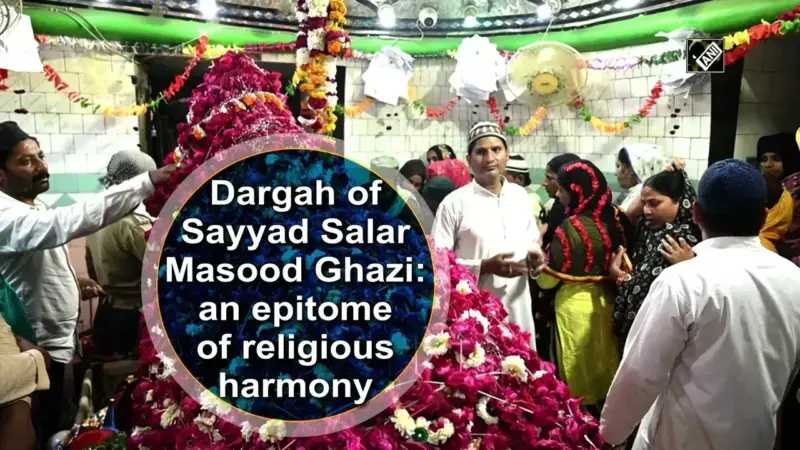

Bahraich Uttar Pradesh, there is the shrine of Salar Masood. Salar Masood is said to be the nephew of Mahmud of Ghazni. It is also believed that he had some miraculous powers.
Due to this, an annual Urs (religious fair) is held at his shrine. Fairs in his honor are also held in Varanasi, Sambhal, and Moradabad, known as the "Neza Mela." These fairs are now the subject of controversy, and the Neza Mela in Sambhal has even been banned. The title "Ghazi" is attached to the name of Salar Masood. Let's understand what the term "Ghazi" means.
"Ghazi" is actually an Arabic word. A "Ghazi" refers to a person who participates in a "ghazwa," which means a military expedition or raid. The term was given to someone who conducted military campaigns against non-Muslims. It is used for warriors who have pledged to fight against non-Muslims. According to the Encyclopedia of the Middle East, the word "Ghazi" was used to refer to several types of warriors or individuals:
A general term for any Islamic warrior.
A type of border guerrilla, Islamic knight, or mercenary soldier, used by the Arabs and later the Ottoman Empire to raid enemy territories and expand Islamic rule by attacking and bringing them under Islamic control.
According to the Cambridge History of Islam, it was considered a religious duty for Ghazis to destroy and subjugate countries that opposed Islam. Ghazis generally lived by plundering and could be rewarded with a land grant as a form of payment for their services.
In some cases, the title was similar to the use of pirates and mercenaries in 16th and 17th-century Europe. However, while European raiders and mercenaries were eventually seen as a threat and their use abandoned, the Gazi tradition was institutionalized in Muslim culture due to its religious significance, much like how Christian warriors were honored with the title "Crusader."
The title of "Ghazi" was an honor in the early days of the Ottoman Empire, which originated in Turkey. In a 1337 inscription, the second ruler of the Ottoman dynasty, Orhan, referred to himself as "Sultan, son of the Sultan of Ghazis, son of Ghazi... ruler of the horizon." Ottoman poet Ahmedi defined Ghazi around 1402 as "the sword of God."
Historical Context
The term ghazi originated during the early Islamic era, particularly after the rise of Islam in the 7th century. In the initial years of Islamic expansion, the term referred to Muslim warriors who fought against non-Muslim forces during the early Islamic conquests. These wars of expansion were often justified as a form of jihad (struggle in the path of God), though it's important to note that the concept of jihad is broader than just warfare, encompassing spiritual and moral struggles.
Ottoman Empire
The ghazi title became particularly significant during the rise of the Ottoman Empire in the late 13th and early 14th centuries. The Ottomans used the term to describe their warrior class, especially those who led military campaigns to expand Ottoman territory into the Balkans, Anatolia, and parts of Eastern Europe. The early Ottoman sultans, like Osman I (the founder of the Ottoman Empire), were often referred to as ghazis. They used the ghazi title to project the image of the Ottomans as the defenders of Islam, battling the Christian Byzantine Empire and other European powers. Ghazi warriors were highly respected in Ottoman society, and their efforts in war were glorified in literature, songs, and oral traditions.
The Role of Ghazis in the Empire
Ghazis were not just warriors; they were also often seen as spiritual figures, embodying the Islamic ideal of defending the faith and engaging in righteous warfare. They were considered defenders of Islam, and their role was not just to fight but also to establish Islamic rule in conquered territories.
The ghazis in the Ottoman Empire played a central role in the empire's early military successes, and their presence helped solidify Ottoman control over vast regions. As the empire expanded, the ghazi role became more symbolic, but it remained an important part of Ottoman identity.
Ghazis and the Crusades
In the context of the Crusades (11th-15th centuries), ghazis were often positioned as Muslim counterparts to the Christian knights fighting in the Holy Land. While the Christian knights of the Crusades sought to capture Jerusalem and defend Christendom, the ghazis were seen as Muslim warriors who sought to protect Islamic territories and holy sites, including Mecca and Medina, from Christian or other non-Muslim threats. This concept of a holy war against external invaders contributed to the rise of a distinct identity for ghazi warriors, who were viewed not just as soldiers but also as symbols of religious duty.
Over time, the term ghazi became more symbolic. It came to represent a hero, someone fighting for a higher cause, even if the actual warfare became less frequent. The ghazi was seen as a warrior who was willing to sacrifice everything, including their life, in the service of God and the Islamic community. The image of the ghazi is still invoked in some parts of the Muslim world today to symbolize those who defend Islam, whether in battle or through ideological struggles.