
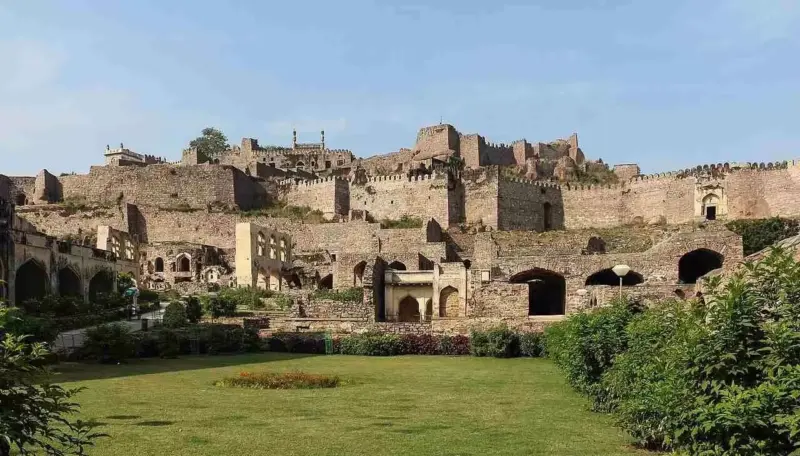

'Golconda Fort': A Multi-Layered Stronghold of Sound, Diamonds, and Deccani Power Yogesh Mishra To understand Golconda Fort is not merely to understand a single architectural structure.
It is to comprehend an entire system where power does not rely solely on military strength, but is sustained through a combination of trade, technology, resources, and knowledge. Located near present-day Hyderabad, this fort represents that Deccani world where a fort was not just a defensive structure-it was a system, a mechanism in which every wall, every pathway, every sound, and every resource had a defined purpose.
The geography of Golconda is its first and most powerful advantage. It is not a single-walled fort, but a multi-layered hill complex, whose defensive layers rise from the outer ramparts at the base to the uppermost citadel known as Bala Hissar. This elevation was not meant for visual dominance alone-it was for control. From the top, not only could enemy movements be monitored, but the economic and strategic activity of the entire surrounding region could also be regulated.
The journey from the base to the summit itself was a test-long winding paths, multiple gateways, and successive defensive layers ensured that any advancing force would be gradually weakened. Thus, the geography of Golconda itself becomes its first soldier. The origins of Golconda were modest. During the Kakatiya period, it was merely a mud fort-a limited defensive outpost sufficient for local control. However, in the 16th century, with the rise of the Qutb Shahi dynasty, the fort underwent a profound transformation. The mud structures were replaced with stone, the ramparts were expanded, and what was once a simple stronghold evolved into a fortress of international significance.
At this point, Golconda ceased to be merely a fort-it became a capital, an economic hub, and a symbol of a power deeply integrated into global trade networks. Its construction cannot be confined to a single period. It evolved over decades, with each ruler contributing to its development. Some strengthened the outer defenses, others expanded the inner palaces, while still others enhanced water systems or established it as a commercial center. Golconda, therefore, is a layer-by-layer fort, where each layer represents a new era, and each era introduces a new strategy. One of Golconda's most remarkable features is its acoustic system, which elevates it beyond architecture into the realm of science.
If a person claps at the main gateway, the sound travels clearly to the Bala Hissar at the top-hundreds of meters away. This is not accidental; it is the result of precise calculations of sound reflection, angles, and surface design. This system was an integral part of security-ensuring that any movement at the base could be immediately communicated to the top.
In this way, Golconda did not rely solely on walls and elevation; it incorporated sound itself as a defensive tool. This stands as an extraordinary example of technological sophistication for its time. The fort's defensive system is multi-layered and meticulously planned. The outer walls extend over several kilometers, enclosing successive inner layers, culminating in the citadel at the top.
This design ensured that an enemy would face a new challenge at every stage. Even if the first wall was breached, the second would resist, then the third-and at each level, the attacking force would lose strength. This was not merely defense; it was an attrition strategy, aimed at gradually exhausting the enemy. Golconda's economic significance sets it apart from most other forts. It was not merely a military stronghold-it was a center of diamond trade. Some of the world's most famous diamonds-including those associated with the Koh-i-Noor-are believed to have originated from this region. This indicates that Golconda's power was not based solely on military might, but also on wealth.
Trade was controlled from here, wealth was generated here, and that wealth, in turn, sustained the fort's defense, expansion, and grandeur. Golconda thus belongs to that rare category where military and economic power reinforce each other. Life within the fort was highly organized and self-sufficient. It contained royal palaces, barracks for soldiers, granaries, and advanced water systems. Supplying water to such a high elevation was a major challenge, but this was overcome through a combination of slopes, channels, and mechanical systems. Rainwater harvesting and distribution systems were designed to ensure that the fort could withstand prolonged sieges.
This demonstrates that Golconda was not built merely for war, but for long-term survival. The most decisive moment in its history came in 1687, when Emperor Aurangzeb laid siege to the fort. The siege was long and arduous. The Mughal army possessed both resources and power, yet the fort's structure proved too strong to be overcome through direct assault. Ultimately, Golconda did not fall to military force-but to betrayal. A gate was opened from within, allowing Mughal forces to enter.
This episode carries a profound historical message-that even the most complex and formidable structures can collapse due to internal weakness. After the Mughal conquest, Golconda gradually declined in importance, especially as Hyderabad emerged as a new political and urban center. The fort receded into the background. Yet, its structure and its story remain alive. Its walls, pathways, and acoustic marvels continue to testify to a time when Deccani power stood at its peak.
If Golconda Fort were to be understood in a single sentence, it can be said that it is a place where power extended beyond walls to integrate science, trade, and strategy into a unified system. Here, stones are not merely structures-they are ideas. And it is these ideas that make Golconda one of the most complex, advanced, and influential forts in India.