





Oxford (UK), June 10 (IANS): Nearly a century and a half after Oxford scholar Max Muller introduced the Ishavasya Upanishad to Western audiences through the first volume of the Sacred Books of the East series, an Indian philosopher has arrived at the same university to restore the text to its living meaning.
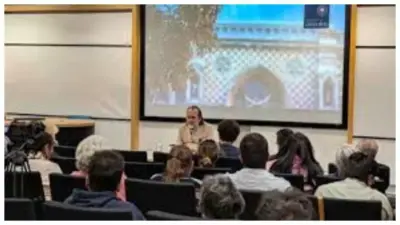
Muller, Oxford's first Professor of Comparative Philology, published the first English translation of the Ishavasya Upanishad in 1879 through Oxford University Press, overseeing the entire Sacred Books of the East series. On June 8, at the lecture theatre in Oxford University's Manor Road Building, Acharya Prashant delivered a detailed philosophical session on the second verse of the Isha Upanishad.
Earlier that day, Oxford students took Acharya Prashant on an extensive tour of the campus, visiting the historic New College and Somerville College, among several other sites.
Standing before the Oxford University Press building, he told IANS: "Max Muller did a remarkable job in bringing this text to the West. But words have to be brought to life, and life is this moment. I have come to set out the relevance the Upanishad holds for the world as it is today."
The Manor Road Building, which houses Oxford University's Department of Economics and has hosted Nobel laureates and leading global thinkers through the prestigious Atkinson Memorial Lecture, became the setting for a session that drew a varied audience of Oxford students and research scholars from the UK, Europe and the United States.
In the very building where economics and policy are taught, Acharya Prashant argued from the standpoint of Vedanta that economics, technology and policy alone cannot resolve the crisis until the consuming individual turns to examine the self.
Speaking to the media, he framed his message as a broad warning. The West, he said, has achieved extraordinary things in the external world, from exploring the universe to splitting the atom to uncovering the secrets of the body. Yet humanity now finds itself in the midst of the sixth mass extinction, a crisis entirely of its own making. Without self-knowledge and a mass-based education of the self, he argued, the prospect of any redemption is slim, whether in addressing the environmental crisis, sectarianism, international divisions, the threat of nuclear war or the mental health epidemic.
The session's central question was: "Who is the actor?" Acharya Prashant said the Upanishads are concerned less with the action than with the actor who stands behind every thought, action and experience.
Distinguishing vidya and avidya, he said humanity already holds an abundance of knowledge of the external, observable world, and that this should continue advancing, but that the task of knowing the knower remains unfinished. "The ego is not merely the sufferer; it is suffering itself," he said. No action, he added, is good or bad in itself; what makes it binding or liberating is the consciousness from which it springs.
He also said that the fear of death belongs not to the body but to the ego, since it is the ego that dreads the dissolution of its own existence. He compared the ego to a coloniser that keeps the body alive not out of love but out of self-interest. True freedom, he said, lies not in the ego gaining more choices but in release from its compulsions.
"The body is a fact; the ego is an error," he observed, adding that "the finest deeds happen in the absence of the ego."
Acharya Prashant called the teaching of Vedanta at Oxford by an Indian a meaningful turn. The knowledge of Vedanta, he said, was never secret, and the qualification for it rests not on birth or caste but on merit-based attributes. The tradition the West once studied from the outside as an object of inquiry is now being presented from within its own living lineage.
The Oxford session is one stop on Acharya Prashant's broader UK tour. On May 30, he delivered his philosophy at the Cambridge Union in a session held under the Cambridge India Business Dialogue, chaired by Professor Jaideep Prabhu of Cambridge Judge Business School. On June 1, in a dialogue hosted by NISAU UK, he spoke with Lord Krish Raval, a member of the UK House of Lords, on the inner dimensions of the climate and environmental crisis. On June 6 and 7, he participated in the fourth Kathmandu Kalinga Literary Festival.
Across all these platforms, his central argument has remained consistent: that Western climate policy is proving inadequate because it leaves the consuming ego unexamined. "Outwardly, we are more prosperous and powerful than at any point in history. Inwardly, we are still cavemen," he said.
In the coming weeks, Acharya Prashant will hold sessions at the London School of Economics and King's College London. He is also due to participate in London Climate Action Week, running from June 20 to 28, the largest independent climate gathering in Europe.
Acharya Prashant, founder of the PrashantAdvait Foundation and author of Truth Without Apology (HarperCollins), told IANS at Oxford: "The university is a place of logic, analysis and intellectual rigour, and Vedanta asks for those same tools to be turned inward. The only difference is that when you apply these tools to yourself, resistance arises from within, because there the seer becomes the seen. That is where inner honesty becomes as essential as outer honesty. You can be anyone and still be a fine scientist, but you cannot be just anyone and be a good human being."