
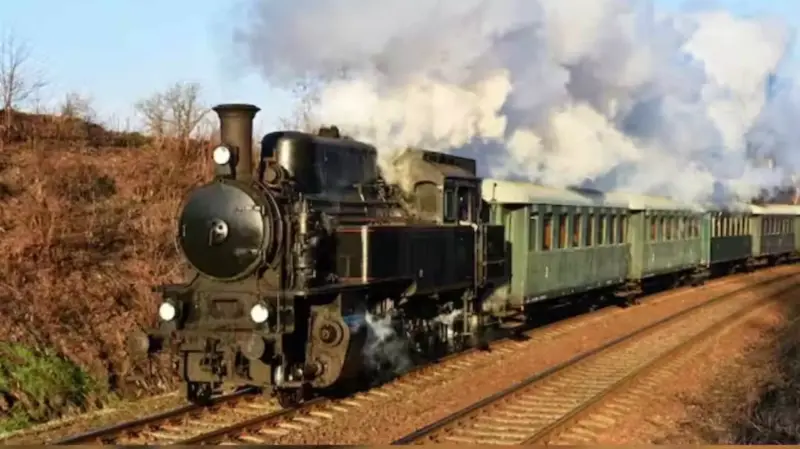

India's first electric train: India's railway network is very close to complete electrification, but the journey began a century ago with a modest suburban line in Mumbai.
From the first electric train in 1925 to achieving nearly 99% electrification of broad gauge routes by 2026, Indian Railways has undergone a massive technological transformation. This shift has not only improved speed and efficiency but also reduced fuel dependency and emissions. Here is a detailed look at the key milestones, routes, and turning points that shaped India's electric rail network-one of the largest in the world today.
India's first electric train
India's electric train journey began on February 3, 1925, when the first electric train ran between Bombay VT (now Chhatrapati Shivaji Maharaj Terminus) and Kurla Harbour. It was operated by the Great Indian Peninsula Railway and used a 1500V DC system, marking the start of suburban electric train services in India.
Why electrification started early
Railway electrification in India began mainly due to practical problems, not just modernisation. It was difficult to run steam engines on the steep slopes of the Western Ghats. Switching to electric trains made operations smoother and more reliable, which expanded electrified routes to places like Igatpuri and Pune.
Expansion in major cities (1928-1931
Following its initial success, electric traction expanded rapidly across major urban routes. In 1928, the Colaba to Borivili section under Western Railway was electrified, followed by the Madras Beach to Tambaram line in 1931. By the time India gained Independence, a total of 388 km of railway lines had been electrified.
Post-Independence push (1950s)
After Independence, railway electrification became a key infrastructure priority under national planning. The Howrah-Burdwan section was electrified by 1958 using a 3000V DC system. This project marked one of the earliest large-scale electrification efforts under India's Five-Year Plans, aimed at boosting capacity and efficiency.
The big shift to 25 kV AC (1957)
In 1957, Indian Railways made a landmark decision to adopt the 25 kV AC traction system as the national standard. Influenced by successful trials in Europe, particularly by French Railways (SNCF), this system proved more economical and suitable for long-distance operations compared to the earlier DC systems
First AC electrified route (1960)
The first railway section in India to be electrified using the 25 kV AC system was the Raj Kharswan-Dongoposi route in 1960 under South Eastern Railway. This marked the beginning of a nationwide transition, with older DC routes such as Howrah-Burdwan later converted to AC by 1968.
Indigenous locomotive production begins
India took a major step towards self-reliance by starting domestic production of electric locomotives at Chittaranjan Locomotive Works in 1960. The first 1500V DC electric locomotive for the Bombay region was flagged off in 1961, laying the foundation for indigenous manufacturing and technological advancement in railways.
Over 69,000 km of route
Railway electrification has accelerated significantly over the past decade, driven by the government's push for full network electrification. By 2026, around 69,000 route kilometres-nearly 99% of the broad gauge network have been electrified, with over 41,655 km added in just ten years, improving efficiency and sustainability.