
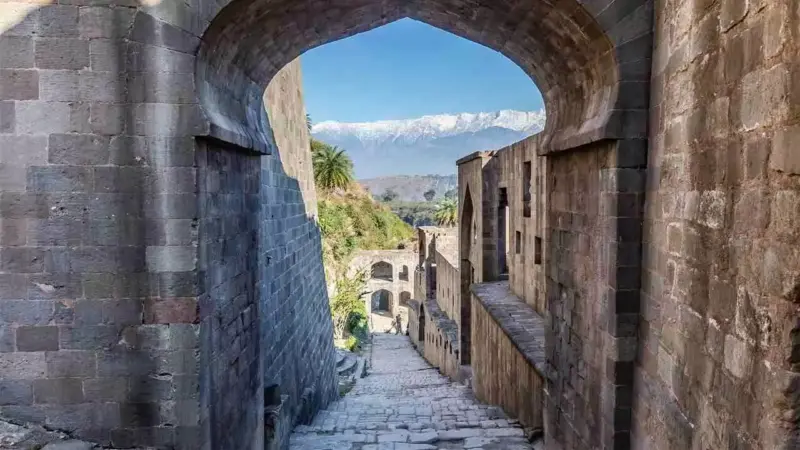

To understand 'Kangra Fort' is to understand one of India's oldest living traditions of fortification. It is not merely a fort-it is history layered over time.
Situated in Kangra, Himachal Pradesh, this fortress stands on a natural outcrop near the confluence of the 'Banganga' and 'Manjhi' rivers. The location is beautiful, but more importantly, it is strategic. On three sides, there are steep slopes. Below, water flows. Above, walls rise. The implication is clear-the fort is protected less by its walls and more by its geography.
The 'Archaeological Survey of India' regards Kangra Fort as an 'ancient hill fort complex'. Its structure was not created through a single unified plan. It evolved over time. It contains walls from different eras, gates from different periods, and temples belonging to different ages. This means that the fort is a 'multi-layered heritage site', where each layer narrates the story of a distinct era.
There are multiple traditions regarding the origin of Kangra Fort. It is often linked to the ancient 'Trigarta' kingdom. According to tradition, 'King Susharma Chandra' is regarded as its earliest builder, a figure associated with the epic tradition of the Mahabharata. While direct archaeological evidence for this remains limited, it is undisputed that this fort is among the oldest continuously used fortifications in India.
The real historical development of Kangra Fort took place under the 'Katoch dynasty'. The Katoch rulers used it as their centre of power. They strengthened its walls, developed its gates, and built temples within it. Thus, Kangra Fort was not merely a military structure-it became a cultural and religious centre as well.
If one asks which rulers controlled this fort, the list is long. Initially, it remained under the Katoch dynasty. Later, it faced repeated invasions. In the 11th century, 'Mahmud of Ghazni' attacked the fort, plundering its temples and immense wealth. This event marks a major turning point in its history. It shows that the fort was not only militarily significant, but also economically and religiously important.
Even after that, the fort passed through several hands. The Mughal emperor 'Akbar' attempted to capture it but did not succeed. Eventually, during the reign of 'Jahangir', it came under Mughal control. Later, it passed into the hands of the Sikh rulers, and finally the British took control. This indicates that Kangra Fort remained a central point in the shifting power dynamics of North India.
Architectural Understanding of Kangra Fort
The approach to Kangra Fort is not direct. It is long, winding, and steadily ascending. Along this path, several gates appear-each forming a line of defence. As the enemy advances, he is forced to struggle at every stage.
Among the major gates are the 'Ranjit Singh Gate', the 'Jahangiri Gate', and several inner entrances. None of these gates open directly forward. They turn at angles. The purpose of this design was to prevent a direct entry into the fort, forcing the attacker to break momentum and formation.
The walls are thick. The stones are massive. Local stone has been used in construction. The walls follow the edges of the rock formations, making the defence stronger and the structure more stable.
Inside the fort, there are multiple levels. The upper sections contain royal and religious structures. The lower sections contain entry and defence systems. This represents a form of 'vertical planning'-power above, conflict below.
One of the most significant features of Kangra Fort is its temples. Shrines such as those of 'Ambika Devi' and 'Lakshmi Narayan' existed within its walls. This indicates that the fort was not merely a place for soldiers-it was also a centre of faith. That is why invaders did not come here merely to capture land-they targeted its wealth and religious importance as well.
Water, Earthquake, and Endurance
Water management here is a combination of natural and artificial systems. Rivers flow below. Within the fort, tanks and reservoirs were constructed. Rainwater was collected and used. This arrangement made the fort somewhat self-sufficient for a period. However, it did not possess the massive water systems seen in forts like Chittorgarh or Kumbhalgarh. Its strength lay more in its proximity to natural water sources.
Another significant layer in the story of Kangra Fort is its history of earthquakes. The devastating earthquake of 1905 caused severe damage to the fort. Many structures collapsed. Walls were broken. This revealed a crucial truth-no matter how strong a fort may be, it has limits before the forces of nature. The remains seen today are the result of that destruction and the subsequent efforts of preservation.
An interesting fact about Kangra Fort is that for a long time it was considered 'invincible'. The reason was not merely its walls, but its location. An enemy had to first cross rivers, then climb steep slopes, then pass through narrow pathways-only then could he reach the fort. This multi-layered natural defence made it an extremely difficult target.
Today, Kangra Fort is a protected monument under the care of the Archaeological Survey of India. Conservation work continues. Damaged sections are stabilized. Efforts are made to preserve its structure for the future.
Yet, the true importance of Kangra Fort lies not merely in its structure, but in its continuity.
This is a fort that-
• was broken many times,
• was looted many times,
• was transformed many times, yet it never disappeared.
If 'Kangra Fort' must be understood in one sentence, it may be said- This is the place where time itself has resided the longest. Here, every stone is ancient. Every wall is an era. And every ruin reminds us that power does not endure by the sword alone-it endures through continuity.