
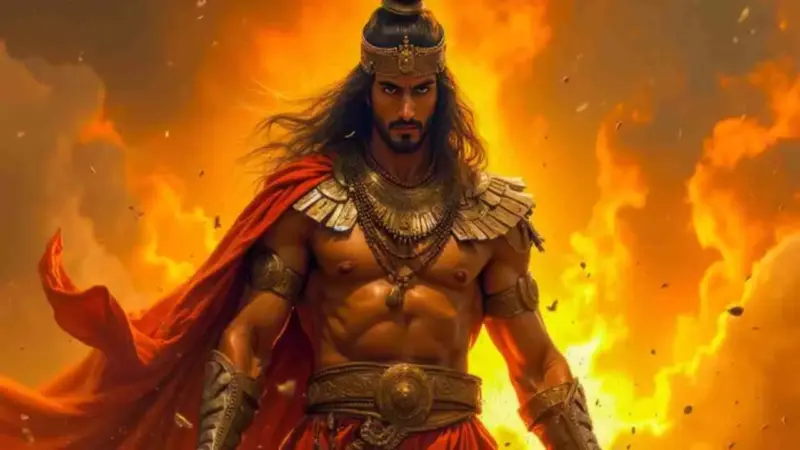

Among all characters of the Mahabharata, Karna is perhaps the most reinterpreted, emotionally reconstructed, and deeply embedded in modern sensibility.
In contemporary literature, cinema, television narratives, and social media discourse, Karna is often portrayed as a tragic hero-a rebel against the system, a gifted warrior denied opportunity, and even as a victim of dharma itself. In this modern image, Karna appears brave, generous, wronged, and often more "human" than the Pandavas-especially Arjuna.
However, when Karna is examined through the scriptural narrative, particularly within the original layers of the Mahabharata, his character emerges as far more complex, contradictory, and ethically challenging. This makes the question-"Karna: A scriptural character or a modern hero?"-not merely a character study, but an inquiry into the clash between modern morality and scriptural ethics.
In the classical text, Karna's tragedy begins with his birth, but it is not merely social-it is deeply ethical. Born to Kunti through the grace of Surya and abandoned at birth, Karna is undeniably of royal origin, not a charioteer's son by birth. Yet the Mahabharata makes it equally clear that identity is not determined solely by birth, but by conduct and choices. Karna's life is not just a story of rejection-it is a story of responsibility for the choices he consciously makes. He aligns himself with Duryodhana-repeatedly, deliberately, and with full awareness. The text does not portray him as confused or helpless, but as a warrior who knows his allegiance and stands by it.
Modern readings often position Karna as a victim of caste discrimination. This is partially true-particularly in episodes like Draupadi's swayamvara and his rivalry with Arjuna. However, the scriptural narrative suggests that Karna's humiliation is not solely due to caste but also tied to ambiguity of identity and his own aggressive conduct. Draupadi's rejection of Karna-often criticized today as an act of social prejudice-appears in the epic as a political and social decision, not merely an expression of caste bias. The Mahabharata does not absolve Draupadi entirely, but reducing Karna to a pure victim distorts the narrative balance.
Karna's most critical moral test occurs during the disrobing of Draupadi. In the scriptural account, Karna does not remain silent-he actively supports her humiliation, using harsh and derogatory language. He calls her a "slave" and justifies her dishonor in the assembly. This episode is profoundly uncomfortable for the modern heroic image of Karna. Consequently, it is often minimized or attributed solely to Duryodhana's influence, thereby diluting Karna's personal accountability. But the text is unequivocal-Karna consciously stands on the side of adharma in that moment.
Karna's famed generosity-celebrated today as his greatest virtue-is, in the scriptural perspective, a paradoxical quality. His act of giving away his divine armor and earrings to Indra is undoubtedly noble. Yet the Mahabharata also frames this act as strategically unwise. Karna elevates charity above dharma, whereas scriptural ethics place generosity within the bounds of righteous judgment. His charity earns personal merit but weakens him and his cause in the context of war. Thus, the text recognizes him as generous, but does not elevate him to the status of an ideal dharmic figure.
Modern narratives frequently depict Karna as equal or superior to Arjuna in martial prowess. The classical text presents a more balanced view. Karna is indeed a formidable warrior, but his abilities are constrained by curses, lack of restraint, and ethical lapses. His acquisition of knowledge from Parashurama through deception introduces a critical moral flaw. The Mahabharata emphasizes that talent sustained by deceit fails at the moment of crisis. Karna's chariot getting stuck and his loss of memory in battle are not merely divine interventions-they are portrayed as the moral consequences of his earlier actions.
The deepest irony of Karna's life is revealed just before the war, when Kunti discloses his true identity. This revelation offers Karna a historic opportunity-to shift to the side of dharma. Yet he chooses otherwise. He refuses to join the Pandavas and instead remains loyal to Duryodhana. Modern interpretations often glorify this as the pinnacle of friendship. The scriptural perspective, however, frames it as a conflict between personal gratitude and dharma. The moral signal of the Mahabharata is clear-loyalty that stands against dharma ultimately leads to destruction.
Thus, Karna is neither a complete villain nor a complete hero. He is perhaps the most humanly flawed character in the Mahabharata-gifted, generous, yet bound by pride, anger, and misplaced loyalties. The modern age embraces Karna because he symbolizes the "wronged talent," resonating with a society grappling with inequality and denied opportunities. But the scriptural narrative cautions us-suffering does not automatically place one on the side of dharma. The path of righteousness is determined by choice, not circumstance.
In conclusion, Karna is a profoundly complex figure of the epic, whom modern sensibility has draped in the mantle of heroism. This reinterpretation is not entirely unjust-but it is incomplete. To see Karna only as a modern hero is to overlook the epic's stern warning: greatness is not defined merely by virtues, but by the side one ultimately chooses.
Karna stands as that warning-a warrior who possessed everything, except the final decision that could have aligned him with dharma.