

The central question of the Mahabharata is not merely the conflict between the Kauravas and the Pandavas. It is also this-who exactly is Krishna, the figure standing at the very center of that conflict?
Is he God, orchestrating events and bending time to his will? Is he a master strategist, navigating power, politics, and opportunity? Or is he a philosopher, guiding humanity toward an understanding of action, duty, and liberation?
This question becomes complex precisely because the Mahabharata refuses to confine Krishna within a single frame. He is neither merely divine, nor merely political, nor simply a teacher. Krishna is the rare figure who embodies all three roles simultaneously-and that is what makes him the most debated, most interpretable, and perhaps the most powerful character in the epic.
In the classical narrative, Krishna does not enter the Mahabharata with an explicit declaration of divinity. He first appears as a Yadava leader, the ruler of Dwarka, and a center of political power. In assemblies, diplomatic missions, and pre-war negotiations, his conduct is not that of a renunciate or mystic, but of an experienced statesman. He goes to Hastinapura, proposes peace, demands merely five villages, and yet knowingly places himself in a situation where rejection is inevitable. His aim is not merely peace-it is the public establishment of dharma, so that if war becomes unavoidable, it stands morally justified.
At the scriptural level, this is crucial. Krishna makes every possible attempt to prevent war, yet he does not retreat from it. This neither makes him war-loving nor an idealistic pacifist. It makes him a realist-one who understands that morality must often operate within the constraints of power.
Krishna's political role comes under the greatest scrutiny when he appears to bend traditional ethical norms. The use of Shikhandi in the fall of Bhishma, the half-truth about Ashwatthama to defeat Drona, and his encouragement to Arjuna during Karna's vulnerable moment-these episodes provoke a fundamental question: Is this the conduct of God, or of opportunism?
The scriptural response is both harsh and clear-dharma in the Mahabharata is not a fixed rulebook but a contextual wisdom. Krishna does not bend rules for personal gain; he bends them because adharma itself is thriving under the protection of those very rules. Calling Krishna merely a politician is therefore only a partial truth-he understands power, recognizes balance, and acts with a deep awareness of time and circumstance.
Yet, reducing Krishna to a clever strategist would be equally unjust. The most profound philosophical text within the Mahabharata-the Bhagavad Gita-emerges from his words. And significantly, it is delivered not in a temple or hermitage, but on the battlefield itself.
Here, Krishna is neither king nor diplomat nor tactician-he is a charioteer, both literally and philosophically. He guides Arjuna's chariot, and simultaneously, his consciousness. In the Gita, Krishna does not present himself as a distant God, but as a philosophical teacher who articulates the paths of karma, knowledge, and devotion. The setting itself is symbolic-the philosophy of the Mahabharata is not about escaping life, but about maintaining balance within conflict.
A crucial point emerges here: Krishna asks Arjuna to fight, but he does not promise victory. He declares that one has a right only to action, not to its fruits. If Krishna were merely a divine controller, he could have revealed the outcome, dictated destiny. Instead, he leaves the final decision to Arjuna. This distinguishes Krishna from a deterministic deity and establishes him as a philosopher of moral freedom.
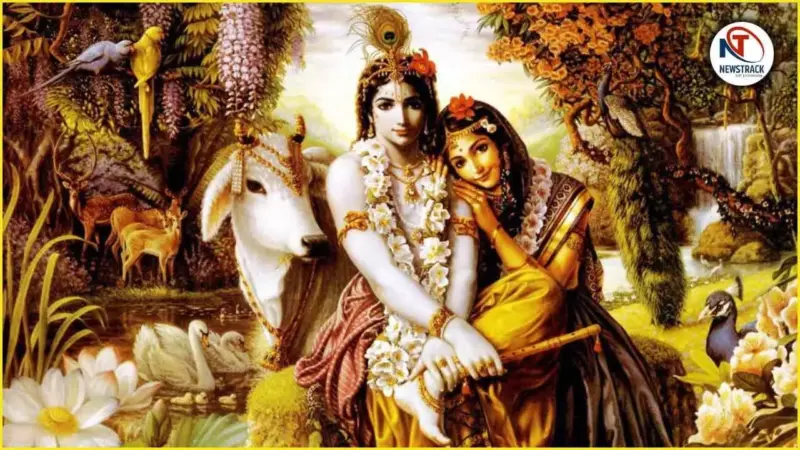
In later traditions and devotional literature, Krishna's image transforms further. He becomes the playful butter thief, the hero of divine love, the symbol of compassion. At first glance, this Krishna seems distant from the strategic and sometimes severe Krishna of the Mahabharata. Yet, from a scriptural perspective, these are not contradictions but complementary cultural expressions. Krishna is both compassionate and decisive, gentle and unyielding. Modern interpretations often isolate one aspect-either the divine, the cunning, or the philosophical. But the text cautions us: to fragment Krishna is not to understand him-it is to simplify him.
The deepest challenge arises when Krishna's morality is judged by modern ethical frameworks. Contemporary thinking often seeks clear binaries-true/false, right/wrong. Krishna dissolves these boundaries. He suggests that sometimes untruth may be required to protect truth, and sometimes rules must be broken to achieve justice. This idea is uncomfortable within modern democratic morality, yet it represents one of the Mahabharata's most profound intellectual contributions-the recognition of dharma as a living, adaptive principle, not a rigid code.
In conclusion, to define Krishna solely as God, or merely as a politician, or only as a philosopher, is to offer an incomplete understanding. Krishna is the confluence of all three. He is divine because he understands the essence of time and dharma. He is political because he does not turn away from the realities of power. And he is philosophical because he entrusts human beings with the responsibility of their own choices.
The Krishna of the Mahabharata is not the deity of an idealized world, but the guide of a real one. He does not claim that life is simple-he teaches how to seek dharma within its complexity.