
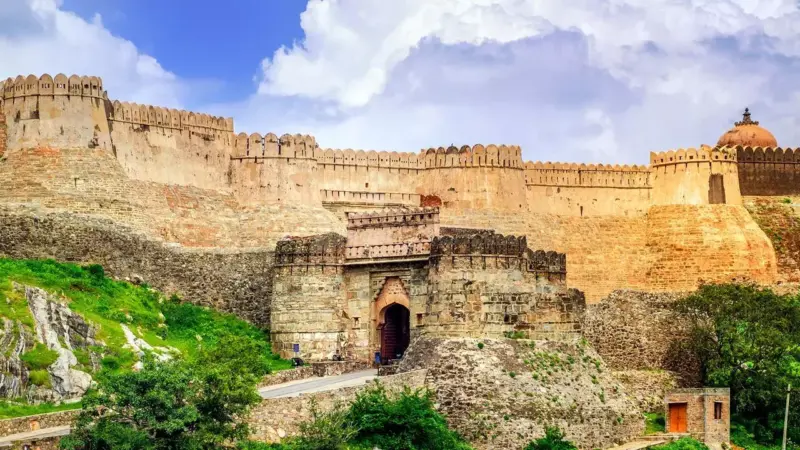

To understand Kumbhalgarh Fort is to understand a strategic idea where a state builds its strongest layer of protection. This is not a fort meant merely for the display of power.
It is a place where power safeguards itself in its most vulnerable moments. Situated deep within the complex ranges of the Aravalli hills, this fortress immediately conveys that it was not constructed merely as an architectural structure, but as a system of survival. Here, nature and architecture are not opposites; they function as parts of a single defensive mechanism.
The Archaeological Survey of India classifies Kumbhalgarh as a "hill fort with an extended fortification system." This means that not only the central fort but also the surrounding walls, hills, routes, and outer territories are integral to its defense. Kumbhalgarh stands as one of the most advanced examples of such a system.
The construction of this fort began in the 15th century under the ruler Rana Kumbha of Mewar. Work started around 1443 CE and the main structure was completed by approximately 1458 CE. This was a carefully planned military project. The name of Mandan is often associated with its architectural design, a renowned scholar-architect who also authored treatises on fort construction. This association is significant because it shows that Kumbhalgarh is not merely a structure but part of a documented architectural philosophy.
The fort was not built in a single phase. Successive Sisodia rulers carried out repairs, expansions, and reinforcements over time. Thus, Kumbhalgarh represents a continuously evolving fortress. While no precise historical cost records exist, its scale, the length of its walls, and the complexity of its internal structures indicate that it was one of the most resource-intensive projects of Mewar.
The Massive Fortification Wall
Now, its most famous feature the wall must be understood.
The fortification wall of Kumbhalgarh stretches for approximately 36 kilometers, making it one of the longest continuous defensive walls in the world. This wall is not straight; it follows the natural contours of the hills. In architectural terms, this is known as "contour-following fortification." This design offers two key advantages structural stability and increased complexity for attackers attempting to breach it.
The width of the wall in many places is substantial enough for multiple soldiers to walk abreast. This is not merely a matter of scale; it is strategic. Wide walls enable faster troop movement, efficient deployment of weapons, and sustained control across a long defensive line.
Location and Natural Defense System
The fort's location forms its second major strength. It stands at an elevation of approximately 1100 meters above sea level, surrounded by dense forests and narrow mountain paths. No army could directly attack it without first navigating forests, then climbing steep terrain, and finally confronting the fortified gates. This is a multi-layered natural defense system.
Gateway and Layered Defense System
Now consider the gateway system.
Kumbhalgarh has several important gates, including Hanuman Pol, Ram Pol, and Paghra Pol. These gates do not open directly in a straight line. Instead, they are connected through winding paths. Each gate is followed by another layer of defense. This creates a layered defense system where even if one gate falls, the next stands ready. Thus, the enemy's momentum is broken at every stage.
Historical Role and Strategic Importance
Historically, the role of Kumbhalgarh is unique. Unlike Chittorgarh Fort, which witnessed repeated large-scale battles and acts of sacrifice, Kumbhalgarh functioned primarily as a refuge fort. When the capital of Mewar, Chittorgarh, was under threat, rulers retreated here. This means the fort was not just for defense, but for regrouping and rebuilding strategy.
For this reason, the royal family resided here. Soldiers were stationed here. Administration functioned here. The Archaeological Survey of India describes it as a "fortified settlement," meaning a complete system of life existed within its walls.
One of the most significant historical associations of this fort is the birth of Maharana Pratap here. This transforms Kumbhalgarh from a military structure into the birthplace of Mewar's enduring spirit of resistance.
Internal Architecture and Temples
Now consider its internal architecture.
Kumbhalgarh houses more than 360 temples, belonging to both Hindu and Jain traditions. This clearly indicates that it was not merely a military installation but a living society. Religion, culture, and governance coexisted within its walls.
The most prominent structure inside the fort is the Badal Mahal, located at its highest point. From here, the entire surrounding region can be viewed. Its design is lighter and more open, allowing proper air circulation. This suggests that the upper levels were intended for royal residence, while the lower levels served military functions.
Water Management and Survival Strategy
Water management was the lifeline of Kumbhalgarh. Numerous tanks, reservoirs, and water storage systems were constructed within the fort. Rainwater harvesting was systematically implemented and water was stored across different levels. This allowed the fort to survive prolonged sieges. The Archaeological Survey of India recognizes this as one of its key strategic features.
Another crucial architectural principle at work here is "defense in depth." This means defense is not concentrated at a single point but spread across multiple layers outer walls, intermediate zones, and inner fortifications each acting as an independent line of resistance.
Later History and UNESCO Status
During the Mughal period, the army of Akbar managed to capture this fort temporarily. However, this control was not sustained. The fort eventually returned to Mewar. This demonstrates that while capturing Kumbhalgarh was possible, maintaining control over it was extremely difficult.
Over time, as political conditions changed, its active military use declined. However, the structure remains largely intact. Today, it is part of the UNESCO listed "Hill Forts of Rajasthan." The Archaeological Survey of India continues to oversee its conservation.
A particularly interesting aspect of Kumbhalgarh is that it did not witness large-scale acts of self-immolation like Chittorgarh. The reason lies in its purpose. It was not a fort of final sacrifice, but of final survival.
Conclusion
If Kumbhalgarh Fort is to be understood in one sentence, it can be said:
It is the place where power does not display itself, but exists in every direction.
It is not a fort of war, but the science of surviving war.
And that is what makes it one of the most strategic and deeply meaningful forts in India.