




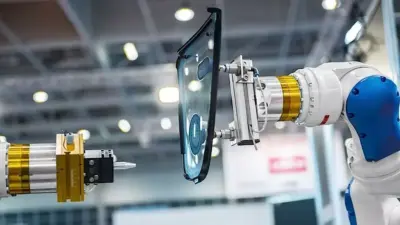

Industrial automation has fundamentally changed how manufacturers approach precision, speed, and repeatability on the production floor.
Every robotic arm, conveyor system, and packaging line depends on intelligent electrical equipment working in exact coordination.
Yet many engineers and procurement teams still underestimate how deeply embedded these systems are in operational outcomes. Understanding how motion control works in industrial automation helps businesses select the right components, reduce downtime, and improve throughput.
From servo drives to closed-loop feedback devices, these systems are far more layered than they appear. Let's examine each critical element and its real-world application.
What is Motion Control and Why Does it Matter in Automation?
At its core, motion control refers to the coordinated management of mechanical movement using electrical devices, drives, motors, and controllers. It governs position, speed, torque, and acceleration across automated machinery.
In industrial settings, even a marginal deviation in positioning accuracy can result in product defects, equipment damage, or line stoppages. The global motion control market is expected to increase from USD 17.31 billion in 2026 to USD 27.85 billion by 2034. This growth reflects how central these systems have become to modern manufacturing infrastructure.
Key Components of a Motion Control System
A well-engineered motion control system integrates several interdependent electrical instruments and devices.
- Motion Controller
This serves as the central brain. It processes sensor inputs, executes trajectory planning, and sends precise commands to downstream drives and motors. Programmable Logic Controllers (PLCs) with high-speed pulse outputs are widely deployed for cost-effective single-axis applications.
- Servo Drives and Servo Motors
Servo drives regulate the electrical energy supplied to servo motors, controlling torque, speed, and position with high accuracy. Servo motors are electromechanical actuators that convert electrical signals into repeatable mechanical movement. They operate within closed-loop systems, constantly adjusting based on real-time feedback.
- Encoders and Feedback Devices
Encoders and resolvers measure actual position and velocity, feeding that data back to the controller. This closed-loop feedback eliminates positional error and maintains synchronization, even during high-speed or dynamic operation.
- Actuators
Linear and rotary actuators translate electrical commands into physical motion. They are employed across robotic joints, precision gantries, and conveyor positioning systems.
- Human Machine Interfaces (HMI) and Supervisory Control and Data Acquisition (SCADA) Integration
HMI and SCADA systems connect motion equipment to plant-level monitoring. They enable real-time diagnostics and parameter adjustments without halting production.
Industrial Use Cases Where Motion Control Delivers Results
What motion control applications look like in practice varies widely across sectors, but the operational benefits remain consistent.
- Packaging and Material Handling
High-speed pick-and-place systems rely on multi-axis servo coordination to handle products at rates exceeding hundreds of cycles per minute. Precise trajectory planning prevents product damage and reduces reject rates.
- Semiconductor and Electronics Manufacturing
Vacuum-compatible precision stages deploy sub-micron positioning for wafer handling and die-attach processes. Any deviation at this scale renders components unusable.
- Automotive Assembly
Robotic welding and fastening stations use synchronized multi-axis motion to maintain consistent weld quality and torque specifications across high-volume production runs.
- Medical Device Manufacturing
Compact servo systems are incorporated into dosing equipment, surgical instrument assembly lines, and laboratory automation platforms where micron-level accuracy is non-negotiable.
- Aerospace Composite Layup
Gantry-based fiber-placement machines require synchronized motion control across multiple axes to accurately position composite materials, directly impacting structural integrity.
Build Smarter Automation With the Right Motion Control Strategy
Motion control is not a plug-and-play decision. Component selection, feedback architecture, communication protocols like EtherCAT, and integration with existing PLCs all determine system performance.
Poorly matched drives and motors create instability, increase energy consumption, and shorten equipment lifespan. Businesses that treat motion control as a strategic investment, rather than a line-item purchase, consistently outperform competitors on throughput and product quality.
Evaluate your application requirements carefully, audit your existing electrical equipment, and partner with certified automation specialists who can match components to real operational demands. The precision your facility needs is achievable, but only with the right system design from the start.