




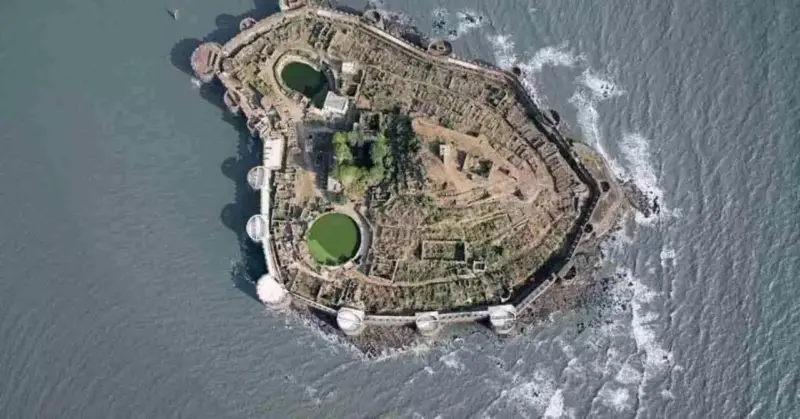

To understand Murud-Janjira Fort is to understand that unique relationship between the sea and power, where water is not merely a boundary, but becomes the strongest line of defense.
Located on a rocky island within the Arabian Sea near Murud on Maharashtra's Konkan coast, this fort presents an entirely different world at first glance. Endless waters on all sides. Massive stone walls rising from within the sea. And within those walls, an entire fortified complex.
This is not a fort built on a hill, nor on a plain-it stands within the sea itself. And that is precisely what makes it nearly unconquerable. Reaching it is itself the first stage of battle-and often the most difficult for any enemy. The origins of Janjira Fort are traced back to the 15th-16th centuries, when local fishermen and regional powers developed an initial structure at this location. However, its true strength and organized form emerged with the rise of the Siddis. The Siddis, of African origin, were formidable warriors who established their dominance in this region through maritime power.
They transformed Janjira not merely into a fort, but into the center of a naval authority. This transformation is crucial, because at this point the fort's identity shifts-it is no longer just a defensive structure; it becomes a command center for controlling the sea. From a construction perspective, Janjira must have been an extremely complex and challenging project. Laying foundations within the sea is no easy task. Continuous wave impact, the corrosive effect of saltwater, and limited working windows-all posed serious challenges. Yet, despite these conditions, the fort was built with remarkable resilience. Its walls are massive-rising approximately 12-15 meters high-and strong enough to withstand constant maritime assault for centuries.
There is no precise historical record of the time taken for its construction, but it is evident that it developed in multiple phases, requiring sustained labor and resources. The cost remains undocumented, but the structure itself clearly indicates that this was no ordinary construction. The greatest strength of Janjira lies in its location. Being situated within the sea, it was naturally protected from direct land-based attacks. Any enemy had to first approach it by boats.
The sea's waves, unpredictable weather, and currents worked against them. Even if they managed to reach the fort, they still had to confront its towering and formidable walls. From the bastions atop these walls, cannons could be fired effectively at any advancing force from the sea. Thus, Janjira's defense did not rely on walls alone-it was a combined force of the sea and architecture. The entrance of the fort is another remarkable feature. It is not directly visible. From the sea, it appears to be just another part of the wall.
Only from the correct angle does the actual gateway become apparent. This was a deliberate design meant to confuse enemies. If an attacker could not even identify the entry point, breaching the fort became even more difficult. This represents a level of architectural intelligence where defense is achieved not only through strength, but through strategy and deception. Life within the fort was highly organized. There were residential quarters for soldiers, granaries for storage, and most importantly-sources of freshwater.
Despite being surrounded by the sea, the fort contains several wells with sweet water. This is an astonishing fact and reflects a deep understanding of geological conditions during construction. No sea fort can survive long without freshwater, and Janjira successfully solved this challenge. Historically, Janjira's greatest distinction is its invincibility. The fort faced numerous attacks over time.
Even the Marathas attempted to capture it, with Chhatrapati Shivaji Maharaj's efforts being particularly notable. Yet, he could not conquer it. Later, Sambhaji Maharaj also made attempts, but without success. This gives Janjira a unique place in Indian history, as most forts were captured at some point-but Janjira remained virtually unconquered throughout its existence. The fort was not only significant militarily but also economically. It functioned as a center of maritime control and trade regulation. Ships passing through these waters could be monitored and, if necessary, intercepted.
Thus, Janjira was not merely a defensive outpost-it was an active center of naval power. With time, as maritime warfare evolved and British dominance expanded, the strategic importance of Janjira gradually declined. However, its structure and legacy continue to hold immense significance.
Even today, the fort stands firmly in the sea, just as it did at the time of its construction. If Murud-Janjira Fort were to be understood in a single sentence, it can be said that it is the place where the sea itself became the wall of the fort. Here, strength does not lie merely in stone-it lies in the choice of location. And that very choice makes it one of the most unconquerable and unique forts in India.