
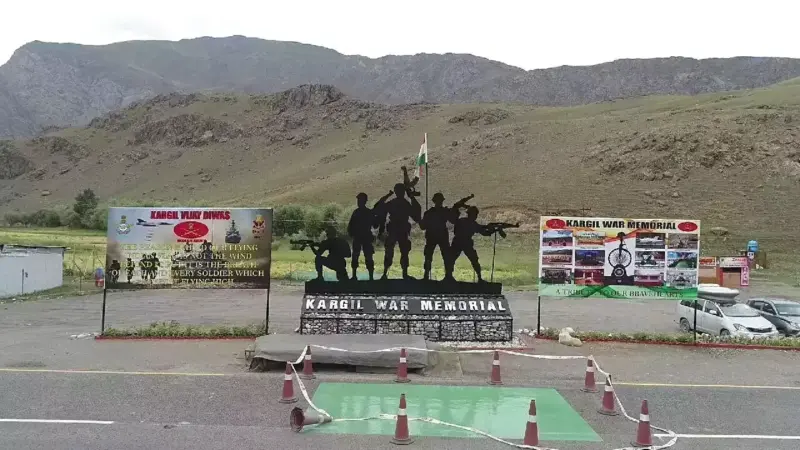

The Kargil War was fought between India and Pakistan from May to July 1999 in the high-altitude regions of the Kargil district and near the Line of Control (LoC) in Kashmir.
During this conflict, the Indian Army, under 'Operation Vijay', repelled Pakistani infiltrators and recaptured several strategic mountain peaks, including Tiger Hill. In this intense war that lasted nearly three months, India lost approximately 490 brave soldiers. To commemorate this historic victory, India observes 'Kargil Vijay Diwas' every year on July 26.
Let's delve into the detailed background and events of the Kargil War.
Background of the Kargil War
The Kargil War (May-July 1999) was a military conflict between India and Pakistan in the Kargil district, part of the disputed Kashmir region near the LoC, which separates Indian and Pakistani-administered Kashmir. Today, Kargil is part of the Union Territory of Ladakh. The war was fought at altitudes around 16,500 feet (5,000 meters) under extremely harsh conditions. As of 2025, it remains one of the few conventional wars fought between two nuclear-armed nations.
The Kargil region had previously been a site of border skirmishes between India and Pakistan, but the Kargil War was the most significant and deadly conflict in the area.
Historical Background
Tensions between India and Pakistan began with the partition of British India in 1947, leading to the creation of Hindu-majority India and Muslim-majority Pakistan. This division caused riots, mass migrations, and the deaths of millions. Subsequent border disputes, especially over the princely state of Jammu and Kashmir, further strained relations.
In 1947, Pakistan-backed tribal fighters invaded Kashmir. The then-ruler, Maharaja Hari Singh, who was Hindu, decided to accede to India, prompting the Indian Army to defend Kashmir. This led to the first Indo-Pak war.
Further wars occurred in 1965 and 1971. The 1971 war resulted in Pakistan's defeat and the creation of Bangladesh. Subsequently, the Simla Agreement was signed in 1972, wherein both countries agreed to respect the border and the LoC. However, tensions persisted.
In the 1980s and 1990s, terrorism and insurgency increased in Kashmir. In 1998, both countries conducted nuclear tests, and in February 1999, they signed the Lahore Declaration to maintain peace. However, this agreement could not prevent a new conflict.
Beginning of the War
In May 1999, the Indian Army discovered that Pakistani infiltrators had entered Indian territory as early as February. This infiltration was part of 'Operation Badr', aiming to capture the Kargil region and force India into negotiations over Kashmir.
The Indian Army launched a counter-offensive named 'Operation Vijay' to evict the infiltrators and reclaim Indian territory. The Indian Air Force initiated 'Operation Safed Sagar' to support ground operations.
Warfare in Harsh Conditions
The war was fought in extremely cold, snowy, and high-altitude areas with low oxygen levels. Diplomatic activities were also ongoing during the conflict.
On June 12, Pakistani Foreign Minister Sartaj Aziz visited Delhi, but his talks with Indian Foreign Minister Jaswant Singh failed. Subsequently, military officials from both countries held meetings. The international community pressured Pakistan to withdraw to the LoC. On July 11, Pakistani Prime Minister Nawaz Sharif announced a withdrawal, and India gave them until July 16. Despite this, skirmishes continued in some areas.
Major Battles
1. Battle of Tololing
The Tololing peak, at approximately 16,000 feet, was captured by Pakistan. Indian soldiers reclaimed it on June 13 after intense fighting, with significant casualties on both sides.
2. Battle of Tiger Hill
Tiger Hill, at about 16,500 feet, was initially held by Pakistan. After persistent assaults, India recaptured it.
3. Battle of Point 4875
Located in the Drass sector, this point overlooked the Srinagar-Leh highway. Pakistan had secretly occupied it. Upon discovery, the Indian Army launched an attack and regained control.
Outcome and Impact of the War
India lost over 500 soldiers, while Pakistani casualties are estimated between 400 and 4,000. On July 26, India reclaimed all occupied territories-this day is now celebrated as Kargil Vijay Diwas.
The war exposed gaps in India's intelligence and border surveillance. Pakistan faced significant diplomatic, military, and political setbacks. Post-war, tensions escalated between Pakistani Prime Minister Nawaz Sharif and Army Chief General Pervez Musharraf. Sharif attempted to dismiss Musharraf, but the military staged a coup in October 1999, ousting Sharif and imposing martial law.
Pakistan's Objective
The Kargil War occurred near the LoC in Jammu and Kashmir's Kargil district. During winter, Pakistani soldiers infiltrated the area disguised as militants. Their main goal was to sever the link between Ladakh and Kashmir and create tension along the Indian border. At that time, the infiltrators held higher ground, giving them an advantage over Indian soldiers positioned below. Eventually, war broke out when Pakistani soldiers crossed the LoC into Indian-controlled territory.
Discovery of the Infiltration
On May 8, 1999, Captain Iftikhar and Lance Havildar Abdul Hakim of Pakistan's 6 Northern Light Infantry, along with 12 soldiers, captured the Azam post in Kargil. They noticed some Indian shepherds grazing their cattle nearby. The Pakistani soldiers considered capturing them but decided against it, fearing the shepherds would consume their rations. Later, these shepherds returned with 6-7 Indian soldiers, exposing Pakistan's intentions.
Initially, the Kargil conflict posed significant challenges for India. However, the deployment of Bofors artillery and the Indian Air Force turned the tide. The Bofors guns inflicted severe damage on Pakistani positions. Pakistani soldiers, lacking supplies, struggled against the bravery of Indian troops. The psychological impact of Indian jets further demoralized Pakistani forces.
India suffered substantial losses, with 527 soldiers martyred. According to former Pakistani Prime Minister Nawaz Sharif, between 2,700 and 4,000 Pakistani soldiers were killed. Post-war, Pakistan experienced political and economic instability, leading to Sharif's ousting by Musharraf. In contrast, the war bolstered patriotism and strengthened India's economy. Several films, such as "LOC Kargil," "Lakshya," and "Dhoop," were inspired by this conflict.
Lessons Learned by India
India took concrete measures to enhance border security post-Kargil. The government increased the defense budget and focused on strengthening the military. Efforts were made to address irregularities revealed during the war, and continuous border surveillance systems were established. The Kargil conflict provided India with crucial lessons, prompting reforms that now enable the country to face adversaries on multiple fronts.
Pakistan aimed to cut off the NH 1D, the lifeline to the Siachen Glacier at India's northern tip, and gain control over it. Pakistani soldiers sought to occupy peaks that would allow them to disrupt supply convoys to Ladakh and compel India to abandon Siachen. Musharraf was particularly aggrieved by India's 1984 capture of Siachen. At that time, he was a major in Pakistan's commando forces and had attempted multiple times to reclaim the area but failed.