




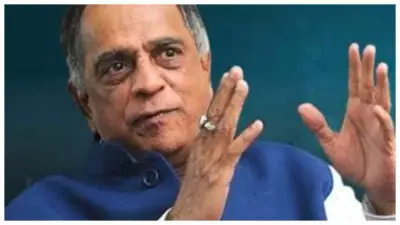

HMUMBAI, June 4, 2026 -- Pahlaj Nihalani, who spent four decades shaping, disrupting, and occasionally infuriating Indian cinema, died at his Mumbai residence early on Thursday morning.
He breathed his last at 9:30 am. He was 76. He is survived by his wife Nita and their three sons, Deepesh, Vishal, and Chirag.
His family confirmed the news in a statement: "With profound grief, we inform you of the passing of our beloved Pahlaj Nihalani on 4th June, 2026. The cremation ceremony will be held at 3 pm today at Santacruz Hindu Crematorium. We are grateful for your thoughts and prayers as we bid him a final farewell."
The Man Who Made Stars
Nihalani arrived in Hindi cinema in the early 1980s as a film producer, at a time when Bollywood was a world of single-screen theatres, mass entertainers, and stars who could fill those seats on name alone. He understood that world instinctively, and he used it well.
His first production, Haathkadi, released in 1982, followed by Aandhi-Toofan in 1985. But the film that cemented his name was Ilzaam in 1986, which marked Govinda's debut as a lead actor in Bollywood. The following year, Nihalani backed Aag Hi Aag, a film that introduced Chunky Pandey to Hindi cinema.
Two careers launched in two successive years. That is not a small thing.
Over the years, he produced a string of mainstream entertainers, including Gunahon Ka Faisla, Paap Ki Duniya, Mitti Aur Sona, Shola Aur Shabnam, and Aankhen. Among them, Aankhen went on to become one of the highest-grossing Hindi films of the 1990s and remains among the most successful projects associated with his name. He also shared a long and productive working relationship with director David Dhawan, one of the most commercially reliable partnerships of that era. His working partnership with Govinda in particular ran deep and long, extending all the way to Rangeela Raja in 2019, which proved to be his final film as a producer.
The Censor Chief Everyone Argued About
Whatever one thought of Nihalani the producer, there was no ignoring Nihalani the regulator.
In January 2015, he was appointed chairman of the Central Board of Film Certification, a role he held until August 2017, when he was replaced by lyricist and advertising professional Prasoon Joshi. In those two and a half years, he became one of the most debated cultural figures in India.
His tenure saw repeated disputes with filmmakers over cuts, bleeps, and disclaimers. The confrontation that drew the most national attention came in 2016, over Udta Punjab, Abhishek Chaubey's film on drug addiction in the state. The CBFC under Nihalani suggested 89 cuts to the film. The case went to the Bombay High Court, which ruled that Udta Punjab should be released with only one cut, a decision widely seen as a significant verdict in favour of creative freedom.
After his ouster, Nihalani was unapologetic and characteristically direct. He said he had no regret about being asked to step down, was proud of being labelled a "sanskari" censor chief, and had in fact been preparing for his exit for months. In a separate interview, he described the CBFC itself as "a confused organisation" and called for progressive guidelines, saying the board was "stuck in a time-warp" without them.
He did not go quietly. He rarely did anything quietly.
Industry Pays Tribute
Filmmaker Ashoke Pandit, sharing news of the death on social media, described Nihalani as "a man who stood by industry causes" and someone "responsible for making many hit films," calling his passing "a great loss to the industry."
Beyond film production and the CBFC, Nihalani had also served as president of the Association of Pictures and TV Programme Producers for almost three decades before stepping down in 2009, a rarely noted but significant part of his contribution to the organisational infrastructure of Hindi cinema.
He was, in the end, a figure who could not be easily reduced to one thing: not merely a hit producer, not merely a controversial regulator, not merely a star-maker, not merely an industry elder. He was all of these, and the friction between those identities was part of what made him impossible to ignore.
Hindi cinema has lost a man who, for better or worse, always had something to say about it.
Sources: IANS, The Tribune, India TV News, Free Press Journal, Wikipedia, Gulf News