




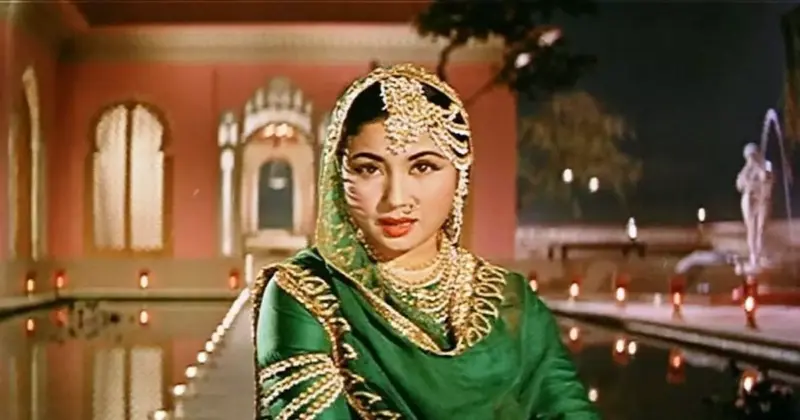

In the history of Indian cinema, there is perhaps no other film whose making was more painful, more beautiful, and more tragic than the story it told on screen.
"Pakeezah" was not merely a film. It was a dream. An obsession. A love letter. And, in the end, the silent cry of a broken relationship.
When "Pakeezah" was released in 1972, the initial response was quite ordinary. Crowds did not rush to cinema halls. Distributors began to worry. But then, suddenly, everything changed. The health of the film's heroine, Meena Kumari, began deteriorating rapidly. Newspapers started carrying reports about her condition. People returned to the theatres. And within a short time, "Pakeezah" became one of the immortal films of Indian cinema.
But the real story of this film existed behind the screen. There were years of waiting. There were financial crises. There were technical changes. There was the collapse of relationships. There was an actress battling alcohol and loneliness. And there was director Kamal Amrohi's obsession, which kept this film alive for nearly a decade and a half.
The idea of "Pakeezah" came to Kamal Amrohi in the mid-1950s. He did not want to make only a love story. He wanted to bring the culture of Lucknow and Awadh, the world of courtesans, poetry, music, and Mughal-era aesthetics onto the screen like a cinematic poem.
By then, Kamal Amrohi had already established himself as an extremely sensitive writer and director. His film "Mahal" had given him a distinct identity. But "Pakeezah" was not an ordinary film for him. It was his most personal and most ambitious creation.
To consider "Pakeezah" merely the love story of a courtesan would be to greatly reduce its real importance. This film was, in truth, a combined document of Kamal Amrohi's aesthetic vision, his personal emotional failure, and Meena Kumari's slowly fading life. Every frame of this film was not just decorated; it was almost sculpted. Kamal Amrohi wanted audiences not merely to watch the film, but to feel it. That is why in "Pakeezah", the camera often pauses more on atmosphere than on story. Chandeliers, curtains, smoke, anklets, light, and silence together create an emotional universe.
From the beginning, there was only one name in his mind for the heroine of the film - Meena Kumari.
At that time, Meena Kumari was not merely a major actress. She was counted among the most sensitive and powerful performers of Indian cinema. There was pain in her eyes. There was softness in her voice. There was a sadness on her face that entered the hearts of audiences. Kamal Amrohi felt that no one except her could bring the character of "Sahibjaan" to life.
But this is where the most complicated story of the film began.
Kamal Amrohi and Meena Kumari were husband and wife. In the beginning, their relationship was deeply emotional and creative. But slowly, tensions began to grow between them. The pressure of work. Differences in temperament. The politics of the industry. And Meena Kumari's growing loneliness. All these gradually weakened the relationship.
The impact of Kamal Amrohi and Meena Kumari's relationship is visible very deeply in the film. The innocent tenderness seen on Sahibjaan's face in the early portions and the fatigue and brokenness visible in the later portions were not merely acting. They were shadows of Meena Kumari's real life. Years of emotional pain, loneliness, and illness had permanently settled on her face. That is why while watching "Pakeezah", one often feels that Meena Kumari is not playing a character; she is living herself.
When the shooting of "Pakeezah" began, everything seemed normal. Grand sets were being built. Expensive costumes were being prepared. Music sessions were taking place. But within a few years, the situation changed. The relationship between the two began to break down, and a time came when the film was almost abandoned.
For several years, "Pakeezah" remained incomplete. Sets gathered dust. Lakhs of rupees remained stuck. The industry began to whisper that perhaps the film would never be completed.
The production cost kept rising. According to different accounts, the total budget of "Pakeezah" reached nearly ₹1.25 crore, which was an extremely large amount for that time. It must be remembered that this was an era when big Hindi films were often made for ₹20 to ₹40 lakh. But Kamal Amrohi was not willing to compromise in any scene.
The greatest expenditure was on sets and art direction. Kamal Amrohi wanted every frame of the film to look like a Mughal miniature painting. For this, grand kothas, chandeliers, carved walls, royal corridors, and elaborate durbar sets were created.
The sets built at Kamalistan Studio in Mumbai became a subject of discussion in the film industry. It is said that many people would visit the studio merely to see the sets.
The sets of "Pakeezah" were not only grand; they were counted among the great art-direction achievements of their time. The kothas and palaces created inside Kamalistan Studio were designed in such a way that they produced the illusion of a real nawabi world. Marble-like floors, handmade carvings, heavy chandeliers, and long corridors were crafted with extraordinary effort. It is said that the decoration of some sets cost as much as entire small films of that period.
But behind these magnificent sets, the technical difficulties were no less serious. The making of the film continued for so long that, during this period, the technology of Hindi cinema itself changed. When shooting began, black-and-white cinema was still dominant. Later, the era of colour films arrived. Cameras changed. Lighting techniques changed. Even the appearance of actors began to change.
The interruptions in shooting affected the film technically as well. Because of the gap of several years, the age, faces, and physical appearance of the actors had changed. Therefore, camera angles, lighting, and make-up styles had to be altered carefully. More close-ups of Meena Kumari were used because it had become difficult to conceal her weakness in long and dynamic scenes. In some dance sequences, body doubles were used, but Kamal Amrohi took special care that the audience should feel emotional continuity.
The biggest challenge was Meena Kumari herself.
When the film began, she was young. But during the long delay, her health kept deteriorating. Alcohol addiction and personal stress had made her physically very weak. Many times, she could not shoot for long hours.
Kamal Amrohi and Meena Kumari had separated, but the film still bound them together. It is said that when discussions began about restarting the shooting, several important people from the industry persuaded both of them that the film had to be completed. Eventually, Meena Kumari agreed.
But by then, everything had changed.
Her face was no longer the same. Her health had become fragile. In several scenes, she could not even stand for long. Therefore, camera angles had to be changed. Heavy close-ups were used. In some dance scenes, a duplicate had to be used.
The cinematography of the film also demands special mention. Kamal Amrohi did not consider light merely a visual element. For him, light was the language of emotion. In "Pakeezah", there are many scenes where shadows speak more than the characters. Dim light, rays filtering through latticed screens, and slow camera movements give the film an almost dreamlike atmosphere. This is why the visual world of "Pakeezah" still carries a distinct identity.
The famous song "Chalte Chalte Yun Hi Koi Mil Gaya Tha" was shot during the phase when Meena Kumari was extremely ill. But on camera, even her fatigue seemed to become part of the character. That is why the pain of Sahibjaan does not feel like acting; it feels like real suffering.
There was also a deep irony hidden behind the song "Chalte Chalte Yun Hi Koi Mil Gaya Tha". At the time it was being filmed, Meena Kumari was very ill. She could not stand for long. But the same exhaustion became part of Sahibjaan's character on screen. Audiences felt as if the soul of a broken woman was speaking. That is why the song did not merely become popular; it became an emotional memory.
Both locations and sets were used extensively during the shooting of the film. To revive the nawabi culture of Lucknow, the art director conducted months of research. Old haveli-like designs, the traditional style of mujra, carpets, curtains, chandeliers, and even paan daans were given special attention.
Kamal Amrohi was extremely strict about the smallest details. If even the fold of a curtain looked wrong to him in a scene, he would have the entire set corrected. Unit members would often become exhausted, but Amrohi's obsession never diminished.
The music of the film was its soul. Composer Ghulam Mohammed created songs that became immortal in the history of Indian film music. But fate was cruel; he passed away before the film was completed. Later, Naushad took charge of completing the music.
The tragedy of the film's music was also deeply moving. Ghulam Mohammed poured all his sensitivity into this film, but he did not live to witness its success. After his death, Naushad helped complete the background score and some unfinished portions. In this way, the music of "Pakeezah" also became a symbol of an incomplete creative journey.
Songs such as "Inhi Logon Ne", "Mausam Hai Aashiqana", "Chalo Dildar Chalo", and "Thare Rahiyo" did not merely become popular. They became part of Indian musical culture.
Live orchestras were used during recording. There was no digital technology then. Great musicians, tabla players, sarangi artists, sitar players, and dozens of instrumentalists would record together. If even a small mistake occurred, the entire take had to be recorded again.
The recording process was extremely difficult. Multi-track digital recording did not exist at that time. Live recording was done with large orchestras. Tabla, sarangi, sitar, flute, and chorus artists would sit together. If even one instrument went wrong, the entire take had to be recorded again. That is why the songs of "Pakeezah" still feel so alive and deep.
The film's most famous dialogue and scene are connected with the train sequence. A traveller sees the feet of Sahibjaan as she sleeps and writes a note - "I saw your feet. They are very beautiful. Do not place them on the ground; they will become soiled."
This scene became one of the most romantic moments in Indian cinema. Interestingly, several takes were required to film it because Kamal Amrohi wanted the feet, the lighting, and the camera angle to be absolutely perfect.
An interesting detail is also associated with the famous train scene. Kamal Amrohi wanted to make this scene intensely poetic. He wanted the audience not merely to hear a dialogue, but to feel the delicacy of a love in which a man becomes enchanted by the beauty of a woman's feet before even seeing her face. That is why extraordinary effort was invested in the camera movement, lighting, and framing of that scene.
When "Pakeezah" was released, the initial response was slow. The film was considered long. Its style seemed to belong to an older era. But within a few weeks, Meena Kumari's condition became serious. Then, on March 31, 1972, she passed away.
And from that moment, "Pakeezah" became history.
People began flooding cinema halls. Audiences started feeling that they were not merely watching a film, but witnessing the final living memory of Meena Kumari.
When "Pakeezah" was released, its initial response was indeed slow. A section of young audiences had already started moving toward faster and more modern films. But Meena Kumari's death took the film to an entirely different emotional level. People began to feel that they were watching the final farewell of an actress. That is why crowds in cinema halls suddenly began increasing.
The film later earned more than ₹6 crore in India and abroad combined and became one of the biggest successes of its time.
But the greatest achievement of "Pakeezah" was not its earnings.
This film became the last great expression of beauty, pain, and poetry in Indian cinema. After this, Hindi cinema began to change. Urban modernity started increasing. But "Pakeezah" remained like the final glow of an older Hindustan, where culture, etiquette, poetry, and incomplete love breathed together.
After the success of "Pakeezah", Meena Kumari became a legend. She had already been considered a great actress, but this film made her image almost immortal. The title "Tragedy Queen" became permanently associated with her. Because audiences felt that she had not merely acted pain; she had lived it.
Most importantly, "Pakeezah" was one of the last great expressions in Indian cinema of a cultural world where Urdu poetry, grace, etiquette, music, and visual beauty breathed together. After this, Hindi cinema became increasingly modern and commercial. But "Pakeezah" still appears like the last radiance of that old India.
Today, when people remember Meena Kumari, the face of "Pakeezah" often rises with her memory. Because this film became not merely the legacy of her acting, but of her soul.
And perhaps that is why "Pakeezah" is not merely watched.
It is felt.
Because within it is trapped the entire incomplete life of a broken love, an ailing actress, and an obsessive director.