




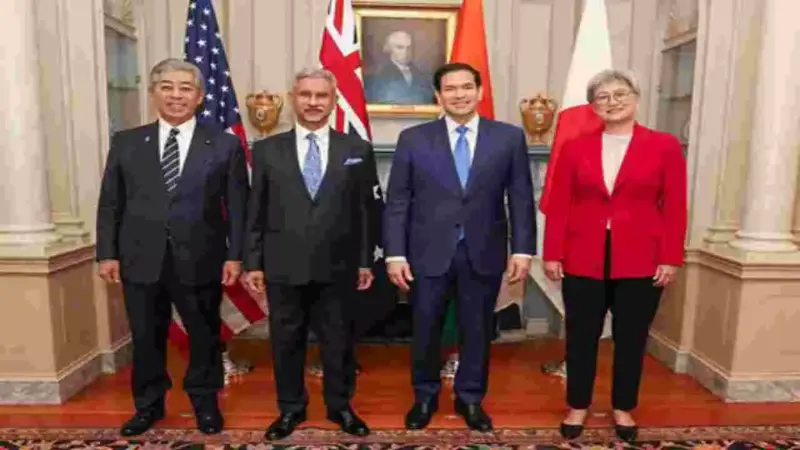

The Quadrilateral Security Dialogue, popularly known as the Quad, is once again at the center of global geopolitical discussions as questions grow over its future role in the Indo-Pacific region.
Comprising India, the United States, Japan, and Australia, the Quad was initially revived to promote a "free, open, and rules-based Indo-Pacific" amid rising concerns over China's growing military and economic influence.
However, geopolitical tensions, changing global priorities, trade disputes, and uncertainty surrounding future US foreign policy have triggered debate over whether the Quad can evolve into a stronger strategic alliance or gradually fade into irrelevance.
The grouping has significantly expanded beyond military coordination in recent years. Today, the Quad focuses on maritime security, supply chain resilience, critical minerals, cybersecurity, infrastructure development, disaster relief, emerging technologies, and vaccine cooperation. Analysts say this broader agenda has helped the alliance gain relevance across the Indo-Pacific region.
China remains the central factor behind the Quad's strategic importance. Although the alliance officially avoids directly naming Beijing as a target, experts widely view the grouping as a counterbalance to China's assertive actions in the South China Sea, East China Sea, and Indo-Pacific maritime routes.
India's role inside the Quad has become especially crucial. New Delhi sees the Indo-Pacific as vital for economic security, maritime trade routes, and regional stability. India's growing naval presence and strategic partnerships with the US, Japan, and Australia have strengthened the alliance's regional influence.
At the same time, concerns remain about whether the Quad can maintain long-term unity. Differences in economic interests, domestic political shifts, and changing leadership priorities among member countries could affect the alliance's momentum. Reports suggesting uncertainty around future Quad summits and concerns over America's long-term commitment have intensified speculation about the bloc's durability.
Despite these challenges, recent diplomatic activity indicates the Quad remains strategically important. US Secretary of State Marco Rubio's India visit ahead of upcoming Quad talks highlights ongoing efforts to deepen cooperation on Indo-Pacific security, critical mineral supply chains, and maritime coordination.
Security experts argue that the Quad's biggest strength lies in its flexibility. Unlike formal military alliances such as NATO, the Quad operates as a strategic partnership that can adapt quickly to evolving geopolitical realities without rigid treaty obligations.
As tensions continue to rise in the Indo-Pacific, the Quad's future may ultimately depend on whether member nations can transform shared strategic concerns into long-term coordinated action. For now, the alliance remains one of the world's most closely watched geopolitical groupings shaping Asia's future balance of power.