
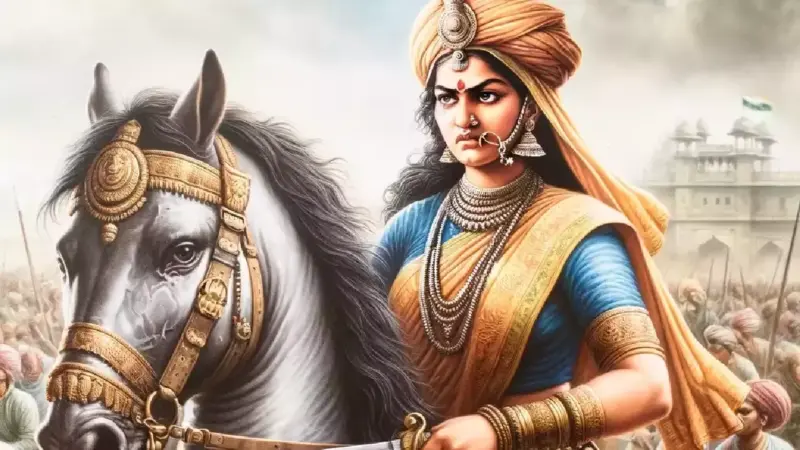

In the vast canvas of Indian history, there are certain personalities whose lives cannot be understood merely as a sequence of events; they must be experienced as a feeling, a consciousness, and a continuing source of inspiration.
Rani Lakshmibai was one such luminous figure, whose life was not just a struggle to defend a kingdom, but a symbol of Indian identity, self-respect, and that first flame of freedom which later stirred an entire nation. The Indian Rebellion of 1857 is recorded as the first organized war of independence in Indian history, and in this uprising, Lakshmibai's role was not merely that of a warrior, but of a leader who demonstrated boundless courage despite limited resources. Her final battle-fought in 1858 near Gwalior at Kotah-ki-Serai-was not just a military episode, but a historical saga where valor, compassion, resolve, and sacrifice stood together as one.
When the British forces deployed their full might to capture Jhansi, Rani Lakshmibai did not merely defend her state; she made it unequivocally clear that she would never accept subjugation at any cost. From the fort of Jhansi to Kalpi and then to Gwalior, her journey of resistance reveals that she was not simply reacting to circumstances; she was leading a structured and determined resistance. Even upon reaching Gwalior, the odds were far from favorable-resources were scarce, allies had dispersed, and the British army was advancing with formidable strength. Yet, she chose the path of battle. The battlefield of Kotah-ki-Serai became the final chapter of her life-but it was that very chapter which immortalized her.
According to historians, in this last battle, Rani Lakshmibai herself mounted her horse and took charge of the front lines. She was not a symbolic figurehead; she was a warrior leading from the forefront. During the fierce clash with British forces, she sustained grave injuries. Different accounts describe these wounds in varying ways-some mention a gunshot, others speak of a sword strike-but all agree that her injuries were severe enough to make further combat nearly impossible. Yet, she did not retreat from the battlefield and continued to fight until her last breath. It is at this moment that a historical figure transforms into legend-for where an ordinary human might surrender, Lakshmibai strengthened her resolve even further.
This episode has also been portrayed by literary figures, among whom Vrindavan Lal Verma holds a special place. In his historical novel 'Jhansi Ki Rani', he presents the final battle of Lakshmibai with profound emotion and vivid imagery. Verma achieves a delicate balance between history and imagination, transporting the reader into the very heart of that turbulent time. In his depiction, Lakshmibai's final struggle was not merely physical-it was also mental and spiritual, a battle fought to uphold her self-respect and the principle of freedom. In his narrative, she emerges as a flame that, even while fading, transforms the surrounding darkness into light.
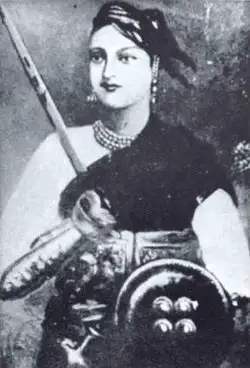
Even after being grievously wounded, her determination remained unshaken. She knew that survival was unlikely, yet she ensured that her body would not be desecrated by the British. It was for this reason that her loyal companions performed her last rites immediately after her death. This act was not merely a personal decision-it was a reflection of the era's sense of dignity and honor, where preserving one's self-respect even after death was considered paramount. In this moment, Lakshmibai transcends the role of a warrior and becomes an ideal-teaching that true valor lies in fighting till the very end to protect one's honor.
Numerous accounts of her final moments exist, some of which have taken the form of folklore. Stories such as her riding into battle with her young son Damodar Rao tied to her back, or continuing to fight despite extreme physical distress, have become part of popular imagination. While such narratives amplify her heroism in public memory, historians advise that they should be approached with caution, as concrete evidence for these details is limited. Nevertheless, their cultural significance remains undeniable, for they reflect the deep emotional bond that Indian society has formed with Lakshmibai's legacy.
The life and final battle of Rani Lakshmibai offer an opportunity to understand that freedom is not merely a political concept-it is a deeply human and moral value. Through her life, she proved that even with limited resources and adverse circumstances, a resolute will can alter the course of history. Her sacrifice did not remain confined to the uprising of 1857; it became a source of inspiration for generations that followed. This is why, in the later phases of India's freedom movement, her name continued to be invoked as a symbol of resistance and courage.
Today, as we live in an independent India, it is essential not only to remember the sacrifices that shaped this freedom but also to strive to embody them in our own lives. The story of Rani Lakshmibai teaches us that courage is not confined to the battlefield-it also manifests in standing firmly by one's principles. Her final battle reminds us that the resolve of a single individual can indeed transform history, and it is this truth that renders her immortal.
Rani Lakshmibai of Jhansi is not merely a heroine of the past; she remains an enduring inspiration for the present and the future. Her life and sacrifice urge us to stand with the same courage and determination whenever we are confronted with injustice and oppression. That would be the truest tribute to her memory-and the path toward building a society rooted in strength and self-respect.