
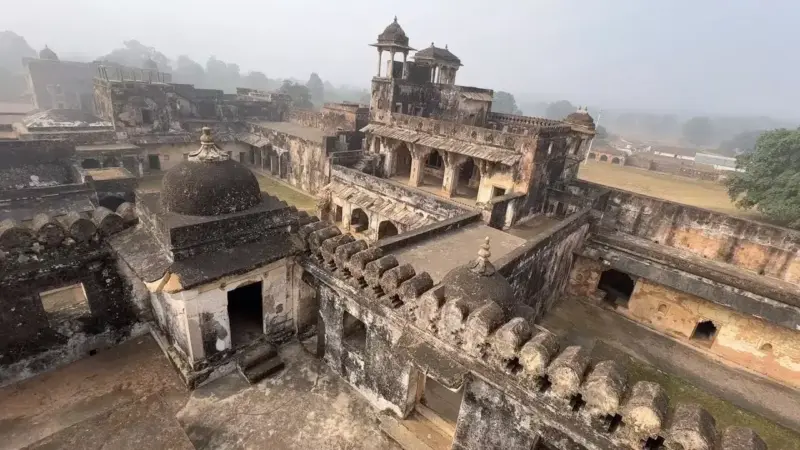

To understand Rohtasgarh Fort is to understand that tradition where forts are not merely built on heights, but where the entire geography is chosen in such a way that it itself transforms into a fort.
Located in the Rohtas district of Bihar, this fort is not situated on a single hill, but spread across a vast plateau. This plateau is surrounded on all sides by deep valleys and rivers, with the Son River forming a crucial part of its natural defensive boundary. The journey from the base to the top itself is extremely difficult, and when one completes this journey, it becomes clear why this location was chosen. Reaching here itself was half the battle.
History of Rohtasgarh Fort
The history of Rohtasgarh is extremely ancient and multi-layered. Various traditions associate its origin with ancient rulers, but its real and historically verified development took place during the medieval period. In the 16th century, Sher Shah Suri took control of this fort and transformed it into a strong administrative and military center. This was the time when Sher Shah Suri was expanding his power across North India and needed a secure location from which he could control his empire. Rohtasgarh was ideal from this perspective, as it was both remote and secure.
From a construction point of view, this fort is not the result of a single period. Initial structures already existed, but during the time of Sher Shah Suri, it underwent extensive reorganization and expansion. Even after that, various rulers made modifications according to their needs over time. This process continued for several centuries. Therefore, it is not possible to confine its construction to a specific timeline. There is no clear historical record of its cost either, but its vastness and structural complexity clearly indicate that it was a highly resource-intensive and carefully planned construction.
Strategic Location and Defensive Design
The greatest feature of Rohtasgarh lies in its location and its spread. This fort is not confined to a compact space, but extends across a vast plateau that includes multiple gates, ramparts, internal pathways, and structures. There are several routes leading to the fort, but all of them are difficult, narrow, winding, and in many places steep. As a result, any invading force had to move with caution at every step, and its speed was automatically controlled. This system was not only for defense; it was a deliberate strategy to exhaust the enemy and gradually weaken its strength.
The gates of the fort are particularly noteworthy. Entry points like 'Hathia Pol' and 'Rajghat Gate' were designed in such a way that they were not merely points of access, but active defensive nodes. The use of curves and elevation in their structure ensured that an enemy could not enter directly. Thus, the defense of Rohtasgarh did not rely solely on outer walls; every entry point itself was turned into a challenge.
Architecture and Internal Structures
The internal world of the fort was vast and well-organized. There are palaces here, among which 'Hathia Mahal' is particularly significant. There are temples as well, indicating that this was not just a military outpost but also a cultural and religious center. There are reservoirs and water tanks that collected rainwater and made the fort self-sufficient for long periods. This system was extremely important, because such a large fort had to sustain itself without external support for extended durations.
Geographical Isolation and Importance
Another important aspect of Rohtasgarh is its geographical isolation. The fort is located at some distance from major trade and urban routes, which made it relatively safe from direct attacks. This location was ideal for rulers who wanted to keep their treasury and families secure. Thus, the fort was not only used for warfare, but also for protection and preservation.
Historical Transitions and Present Condition
Historically, the fort passed through the hands of several powers, but its importance never completely declined. During the Mughal period as well, it continued to be used, and later gradually transformed into a historical site. Today, many of its structures are in ruins, yet they are sufficient to give an idea of its former grandeur and strength.
Conclusion
If Rohtasgarh Fort is to be understood in a single sentence, it can be said that this is a place where a fort is not a point, but an entire landscape. Here, strength does not lie in the walls; it lies in the choice of location, where the entire terrain itself is transformed into a defensive system. And that is what makes it one of the largest and most strategically significant forts in India.