




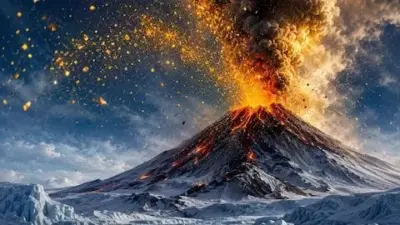

Deep in the frozen wilderness of Antarctica, Mount Erebus, the southernmost active volcano on Earth, is quietly releasing microscopic particles of gold into the atmosphere every day.
Scientists estimate that the volcano emits nearly 80 grams of gold vapour daily, amounting to roughly 30 kilograms of gold each year-worth around ₹17 crore at current market prices.
Despite the astonishing value of the precious metal being released, there is no possibility of mining or collecting it. The gold is emitted as microscopic particles, each measuring less than the width of a human hair, making recovery virtually impossible. Researchers have even detected these tiny gold particles up to 1,000 kilometres away from the volcano, carried by powerful Antarctic winds.
Located on Ross Island, Mount Erebus stands approximately 3,794 metres (12,448 feet) above sea level and is one of the few volcanoes in the world with a persistent lava lake. The volcano has remained continuously active for decades, allowing scientists to closely study its unusual volcanic processes.
The phenomenon occurs because the extremely hot volcanic gases contain trace amounts of vaporised metals, including gold. As these gases escape into the frigid Antarctic air, the gold vapour cools rapidly and condenses into tiny solid particles that are dispersed by the wind. Scientists first documented this remarkable process in a landmark study published in 1991, making Mount Erebus the first volcano where direct emission of elemental gold particles was scientifically confirmed.
Apart from gold, the volcano also releases other volcanic gases and minerals, providing researchers with valuable insights into volcanic chemistry and Earth's geological processes. Its long-lived lava lake and relatively steady eruptions make it one of the world's most important natural laboratories for volcanologists.
Mount Erebus is also known for its unique ice fumaroles-tower-like ice formations created when volcanic gases escape through the frozen surface. These icy caves host rare microorganisms capable of surviving in extreme conditions, making the volcano an important site for astrobiology research. Scientists believe studying these organisms could offer clues about the possibility of life on other planets, including Mars.
Although the idea of a volcano releasing crores worth of gold every year sounds extraordinary, experts stress that the metal exists only in microscopic quantities scattered over vast distances. Recovering it would cost far more than its value, making commercial extraction impossible.
Instead, Mount Erebus continues to fascinate scientists not because of its hidden wealth, but because it offers a rare opportunity to study volcanic activity, atmospheric chemistry and extreme ecosystems in one of the harshest environments on Earth.