




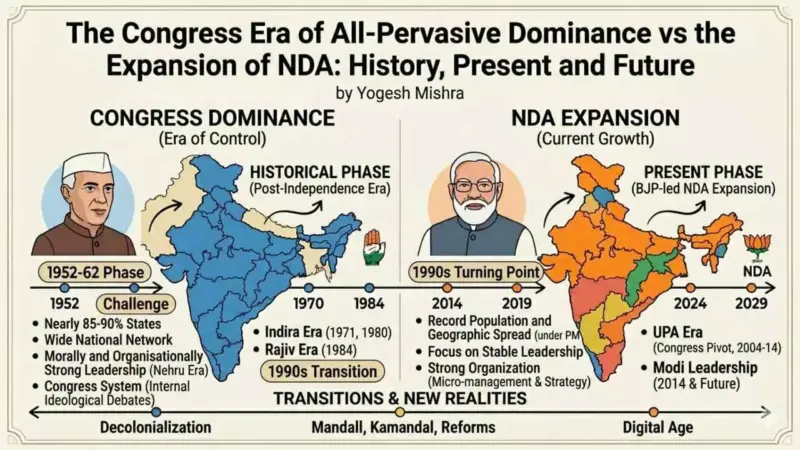

The picture is now clear. Old predictions failed because the final results shattered several established assumptions. In Bengal, the BJP made a historic leap and positioned itself to form the government for the first time.
According to reports, the BJP crossed more than 200 seats, and Mamata Banerjee's strong fortress collapsed. This is not merely the defeat of the Trinamool Congress. It is a signal of the BJP's biggest expansion in eastern India.
Tamil Nadu Delivers the Biggest Shock
Tamil Nadu delivered the biggest upset. Vijay's TVK, in its very first Assembly contest, crossed more than 100 seats and pushed both the DMK and AIADMK behind. Reports placed TVK at around 107 seats. Vijay himself won from two seats. This is a new story in South Indian politics. It is a shock similar to the one N. T. Rama Rao once gave the Congress in Andhra Pradesh.
Kerala, Assam and Puducherry Send Strong Signals
Kerala also saw a major shift. According to reports, the Congress-led UDF returned to a position of strength, while the Left Front suffered a setback. This means that even old ideological politics in the South is no longer fully secure. The BJP did not reach power in Kerala, but the weakening of the Left has weakened another pillar of the national opposition.
In Assam, the BJP/NDA retained its hold. This is the most important sign of stability. In the Northeast, the BJP is no longer a temporary force. It has become a permanent power structure. The Assam result shows that the BJP's Northeast strategy is still working.
Puducherry's result is small in size but large in signal. The NDA's presence there symbolically confirms its southern expansion. The BJP no longer does politics only in large states. It also treats smaller Union Territories as part of its national political map.
Biggest National Message for 2029
The biggest message for 2029 from these results is that the NDA's geography is expanding. The BJP's victory in Bengal has given it new strength in the East. Assam has kept the Northeast secure. Puducherry has shown southern presence. The rise of TVK in Tamil Nadu has broken the back of the DMK. This has weakened the southern pillar of the INDIA alliance.
This is the biggest crisis for the INDIA alliance. TMC has weakened in Bengal. DMK has weakened in Tamil Nadu. The Left Front has weakened in Kerala. That means three of its major regional bases have been shaken simultaneously. Congress may get some relief in Kerala, but at the national alliance level, this relief is limited. The strength of the INDIA alliance rested on collective regional satraps. Those very satraps now appear to be in crisis in their own states.
Why Opposition Politics Failed
The biggest lesson is that elections cannot be won merely through anti-BJP politics. The voter now looks for stable leadership, local organization, a clear face and a credible alternative. Where the opposition provided this, it won. Where it relied only on old equations, it lost.
The BJP's position for 2029 has strengthened. But it is also true that the rise of TVK in Tamil Nadu is not a direct victory for the BJP. It is the rise of a new third force. Therefore, in 2029, the BJP will have to choose one of three paths with Vijay relationship, distance or competition.
In conclusion, these five states have changed the direction of national politics. Bengal has opened the eastern door for the BJP. Assam has stabilized the Northeast. Puducherry has shown southern presence. Kerala has hurt Left politics. And Tamil Nadu has turned Vijay into the face of new politics. The 2029 contest will no longer remain only Modi versus the opposition. It will be a triangular battle between the expanding geography of the NDA, the weakening pillars of the INDIA alliance and the rise of new regional players.
Why Election Predictions Failed
Now the question is where the predictions went wrong. Except for one or two survey agencies, most surveys collapsed badly. Even the agencies that got some chance to congratulate themselves got one or two states right, but failed badly in others. First, it is important to understand that the mistake was not only in seat numbers. The mistake was in reading the political mood.
Where the opposition was considered strong, it turned out to be fragmented. Where anger against the ruling party was assumed, the vote did not transfer. Where a new party or third option was considered effective, it could not become decisive. In other words, the problem was not merely with numbers. The problem was with perception.
Overrating Anti-Incumbency
It is often assumed that long rule automatically means public anger. But this is not always true. If the government is delivering schemes, if leadership appears strong, and if the opposition is weak, anti-incumbency gets neutralized. Many analyses assumed that people wanted change. But on the ground, people wanted stability.
Overestimating Alliances
On paper, alliances look strong. But on the ground, votes do not always transfer. Workers do not support one another, and the voter gets confused. Local-level resistance remains. That is what happened. Wherever the INDIA alliance was assessed by simply adding votes together, that arithmetic did not convert into real votes. In other words, 1 + 1 did not become 2. In many places, 1 + 1 remained only 1.3.
Local vs National Narrative
In analysis, the larger narrative often dominates Centre versus state, leader versus leader, ideology versus ideology. But elections are local. What kind of candidate is contesting? Did the MLA work or not? How strong is the local network? These factors changed the entire game on many seats.
Failure to Understand the Silent Voter
This is the most dangerous factor. Many voters do not reveal their real preference. They give one answer in surveys and vote differently. This silent vote caused reversals on many seats.
Overestimation of New Parties
There is often excessive excitement around new parties. Crowds appear large. Social media trends are visible. Young people discuss them. But converting this into votes is a different matter. In many places, it was assumed that a new party would become a game changer. But it remained limited to being a vote-cutter.
Underestimating Organizational Strength
This is the biggest factor. Booth management, worker networks and the ability to bring voters to the polling booth win elections. Where a party's organization was strong, it gained the final edge. This factor was underestimated in many analyses.
Failure to Capture Momentum
In an election, there comes a point when the wind turns in one direction. This is called momentum. Media discussions, leaders' statements and crowd behavior together create a sudden wave. This wave often forms in the last five to seven days. This is where most mistakes happen.
Five Big Trends Emerging From These Results
The most important takeaway lies here. Five major trends emerge from these results.
The first trend is that India is giving priority to stable leadership. The second trend is that an alliance works only when there is unity on the ground. The third trend is that regional parties are no longer fully secure. The fourth trend is that organization has become the biggest weapon in elections. The fifth trend is that the silent voter is now the decisive factor.
The Biggest Lesson for Future Elections
The lesson for the future is that elections cannot be understood through data alone. Nor can they be understood through narrative alone. A balance between the two is necessary. Seat-by-seat analysis is necessary. Ground reports are necessary. And the mood of the final week is most important.
It is not unusual for predictions to go wrong. But failing to learn from them is a major mistake. The biggest lesson this time is that elections have become more complex. They are no longer decided only by waves or alliances. They are decided by micro-management, perception and the mood of the final moment. At present, the BJP of Narendra Modi and Amit Shah appears to be the master of this art.