




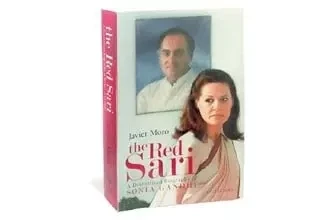

Few figures in Indian politics have remained as widely discussed as Sonia Gandhi. Equally discussed, controversial, and debated has been the book written about her - The Red Sari.
This book was never merely a conventional political biography. Instead, it evolved into a fascinating blend of politics, love, family, power, memory, and controversy - a combination that triggered intense debate across India. The book was written by Spanish author Javier Moro and was originally published in Spanish under the title "El sari rojo". Later, it was translated into English, Hindi, and several other languages.
The most distinctive aspect of the book was its narrative style. Rather than presenting Sonia Gandhi's life like a formal government document or a traditional political biography, the author chose to narrate it almost like a literary novel. Javier Moro attempted to vividly reconstruct those portions of Sonia Gandhi's life about which very little was publicly known.
Her childhood in Italy. The disciplined atmosphere within her family. The emotions and uncertainties of an ordinary young woman. Then her meeting with Rajiv Gandhi in Cambridge. Their romance. Her arrival in India. And eventually, her gradual transformation into a member of the most influential political family in India.
A Love Story Told Almost Like Cinema
The book portrays the relationship between Rajiv Gandhi and Sonia Gandhi in deeply emotional and almost cinematic terms. Javier Moro presents their union as the coming together of two completely different cultures and worlds.
At several places, the book includes private conversations, emotional exchanges, and deeply personal moments that appear remarkably real to readers. But this very aspect became the center of the biggest controversy surrounding the book.
Leaders from the Indian National Congress alleged that many portions of the narrative were based more on the author's imagination than on documented fact. Personal conversations and emotional situations were described with such detail that readers could easily assume the author himself had been a direct witness to every event.
This is precisely why many critics described the book as a "dramatized biography" - a blend of factual events and literary imagination.
Inside the Gandhi Family
A significant portion of the book also focuses on the atmosphere within the Gandhi family itself. The relationship between Indira Gandhi and Sonia Gandhi is portrayed as layered, emotionally complex, and occasionally tense.
The pressures of power. The harshness of public life. The collision between politics and family. The emotional challenges faced by a foreign daughter-in-law trying to adapt to India's political center of gravity - Javier Moro attempts to explore all these dimensions throughout the narrative.
The book suggests that Sonia Gandhi's transition into Indian political life was far from easy. The language was unfamiliar. The culture was different. And the political atmosphere surrounding the Gandhi family was extraordinarily intense.
Yet gradually, according to the author, she became deeply woven into that very system.
Critics, however, argued that many of these intimate emotional interpretations lacked sufficient documentary evidence.
Politics, Emergency, and the Weight of Power
The narrative later moves through some of the biggest political events in modern Indian history - including the period of the The Emergency (India), the dominance of Congress politics, political conflicts, and the growing centralization of power.
Javier Moro attempts to look at many of these developments through Sonia Gandhi's perspective.
Opponents of the book argued that this narrative style could create the impression that Sonia Gandhi possessed intimate knowledge of every major political decision of that era, even though she was not actively involved in politics at the time.
Critics also claimed that the author had deeply merged his own interpretations into real historical events, thereby blurring the line between history and storytelling.
The Most Emotional Chapter: Rajiv Gandhi's Assassination
Perhaps the most emotionally powerful section of the book revolves around the assassination of Rajiv Gandhi.
The author portrays this moment as the single greatest turning point in Sonia Gandhi's life - the moment when a woman who wished to remain distant from politics suddenly found herself standing at the center of Indian history and political power.
The narrative describes how, after Rajiv Gandhi's death, Sonia Gandhi reportedly tried to avoid politics for a long time. But gradually, the pressure from the Congress party, the legacy of the Gandhi family, and India's changing political circumstances drew her into active political life.
The 2004 Prime Ministership Decision
Javier Moro also places great importance on Sonia Gandhi's decision in 2004 not to accept the post of Prime Minister.
The book presents that moment almost as a symbol of renunciation and distance from personal power. In several later interviews, Javier Moro clarified that he had not intended to portray Sonia Gandhi negatively. Instead, he said he saw her as a strong, restrained, and emotionally resilient woman.
He publicly expressed surprise over the intensity of the opposition that emerged from Congress circles against the book.
The Real Controversy: Style, Not Just Content
In reality, the controversy surrounding "The Red Sari" was not limited only to its content. Its literary style became equally controversial.
The book reads like a political novel. It contains scenes, dialogues, emotional reconstructions, inner conflicts, and psychological descriptions. Readers often feel as though they are reading documented history, whereas several sections may actually be literary recreations based partly on imagination.
Congress leaders accused the book of containing "half truths", "imaginary conversations", and "falsehoods". According to several reports, legal objections were also raised from political circles. As a result, the book remained difficult to access in India for several years.
Was the Book Ever Officially Banned?
One important fact often misunderstood is that "The Red Sari" was never officially banned in India.
It is frequently described as a "banned book", but technically this is inaccurate. Due to political pressure, legal concerns, and publishing complications, its release remained delayed for years. However, in 2015, the book was officially published and made available in India.
In other words, it remained controversial - but not legally prohibited.
Today, the book is available in English, Hindi, and several European languages. In India, it can be purchased through online platforms and major bookstores. Digital editions are also available.
A Political Biography or Literary Reconstruction?
Perhaps the most balanced way to understand "The Red Sari" is this: it is neither entirely fiction nor entirely documented history.
It is a literary reconstruction built upon real political events, public personalities, emotional interpretation, and the author's personal perspective.
Within its pages exist politics, love, family, power, tragedy, memory, and imagination all at once.
That is precisely why "The Red Sari" did not remain just another political biography. It evolved into one of the most discussed, debated, and controversial books ever written about Indian politics and the Gandhi family.